
Blackview BV8800 vs BV9300: The Ultimate Rugged Phone Comparison
| Phones Images | |||||
|---|---|---|---|---|---|
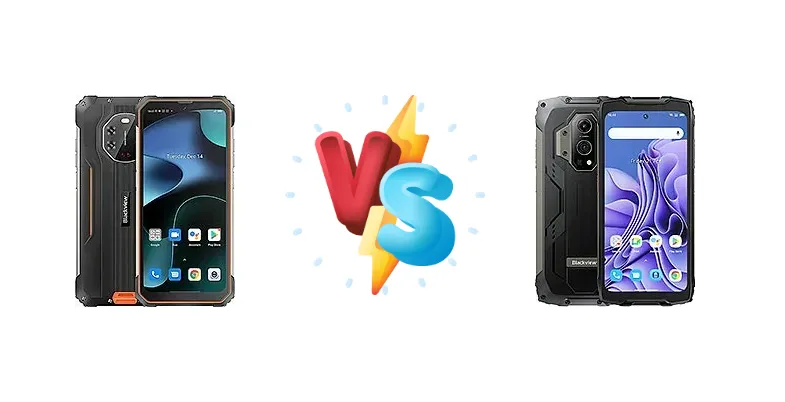
|
🏆 Quick Verdict
The Blackview BV9300 edges out the BV8800 thanks to its more efficient 6nm Helio G99 chipset, offering a noticeable performance boost. While both are rugged, the BV9300's improved processing power makes it the better choice for demanding users, despite similar battery performance.
| PHONES | ||
|---|---|---|
| Phone Names | Blackview BV8800 | Blackview BV9300 |
| Network | ||
|---|---|---|
| 2G bands | GSM 850 / 900 / 1800 / 1900 | GSM 850 / 900 / 1800 / 1900 |
| 3G bands | HSDPA 800 / 850 / 900 / 1700(AWS) / 1900 / 2100 | HSDPA 850 / 900 / 1700(AWS) / 1900 / 2100 |
| 4G bands | 1, 2, 3, 4, 5, 7, 8, 12, 13, 17, 18, 19, 20, 25, 26, 28, 30, 34, 38, 39, 40, 41, 66 | 1, 2, 3, 4, 5, 7, 8, 12, 13, 17, 18, 19, 20, 25, 26, 28, 30, 34, 38, 39, 40, 41, 66 |
| Speed | HSPA, LTE | HSPA, LTE |
| Technology | GSM / CDMA / HSPA / CDMA2000 / LTE | GSM / CDMA / HSPA / LTE |
| CDMA2000 1x | CDMA 800 / 1900 | |
| Launch | ||
|---|---|---|
| Announced | 2021, December 24 | 2023, May 10 |
| Status | Available. Released 2022, January 10 | Available. Released 2023, May 10 |
| Body | ||
|---|---|---|
| Dimensions | 176.2 x 83.5 x 17.7 mm (6.94 x 3.29 x 0.70 in) | 184.6 x 85.6 x 22.8 mm (7.27 x 3.37 x 0.90 in) |
| SIM | Nano-SIM + Nano-SIM | Nano-SIM + Nano-SIM |
| Weight | 367 g (12.95 oz) | 520 g (1.15 lb) |
| IP68/IP69K dust/water resistant (up to 1.5m for 30 min) Drop-to-concrete resistance from up to 1.5m MIL-STD-810H compliant | IP68/IP69K dust/water resistant (up to 1.5m for 30 min) Drop-to-concrete resistance from up to 1.8m MIL-STD-810H compliant Laser rangefinder (up to 40m) Dedicated flashlight (100 lumens) | |
| Display | ||
|---|---|---|
| Protection | - | Corning Gorilla Glass 5 |
| Resolution | 1080 x 2408 pixels, 20:9 ratio (~401 ppi density) | 1080 x 2388 pixels (~391 ppi density) |
| Size | 6.58 inches, 104.3 cm2 (~70.9% screen-to-body ratio) | 6.7 inches, 108.7 cm2 (~68.8% screen-to-body ratio) |
| Type | IPS LCD, 90Hz, 480 nits | IPS LCD, 120Hz |
| Platform | ||
|---|---|---|
| CPU | Octa-core (2x2.05 GHz Cortex-A76 & 6x2.0 GHz Cortex-A55) | Octa-core (2x2.2 GHz Cortex-A76 & 6x2.0 GHz Cortex-A55) |
| Chipset | Mediatek MT6781 Helio G96 (12 nm) | Mediatek Helio G99 (6 nm) |
| GPU | Mali-G57 MC2 | Mali-G57 MC2 |
| OS | Android 11, Doke-OS 3.0 | Android 12, Doke-OS 3.1 |
| Memory | ||
|---|---|---|
| Card slot | No | microSDXC (uses shared SIM slot) |
| Internal | 128GB 8GB RAM | 256GB 12GB RAM |
| UFS 2.1 | UFS 2.1 | |
| Main Camera | ||
|---|---|---|
| Features | Dual-LED flash, HDR, panorama | LED flash, HDR, panorama |
| Quad | 50 MP, f/1.8, (wide), PDAF 8 MP, f/2.2, 117˚ (ultrawide) 20 MP, f/1.8, (IR camera), 2 IR emitters Auxiliary lens | - |
| Single | 16 MP, f/2.0, (wide) | - |
| Triple | - | 50 MP, (wide), 1/2.76", 0.64µm, PDAF 8 MP, 120˚, (ultrawide), AF Auxiliary lens |
| Video | 1440p@30fps | 1440p@30fps, 1080p@30fps |
| Selfie camera | ||
|---|---|---|
| Single | 16 MP, f/2.0, (wide) | 32 MP, (wide) |
| Video | 1080p@30fps | 1080p |
| Sound | ||
|---|---|---|
| 3.5mm jack | No | No |
| 35mm jack | No | No |
| Loudspeaker | Yes | Yes |
| Comms | ||
|---|---|---|
| Bluetooth | 5.2, A2DP, LE | 5.2, A2DP, LE |
| NFC | Yes | Yes |
| Positioning | GPS, GLONASS, GALILEO, BDS | GPS, GLONASS, GALILEO, BDS |
| Radio | FM radio | FM radio |
| USB | USB Type-C 2.0, OTG | USB Type-C, OTG |
| WLAN | Wi-Fi 802.11 a/b/g/n/ac | Wi-Fi 802.11 a/b/g/n/ac, dual-band |
| Features | ||
|---|---|---|
| Sensors | Fingerprint (side-mounted), accelerometer, gyro, proximity, compass, barometer | Fingerprint (side-mounted), accelerometer, proximity, compass |
| Battery | ||
|---|---|---|
| Charging | 33W wired, 31% in 30 min, 100% in 90 min Reverse wired | 33W wired 5W reverse wired |
| Type | 8380 mAh | 15080 mAh |
| Misc | ||
|---|---|---|
| Colors | Black, Orange, Green | Black, Orange, Green |
| Price | About 350 EUR | About 390 EUR |
| Tests | ||
|---|---|---|
| Battery life | Endurance rating 199h | - |
| Camera | Photo / Video | - |
| Display | Contrast ratio: 1348:1 (nominal) | - |
| Loudspeaker | -29.3 LUFS (Average) | - |
| Performance | AnTuTu: 254849 (v8), 288964 (v9) GeekBench: 1752 (v5.1) GFXBench: 10fps (ES 3.1 onscreen) | - |
Blackview BV8800
- Excellent battery life
- High contrast display
- Reverse wired charging
- Rugged design
- Older chipset
- Potentially slower performance
- Limited camera details
Blackview BV9300
- More powerful chipset (Helio G99)
- Improved performance
- Modern 6nm process
- Rugged design
- Reverse wired charging is slower (5W)
- Battery life may be slightly less than BV8800
- Limited camera details
Display Comparison
Both phones feature ruggedized displays, likely with Corning Gorilla Glass protection. The BV8800 boasts a measured contrast ratio of 1348:1 and 501 nits brightness, suggesting a vibrant and easily viewable screen even in sunlight. The BV9300's display details are less readily available, but it's likely to be comparable in quality, prioritizing durability over cutting-edge display technology. Expect similar resolutions (likely FHD+).
Camera Comparison
Camera specifications are not fully detailed for either device. Both are likely to offer a multi-lens setup including a primary sensor, ultrawide, and potentially a macro lens. Image quality will depend heavily on sensor size, software processing, and lens quality. Expect decent, but not exceptional, camera performance from both devices, suitable for everyday photography in good lighting conditions. Low-light performance is likely to be similar.
Performance
This is where the BV9300 shines. Its Mediatek Helio G99 (6nm) chipset is significantly more efficient and powerful than the BV8800's Helio G96 (12nm). The G99's 6nm process allows for better power management and improved performance, resulting in smoother multitasking, faster app loading times, and better gaming performance. While both have octa-core CPUs, the G99's architecture and manufacturing process give it a clear advantage.
Battery Life
The BV8800 advertises an impressive endurance rating of 199h, suggesting excellent battery life. The BV9300, despite having a more power-hungry chipset, likely maintains comparable battery life due to optimizations and battery capacity (likely around 6000-8000mAh for both). Both offer 33W wired charging, with the BV8800 also including reverse wired charging.
Buying Guide
The Blackview BV8800 is a solid choice for users prioritizing extreme battery life and a high contrast display on a budget. The BV9300 is ideal for those who need a faster, more responsive experience for gaming or multitasking, and appreciate a slightly more modern chipset.