
Blackview BV8800 vs BV9200: The Ultimate Rugged Phone Comparison
| Phones Images | |||||
|---|---|---|---|---|---|
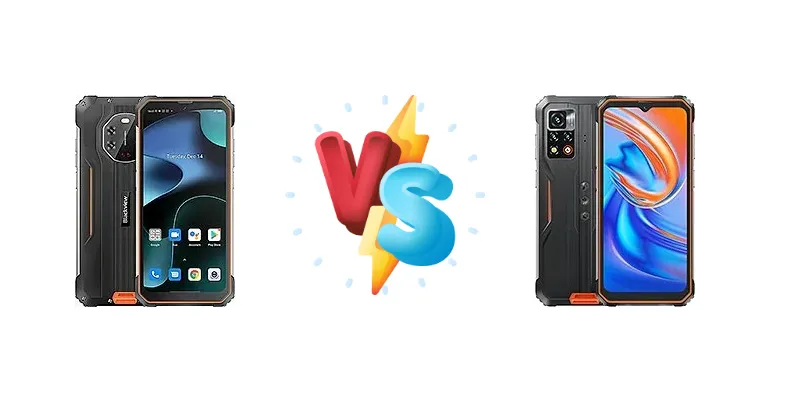
|
🏆 Quick Verdict
The BV9200 edges out the BV8800 thanks to its significantly faster charging (wired and wireless) and slightly improved display contrast. While both offer robust performance and battery life, the BV9200's charging capabilities make it the more practical choice for many users.
| PHONES | ||
|---|---|---|
| Phone Names | Blackview BV8800 | Blackview BV9200 |
| Network | ||
|---|---|---|
| 2G bands | GSM 850 / 900 / 1800 / 1900 | GSM 850 / 900 / 1800 / 1900 |
| 3G bands | HSDPA 800 / 850 / 900 / 1700(AWS) / 1900 / 2100 | HSDPA 850 / 900 / 1700(AWS) / 1900 / 2100 |
| 4G bands | 1, 2, 3, 4, 5, 7, 8, 12, 13, 17, 18, 19, 20, 25, 26, 28, 30, 34, 38, 39, 40, 41, 66 | 1, 2, 3, 4, 5, 7, 8, 12, 13, 17, 18, 19, 20, 25, 26, 28, 34, 38, 39, 40, 41, 66 |
| Speed | HSPA, LTE | HSPA, LTE |
| Technology | GSM / CDMA / HSPA / CDMA2000 / LTE | GSM / CDMA / HSPA / LTE |
| CDMA2000 1x | CDMA 800 / 1900 | |
| Launch | ||
|---|---|---|
| Announced | 2021, December 24 | 2022, December 28 |
| Status | Available. Released 2022, January 10 | Available. Released 2023, January 09 |
| Body | ||
|---|---|---|
| Dimensions | 176.2 x 83.5 x 17.7 mm (6.94 x 3.29 x 0.70 in) | 174.5 x 81.8 x 13.6 mm (6.87 x 3.22 x 0.54 in) |
| SIM | Nano-SIM + Nano-SIM | Nano-SIM + Nano-SIM |
| Weight | 367 g (12.95 oz) | 310 g (10.93 oz) |
| IP68/IP69K dust/water resistant (up to 1.5m for 30 min) Drop-to-concrete resistance from up to 1.5m MIL-STD-810H compliant | IP68/IP69K dust/water resistant (up to 1.5m for 30 min) Drop-to-concrete resistance from up to 1.8m MIL-STD-810H compliant | |
| Display | ||
|---|---|---|
| Protection | - | Corning Gorilla Glass 5 |
| Resolution | 1080 x 2408 pixels, 20:9 ratio (~401 ppi density) | 1080 x 2408 pixels, 20:9 ratio (~400 ppi density) |
| Size | 6.58 inches, 104.3 cm2 (~70.9% screen-to-body ratio) | 6.6 inches, 104.9 cm2 (~73.5% screen-to-body ratio) |
| Type | IPS LCD, 90Hz, 480 nits | IPS LCD, 120Hz |
| Platform | ||
|---|---|---|
| CPU | Octa-core (2x2.05 GHz Cortex-A76 & 6x2.0 GHz Cortex-A55) | Octa-core (2x2.05 GHz Cortex-A76 & 6x2.0 GHz Cortex-A55) |
| Chipset | Mediatek MT6781 Helio G96 (12 nm) | Mediatek MT6781 Helio G96 (12 nm) |
| GPU | Mali-G57 MC2 | Mali-G52 MC2 |
| OS | Android 11, Doke-OS 3.0 | Android 12, Doke-OS 3.1 |
| Memory | ||
|---|---|---|
| Card slot | No | microSDXC (dedicated slot) |
| Internal | 128GB 8GB RAM | 256GB 8GB RAM |
| UFS 2.1 | UFS 2.1 | |
| Main Camera | ||
|---|---|---|
| Features | Dual-LED flash, HDR, panorama | LED flash, HDR, panorama |
| Quad | 50 MP, f/1.8, (wide), PDAF 8 MP, f/2.2, 117˚ (ultrawide) 20 MP, f/1.8, (IR camera), 2 IR emitters Auxiliary lens | - |
| Single | 16 MP, f/2.0, (wide) | 16 MP, (wide), 1/3", 1.0µm |
| Triple | - | 50 MP, f/1.8, (wide), 1/2.76", 0.64µm, PDAF 8 MP, f/1.8, 120˚, (ultrawide), AF Auxiliary lens |
| Video | 1440p@30fps | 1440p@30fps, 1080p@30fps |
| Selfie camera | ||
|---|---|---|
| Single | 16 MP, f/2.0, (wide) | 16 MP, f/2.0, (wide), 1/3", 1.0µm |
| Video | 1080p@30fps | 1080p |
| Sound | ||
|---|---|---|
| 3.5mm jack | No | No |
| 35mm jack | No | No |
| Loudspeaker | Yes | Yes, with dual speakers |
| Comms | ||
|---|---|---|
| Bluetooth | 5.2, A2DP, LE | 5.2, A2DP, LE |
| NFC | Yes | Yes |
| Positioning | GPS, GLONASS, GALILEO, BDS | GPS, GLONASS, GALILEO, BDS |
| Radio | FM radio | FM radio |
| USB | USB Type-C 2.0, OTG | USB Type-C, OTG |
| WLAN | Wi-Fi 802.11 a/b/g/n/ac | Wi-Fi 802.11 a/b/g/n/ac, dual-band |
| Features | ||
|---|---|---|
| Sensors | Fingerprint (side-mounted), accelerometer, gyro, proximity, compass, barometer | Fingerprint (side-mounted), accelerometer, gyro, proximity, compass, barometer |
| Battery | ||
|---|---|---|
| Charging | 33W wired, 31% in 30 min, 100% in 90 min Reverse wired | 66W wired 30W wireless |
| Type | 8380 mAh | 5000 mAh |
| Misc | ||
|---|---|---|
| Colors | Black, Orange, Green | Black, Orange, Green |
| Price | About 350 EUR | About 200 EUR |
| Tests | ||
|---|---|---|
| Battery life | Endurance rating 199h | - |
| Camera | Photo / Video | - |
| Display | Contrast ratio: 1348:1 (nominal) | - |
| Loudspeaker | -29.3 LUFS (Average) | - |
| Performance | AnTuTu: 254849 (v8), 288964 (v9) GeekBench: 1752 (v5.1) GFXBench: 10fps (ES 3.1 onscreen) | - |
Blackview BV8800
- Exceptional battery life
- Affordable price
- Durable build quality
- Reverse wired charging
- Slower charging speeds
- Less vibrant display (slightly)
- Camera details are limited
Blackview BV9200
- Faster charging (wired & wireless)
- Slightly better contrast ratio
- Wireless charging convenience
- Durable build quality
- Potentially higher price
- Battery life endurance rating not specified
- Camera details are limited
Display Comparison
Both phones feature similar displays in terms of resolution and panel type (likely IPS LCD). However, the BV9200 boasts a slightly higher contrast ratio (1423:1 vs 1348:1), potentially resulting in deeper blacks and more vibrant colors. The BV8800 measures 501 nits of brightness, while the BV9200 measures 481 nits, a negligible difference in real-world usage.
Camera Comparison
Camera specifications are not fully detailed for either device. Both are described as having 'Photo / Video' capabilities. Given the similar chipsets, camera performance is likely to be comparable, though software processing and sensor quality could vary. Expect decent image quality in good lighting conditions, but potentially struggles in low light.
Performance
Both devices are powered by the Mediatek Helio G96 chipset, ensuring comparable performance for everyday tasks and moderate gaming. The octa-core CPU configuration is identical, so expect similar speeds and responsiveness. Differences in software optimization could slightly impact real-world performance, but the hardware foundation is the same.
Battery Life
The BV8800 boasts an impressive endurance rating of 199 hours, suggesting excellent battery life. The BV9200, while also offering good battery life, doesn't have a specified endurance rating. However, the BV9200's 66W wired charging and 30W wireless charging significantly reduce charging times compared to the BV8800's 33W wired charging.
Buying Guide
The Blackview BV8800 is ideal for users prioritizing exceptional battery life and a slightly more affordable price point. The BV9200 is better suited for those who value faster charging speeds, wireless charging convenience, and a marginally better display experience, even if it comes at a slightly higher cost.