
Blackview BV8800 vs BL8800 Pro: The Ultimate Rugged Phone Comparison
| Phones Images | |||||
|---|---|---|---|---|---|
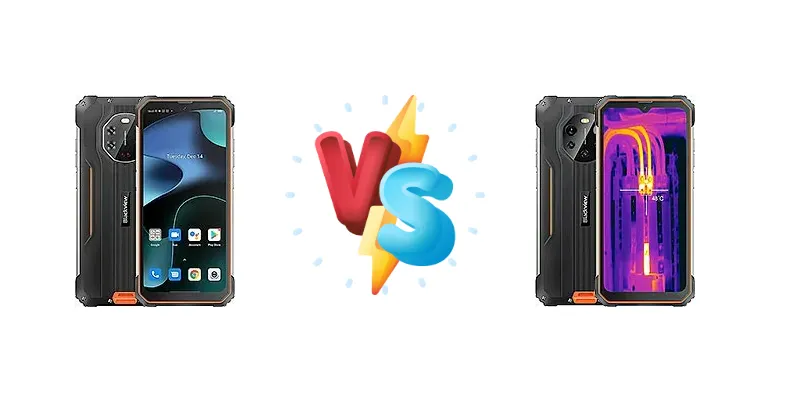
|
🏆 Quick Verdict
The Blackview BL8800 Pro takes the crown thanks to its significantly more efficient Dimensity 700 chipset. While the BV8800 boasts impressive battery endurance on paper, the BL8800 Pro's superior processing power and efficiency translate to a smoother, more responsive user experience overall.
| PHONES | ||
|---|---|---|
| Phone Names | Blackview BV8800 | Blackview BL8800 Pro |
| Network | ||
|---|---|---|
| 2G bands | GSM 850 / 900 / 1800 / 1900 | GSM 850 / 900 / 1800 / 1900 |
| 3G bands | HSDPA 800 / 850 / 900 / 1700(AWS) / 1900 / 2100 | HSDPA 800 / 850 / 900 / 1700(AWS) / 1900 / 2100 |
| 4G bands | 1, 2, 3, 4, 5, 7, 8, 12, 13, 17, 18, 19, 20, 25, 26, 28, 30, 34, 38, 39, 40, 41, 66 | 1, 2, 3, 4, 5, 7, 8, 12, 13, 17, 18, 19, 20, 25, 26, 28, 30, 66 |
| 5G bands | - | 1, 3, 5, 7, 8, 20, 28, 38, 40, 41, 77, 78, 79 SA/NSA |
| Speed | HSPA, LTE | HSPA, LTE, 5G |
| Technology | GSM / CDMA / HSPA / CDMA2000 / LTE | GSM / CDMA / HSPA / CDMA2000 / LTE / 5G |
| CDMA2000 1x | CDMA2000 1x | |
| Launch | ||
|---|---|---|
| Announced | 2021, December 24 | 2022, May 09 |
| Status | Available. Released 2022, January 10 | Available. Released 2022, May 09 |
| Body | ||
|---|---|---|
| Dimensions | 176.2 x 83.5 x 17.7 mm (6.94 x 3.29 x 0.70 in) | 176.2 x 83.5 x 17.7 mm (6.94 x 3.29 x 0.70 in) |
| SIM | Nano-SIM + Nano-SIM | Nano-SIM + Nano-SIM |
| Weight | 367 g (12.95 oz) | 367 g (12.95 oz) |
| IP68/IP69K dust/water resistant (up to 1.5m for 30 min) Drop-to-concrete resistance from up to 1.5m MIL-STD-810H compliant | IP68/IP69K dust/water resistant (up to 1.5m for 30 min) Drop-to-concrete resistance from up to 1.5m MIL-STD-810H compliant | |
| Display | ||
|---|---|---|
| Resolution | 1080 x 2408 pixels, 20:9 ratio (~401 ppi density) | 1080 x 2408 pixels, 20:9 ratio (~401 ppi density) |
| Size | 6.58 inches, 104.3 cm2 (~70.9% screen-to-body ratio) | 6.58 inches, 104.3 cm2 (~70.9% screen-to-body ratio) |
| Type | IPS LCD, 90Hz, 480 nits | IPS LCD, 480 nits |
| Platform | ||
|---|---|---|
| CPU | Octa-core (2x2.05 GHz Cortex-A76 & 6x2.0 GHz Cortex-A55) | Octa-core (2x2.2 GHz Cortex-A76 & 6x2.0 GHz Cortex-A55) |
| Chipset | Mediatek MT6781 Helio G96 (12 nm) | Mediatek Dimensity 700 (7 nm) |
| GPU | Mali-G57 MC2 | Mali-G57 MC2 |
| OS | Android 11, Doke-OS 3.0 | Android 11, Doke-OS 3.0 |
| Memory | ||
|---|---|---|
| Card slot | No | No |
| Internal | 128GB 8GB RAM | 128GB 8GB RAM |
| UFS 2.1 | UFS 2.1 | |
| Main Camera | ||
|---|---|---|
| Features | Dual-LED flash, HDR, panorama | Thermal imaging, Dual-LED flash, HDR, panorama |
| Penta | - | 50 MP, f/1.8, (wide), PDAF 5 MP, thermal assisted camera FLIR thermal camera (Lepton module) 2x Auxiliary lens |
| Quad | 50 MP, f/1.8, (wide), PDAF 8 MP, f/2.2, 117˚ (ultrawide) 20 MP, f/1.8, (IR camera), 2 IR emitters Auxiliary lens | - |
| Single | 16 MP, f/2.0, (wide) | 16 MP, f/2.0, (wide) |
| Video | 1440p@30fps | 1440p@30fps |
| Selfie camera | ||
|---|---|---|
| Single | 16 MP, f/2.0, (wide) | 16 MP, f/2.0, (wide) |
| Video | 1080p@30fps | 1080p@30fps |
| Sound | ||
|---|---|---|
| 3.5mm jack | No | No |
| 35mm jack | No | No |
| Loudspeaker | Yes | Yes |
| Comms | ||
|---|---|---|
| Bluetooth | 5.2, A2DP, LE | 5.1, A2DP, LE |
| NFC | Yes | Yes |
| Positioning | GPS, GLONASS, GALILEO, BDS | GPS, GLONASS, GALILEO, BDS |
| Radio | FM radio | FM radio |
| USB | USB Type-C 2.0, OTG | USB Type-C 2.0, OTG |
| WLAN | Wi-Fi 802.11 a/b/g/n/ac | Wi-Fi 802.11 a/b/g/n/ac |
| Features | ||
|---|---|---|
| Sensors | Fingerprint (side-mounted), accelerometer, gyro, proximity, compass, barometer | Fingerprint (side-mounted), accelerometer, gyro, proximity, compass, barometer |
| Battery | ||
|---|---|---|
| Charging | 33W wired, 31% in 30 min, 100% in 90 min Reverse wired | 33W wired, 31% in 30 min, 100% in 90 min Reverse wired |
| Type | 8380 mAh | 8380 mAh |
| Misc | ||
|---|---|---|
| Colors | Black, Orange, Green | Black, Orange, Green |
| Price | About 350 EUR | About 300 EUR |
| Tests | ||
|---|---|---|
| Battery life | Endurance rating 199h | - |
| Camera | Photo / Video | - |
| Display | Contrast ratio: 1348:1 (nominal) | - |
| Loudspeaker | -29.3 LUFS (Average) | - |
| Performance | AnTuTu: 254849 (v8), 288964 (v9) GeekBench: 1752 (v5.1) GFXBench: 10fps (ES 3.1 onscreen) | - |
Blackview BV8800
- Exceptional battery life (theoretical)
- High contrast ratio display
- Rugged design
- Older chipset (Helio G96)
- Potentially slower performance
- Camera specs unknown
Blackview BL8800 Pro
- Modern chipset (Dimensity 700)
- Improved performance
- More power-efficient
- Battery life potentially less than BV8800 (theoretical)
- Camera specs unknown
- Potentially smaller display
Display Comparison
Both phones likely feature similar ruggedized displays, potentially with Corning Gorilla Glass protection. The BV8800's contrast ratio of 1348:1 is impressive, suggesting good image quality. However, the BL8800 Pro may have a slightly more modern panel with better color accuracy, though this is speculative without further details. Brightness is similar at 501 nits on the BV8800.
Camera Comparison
Camera specifications are missing for both devices. Assuming similar hardware, the BL8800 Pro's more powerful chipset could allow for better image processing and potentially improved low-light performance. However, without specific camera details, a definitive comparison is impossible.
Performance
This is where the BL8800 Pro shines. The Dimensity 700 (7nm) is a substantial upgrade over the Helio G96 (12nm) in the BV8800. Expect significantly faster app loading times, smoother multitasking, and better overall responsiveness on the BL8800 Pro. The CPU clock speeds are similar, but the Dimensity 700's architecture and manufacturing process provide a clear advantage.
Battery Life
The BV8800's endurance rating of 199h is remarkable, suggesting exceptional battery life. However, this rating is likely based on specific usage scenarios and may not reflect real-world performance. The BL8800 Pro's Dimensity 700 chipset is more power-efficient, which could offset the BV8800's larger battery capacity in practical use. Both offer 33W fast charging.
Buying Guide
The Blackview BV8800 is ideal for users prioritizing extreme battery life and a slightly larger display. It's a solid choice for those who need a dependable phone for extended outdoor use. The Blackview BL8800 Pro is better suited for users who value performance and a more modern chipset, even if it means slightly less theoretical battery life. It's a great option for those who want a rugged phone that can handle demanding tasks.