
Blackview BV8800 vs BL8800: The Ultimate Rugged Phone Comparison
| Phones Images | |||||
|---|---|---|---|---|---|
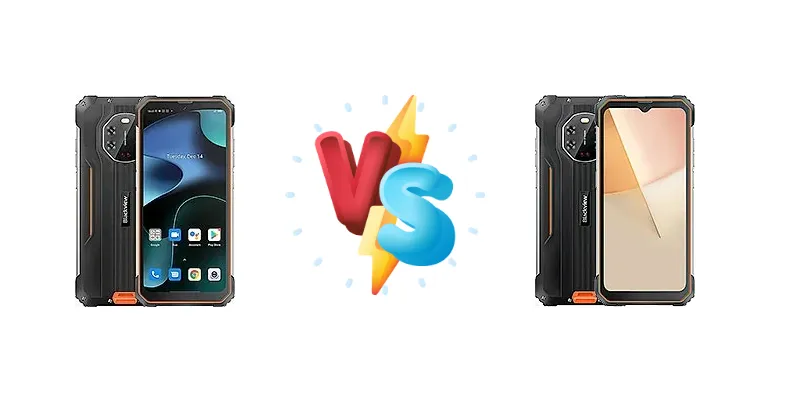
|
🏆 Quick Verdict
The Blackview BL8800 takes the lead thanks to its significantly more efficient Dimensity 700 chipset. While the BV8800 boasts a higher contrast ratio display, the BL8800's superior processing power and modern architecture make it the better overall choice for most users.
| PHONES | ||
|---|---|---|
| Phone Names | Blackview BV8800 | Blackview BL8800 |
| Network | ||
|---|---|---|
| 2G bands | GSM 850 / 900 / 1800 / 1900 | GSM 850 / 900 / 1800 / 1900 |
| 3G bands | HSDPA 800 / 850 / 900 / 1700(AWS) / 1900 / 2100 | HSDPA 800 / 850 / 900 / 1700(AWS) / 1900 / 2100 |
| 4G bands | 1, 2, 3, 4, 5, 7, 8, 12, 13, 17, 18, 19, 20, 25, 26, 28, 30, 34, 38, 39, 40, 41, 66 | 1, 2, 3, 4, 5, 7, 8, 12, 13, 17, 18, 19, 20, 25, 26, 28, 30, 66 |
| 5G bands | - | 1, 3, 5, 7, 8, 20, 28, 38, 40, 41, 77, 78, 79 SA/NSA |
| Speed | HSPA, LTE | HSPA, LTE, 5G |
| Technology | GSM / CDMA / HSPA / CDMA2000 / LTE | GSM / CDMA / HSPA / CDMA2000 / LTE / 5G |
| CDMA2000 1x | CDMA2000 1x | |
| Launch | ||
|---|---|---|
| Announced | 2021, December 24 | 2022, May 09 |
| Status | Available. Released 2022, January 10 | Available. Released 2022, May 09 |
| Body | ||
|---|---|---|
| Dimensions | 176.2 x 83.5 x 17.7 mm (6.94 x 3.29 x 0.70 in) | 176.2 x 83.5 x 17.7 mm (6.94 x 3.29 x 0.70 in) |
| SIM | Nano-SIM + Nano-SIM | Nano-SIM + Nano-SIM |
| Weight | 367 g (12.95 oz) | 367 g (12.95 oz) |
| IP68/IP69K dust/water resistant (up to 1.5m for 30 min) Drop-to-concrete resistance from up to 1.5m MIL-STD-810H compliant | IP68/IP69K dust/water resistant (up to 1.5m for 30 min) Drop-to-concrete resistance from up to 1.5m MIL-STD-810H compliant | |
| Display | ||
|---|---|---|
| Resolution | 1080 x 2408 pixels, 20:9 ratio (~401 ppi density) | 1080 x 2408 pixels, 20:9 ratio (~401 ppi density) |
| Size | 6.58 inches, 104.3 cm2 (~70.9% screen-to-body ratio) | 6.58 inches, 104.3 cm2 (~70.9% screen-to-body ratio) |
| Type | IPS LCD, 90Hz, 480 nits | IPS LCD, 480 nits |
| Platform | ||
|---|---|---|
| CPU | Octa-core (2x2.05 GHz Cortex-A76 & 6x2.0 GHz Cortex-A55) | Octa-core (2x2.2 GHz Cortex-A76 & 6x2.0 GHz Cortex-A55) |
| Chipset | Mediatek MT6781 Helio G96 (12 nm) | Mediatek Dimensity 700 (7 nm) |
| GPU | Mali-G57 MC2 | Mali-G57 MC2 |
| OS | Android 11, Doke-OS 3.0 | Android 11, Doke-OS 3.0 |
| Memory | ||
|---|---|---|
| Card slot | No | No |
| Internal | 128GB 8GB RAM | 128GB 8GB RAM |
| UFS 2.1 | UFS 2.1 | |
| Main Camera | ||
|---|---|---|
| Features | Dual-LED flash, HDR, panorama | Dual-LED flash, HDR, panorama |
| Quad | 50 MP, f/1.8, (wide), PDAF 8 MP, f/2.2, 117˚ (ultrawide) 20 MP, f/1.8, (IR camera), 2 IR emitters Auxiliary lens | 50 MP, f/1.8, (wide), PDAF 8 MP, f/2.2, 117˚ (ultrawide) 20 MP, f/1.8, (IR camera), 2 IR emitters Auxiliary lens |
| Single | 16 MP, f/2.0, (wide) | 16 MP, f/2.0, (wide) |
| Video | 1440p@30fps | 1440p@30fps |
| Selfie camera | ||
|---|---|---|
| Single | 16 MP, f/2.0, (wide) | 16 MP, f/2.0, (wide) |
| Video | 1080p@30fps | 1080p@30fps |
| Sound | ||
|---|---|---|
| 3.5mm jack | No | No |
| 35mm jack | No | No |
| Loudspeaker | Yes | Yes |
| Comms | ||
|---|---|---|
| Bluetooth | 5.2, A2DP, LE | 5.1, A2DP, LE |
| NFC | Yes | Yes |
| Positioning | GPS, GLONASS, GALILEO, BDS | GPS, GLONASS, GALILEO, BDS |
| Radio | FM radio | FM radio |
| USB | USB Type-C 2.0, OTG | USB Type-C 2.0, OTG |
| WLAN | Wi-Fi 802.11 a/b/g/n/ac | Wi-Fi 802.11 a/b/g/n/ac |
| Features | ||
|---|---|---|
| Sensors | Fingerprint (side-mounted), accelerometer, gyro, proximity, compass, barometer | Fingerprint (side-mounted), accelerometer, gyro, proximity, compass, barometer |
| Battery | ||
|---|---|---|
| Charging | 33W wired, 31% in 30 min, 100% in 90 min Reverse wired | 33W wired, 31% in 30 min, 100% in 90 min Reverse wired |
| Type | 8380 mAh | 8380 mAh |
| Misc | ||
|---|---|---|
| Colors | Black, Orange, Green | Black, Orange, Green |
| Price | About 350 EUR | About 480 EUR |
| Tests | ||
|---|---|---|
| Battery life | Endurance rating 199h | - |
| Camera | Photo / Video | - |
| Display | Contrast ratio: 1348:1 (nominal) | - |
| Loudspeaker | -29.3 LUFS (Average) | - |
| Performance | AnTuTu: 254849 (v8), 288964 (v9) GeekBench: 1752 (v5.1) GFXBench: 10fps (ES 3.1 onscreen) | - |
Blackview BV8800
- High contrast ratio display
- Reverse wired charging
- Potentially longer battery life (under light use)
- Older chipset (Helio G96)
- Less efficient processor
- Limited camera details
Blackview BL8800
- Modern and efficient Dimensity 700 chipset
- Better performance for gaming and multitasking
- Reverse wired charging
- 7nm manufacturing process
- Display specifications less detailed
- Camera details limited
Display Comparison
The BV8800 features a reported contrast ratio of 1348:1 and a measured brightness of 501 nits, suggesting a vibrant and easily viewable display even in bright sunlight. The BL8800's display specifications are not provided, but it's likely to be a standard, durable display common in rugged phones. While the BV8800 has a potential edge in contrast, both are likely to prioritize durability over cutting-edge display technology.
Camera Comparison
Camera details are sparse for both devices. Both are listed simply as 'Photo / Video'. Without further information, it's difficult to make a direct comparison. Both likely feature durable camera modules designed to withstand rugged conditions.
Performance
This is where the BL8800 shines. Its Dimensity 700 chipset (7nm) is significantly more efficient and powerful than the BV8800's Helio G96 (12nm). Expect smoother app loading, faster multitasking, and better gaming performance on the BL8800. The BL8800's CPU also has slightly higher clock speeds.
Battery Life
Both phones offer a substantial battery capacity and 33W wired charging with reverse wired charging. The BV8800 claims an endurance rating of 199h, which is impressive, but this is likely a theoretical maximum under very light usage. The BL8800's Dimensity 700 chipset should contribute to better overall battery efficiency despite similar battery capacity.
Buying Guide
The Blackview BV8800 is ideal for users prioritizing a vibrant display and potentially longer battery life in low-usage scenarios. The Blackview BL8800 is better suited for those who need a smoother, faster experience for gaming, multitasking, and everyday use, especially appreciating the more modern chipset.