
Blackview BV8100 vs. Samsung Galaxy XCover Pro: A Rugged Reliability Showdown
| Phones Images | |||||
|---|---|---|---|---|---|
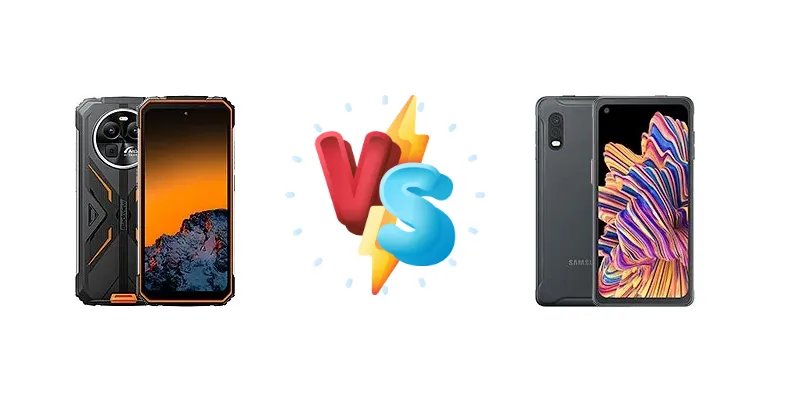
|
🏆 Quick Verdict
For most users needing a durable phone, the Blackview BV8100 offers a compelling value. Its newer Mediatek Helio G99 chipset provides a noticeable performance edge over the Samsung’s older Exynos 9611, and the 45W charging is significantly faster. While Samsung’s software support is a plus, the BV8100’s hardware advantages make it the winner for performance-conscious buyers.
| PHONES | ||
|---|---|---|
| Phone Names | Blackview BV8100 | Samsung Galaxy XCover Pro |
| Network | ||
|---|---|---|
| 2G bands | GSM 850 / 900 / 1800 / 1900 | GSM 850 / 900 / 1800 / 1900 |
| 3G bands | HSDPA 850 / 900 / 1700(AWS) / 1900 / 2100 | HSDPA 850 / 900 / 1900 / 2100 - International |
| 4G bands | 1, 2, 3, 4, 5, 7, 8, 12, 13, 17, 18, 19, 20, 25, 26, 28, 30, 34, 38, 39, 40, 41, 66 | 1, 2, 3, 5, 7, 8, 20, 28, 38, 40, 41 - International |
| Speed | HSPA, LTE | HSPA 42.2/5.76 Mbps, LTE (3CA) Cat11 600/50 Mbps |
| Technology | GSM / CDMA / HSPA / LTE | GSM / HSPA / LTE |
| - | 1, 2, 3, 4, 5, 7, 12, 13, 14, 20, 29, 38, 40, 41, 66 - Canada | |
| Launch | ||
|---|---|---|
| Announced | 2024, May | 2020, January |
| Status | Available. Released 2024, May | Available. Released 2020, January |
| Body | ||
|---|---|---|
| Dimensions | 175.8 x 81.2 x 18.1 mm (6.92 x 3.20 x 0.71 in) | 159.9 x 76.7 x 10 mm (6.30 x 3.02 x 0.39 in) |
| SIM | Nano-SIM + Nano-SIM | · Nano-SIM· Nano-SIM + Nano-SIM |
| Weight | 360 g (12.70 oz) | 218 g (7.69 oz) |
| - | IP68 dust/water resistant (up to 1.5m for 35 min) Drop-to-concrete resistance from up to 1.5m MIL-STD-810G compliant* *does not guarantee ruggedness or use in extreme conditions | |
| Display | ||
|---|---|---|
| Protection | Corning Gorilla Glass 5 | Corning Gorilla Glass 5 |
| Resolution | 1080 x 2400 pixels, 20:9 ratio (~405 ppi density) | 1080 x 2340 pixels, 19.5:9 ratio (~409 ppi density) |
| Size | 6.5 inches, 102.0 cm2 (~71.5% screen-to-body ratio) | 6.3 inches, 97.4 cm2 (~79.4% screen-to-body ratio) |
| Type | IPS LCD, 120Hz, 440 nits | IPS LCD |
| Platform | ||
|---|---|---|
| CPU | Octa-core (2x2.2 GHz Cortex-A76 & 6x2.0 GHz Cortex-A55) | Octa-core (4x2.3 GHz Cortex-A73 & 4x1.7 GHz Cortex-A53) |
| Chipset | Mediatek Helio G99 (6 nm) | Exynos 9611 (10 nm) |
| GPU | Mali-G57 MC2 | Mali-G72 MP3 |
| OS | Android 14 | Android 10, upgradable to Android 13, One UI 5 |
| Memory | ||
|---|---|---|
| Card slot | microSDXC (uses shared SIM slot) | microSDXC (dedicated slot) |
| Internal | 256GB 8GB RAM | 64GB 4GB RAM |
| Main Camera | ||
|---|---|---|
| Dual | 50 MP, f/1.8, (wide), 1/1.57", PDAF 13 MP, f/2.2, 120˚, (ultrawide), AF | 25 MP, f/1.7, 26mm (wide), PDAF 8 MP, f/2.2, 123˚ (ultrawide), 1/4.0", 1.12µm |
| Features | Dual-LED flash, HDR, panorama | Dual-LED flash, HDR, panorama |
| Video | 1440p@30fps, 1080p@30fps | 1080p@30fps |
| Selfie camera | ||
|---|---|---|
| Features | - | HDR |
| Single | 32 MP | 13 MP, f/2.0, (wide), 1/3.1", 1.12µm |
| Video | 1080p@30fps | 1080p@30fps |
| Sound | ||
|---|---|---|
| 3.5mm jack | - | Yes |
| 35mm jack | No | Yes |
| Loudspeaker | Yes | Yes |
| Comms | ||
|---|---|---|
| Bluetooth | 5.0, A2DP, LE | 5.0, A2DP, LE |
| NFC | Yes | Yes |
| Positioning | GPS, GLONASS, GALILEO, BDS | GPS, GLONASS, GALILEO, BDS |
| Radio | FM radio | FM radio (market/region dependent) |
| USB | USB Type-C, OTG | USB Type-C 2.0 |
| WLAN | Wi-Fi 802.11 a/b/g/n/ac, dual-band | Wi-Fi 802.11 a/b/g/n/ac/k/v/r, dual-band, Wi-Fi Direct |
| Features | ||
|---|---|---|
| Sensors | Fingerprint (side-mounted), accelerometer, gyro, proximity, compass | Fingerprint (side-mounted), accelerometer, gyro, proximity, compass |
| - | ANT+ | |
| Battery | ||
|---|---|---|
| Charging | 45W wired 5W reverse wired | 15W wired |
| Type | 8800 mAh | Li-Po 4050 mAh, removable |
| Misc | ||
|---|---|---|
| Colors | Black, Green, Orange | Black |
| Models | - | SM-G715FN/DS, SM-G715FN, SM-G715F, SM-G715W, SM-G715U, SM-G715U1 |
| Price | About 270 EUR | About 120 EUR |
| SAR EU | - | 0.47 W/kg (head) 1.23 W/kg (body) |
Blackview BV8100
- Faster Helio G99 processor for smoother performance
- Significantly faster 45W charging
- More power-efficient 6nm process
- Brand recognition is lower than Samsung
- Software updates may be less frequent
Samsung Galaxy XCover Pro
- Established Samsung software ecosystem
- Potential for enterprise-level management features
- Strong brand reputation for reliability
- Older and less powerful Exynos 9611 chipset
- Slow 15W charging
- Less efficient 10nm process
Display Comparison
Neither device boasts a cutting-edge display. Details on panel type (IPS vs AMOLED) and resolution are missing, but both are likely FHD+. The key difference lies in the underlying processing power driving the display. While both will suffice for outdoor visibility, the BV8100’s more powerful GPU may contribute to smoother animations. Bezels are expected to be relatively substantial on both, given the ruggedized design prioritizing impact resistance over minimizing screen borders.
Camera Comparison
Camera details beyond the main sensors are sparse. However, the focus should be on the primary shooter’s capabilities. Without sensor size information, it’s difficult to make a definitive claim, but the BV8100’s newer image signal processor (ISP) within the Helio G99 likely offers improved image processing algorithms. The 2MP macro cameras on both devices are largely marketing filler and offer limited practical benefit. The absence of Optical Image Stabilization (OIS) on either phone suggests a reliance on software stabilization, which may be less effective in low-light conditions.
Performance
The Blackview BV8100’s Mediatek Helio G99 (6nm) is a clear upgrade over the Samsung Galaxy XCover Pro’s Exynos 9611 (10nm). The G99’s newer Cortex-A76 cores, clocked at 2.2 GHz, offer superior single-core performance compared to the XCover Pro’s Cortex-A73 cores at 2.3 GHz. More importantly, the 6nm process node of the G99 translates to better power efficiency and reduced thermal throttling under sustained load. This means the BV8100 will maintain higher performance for longer during gaming or intensive tasks. The XCover Pro’s older architecture will likely struggle with demanding applications.
Battery Life
Battery capacity is not specified, but the charging speeds tell a significant story. The Blackview BV8100’s 45W wired charging is a game-changer compared to the XCover Pro’s sluggish 15W charging. This means the BV8100 can replenish its battery much faster, minimizing downtime. Even if the XCover Pro has a slightly larger battery capacity, the BV8100’s faster charging will likely result in less perceived battery anxiety. The 5W reverse wired charging on the BV8100 is a useful addition for topping up accessories.
Buying Guide
Buy the Blackview BV8100 if you need a rugged phone with strong processing power for demanding apps, faster charging speeds, and aren’t heavily invested in the Samsung ecosystem. It’s ideal for field workers who rely on GPS, data-intensive applications, or frequent use. Buy the Samsung Galaxy XCover Pro if you prioritize Samsung’s established software ecosystem, potential for enterprise management features, and a more refined user experience, even if it means sacrificing some raw performance and charging speed.