
Blackview BV8100 vs BV9900E: Which Rugged Phone Reigns Supreme?
| Phones Images | |||||
|---|---|---|---|---|---|
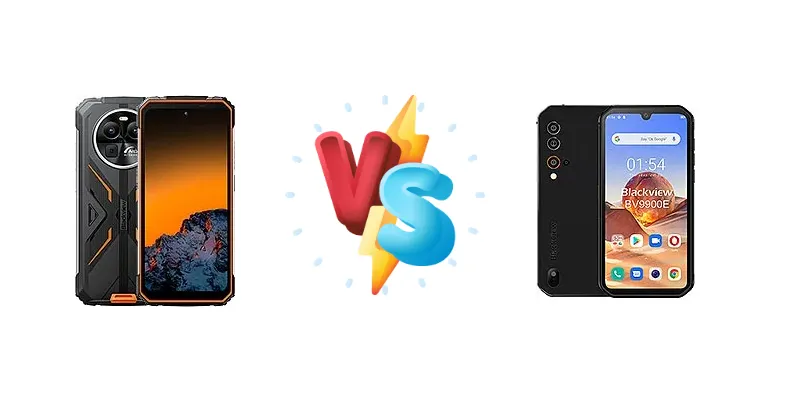
|
🏆 Quick Verdict
For most users, the Blackview BV8100 emerges as the better choice. Its newer Mediatek Helio G99 chipset provides a more efficient and potentially longer-lasting experience, coupled with significantly faster 45W wired charging. While the BV9900E offers wireless charging, the older Helio P90 and slower charging speeds hold it back.
| PHONES | ||
|---|---|---|
| Phone Names | Blackview BV8100 | Blackview BV9900E |
| Network | ||
|---|---|---|
| 2G bands | GSM 850 / 900 / 1800 / 1900 | GSM 850 / 900 / 1800 / 1900 |
| 3G bands | HSDPA 850 / 900 / 1700(AWS) / 1900 / 2100 | HSDPA 800 / 850 / 900 / 1700(AWS) / 1900 / 2100 |
| 4G bands | 1, 2, 3, 4, 5, 7, 8, 12, 13, 17, 18, 19, 20, 25, 26, 28, 30, 34, 38, 39, 40, 41, 66 | 1, 2, 3, 4, 5, 7, 8, 12, 13, 17, 18, 19, 20, 25, 26, 28, 34, 38, 39, 40, 41, 66 |
| Speed | HSPA, LTE | HSPA, LTE |
| Technology | GSM / CDMA / HSPA / LTE | GSM / CDMA / HSPA / CDMA2000 / LTE |
| Launch | ||
|---|---|---|
| Announced | 2024, May | 2020, September 10. Released 2020, September |
| Status | Available. Released 2024, May | Discontinued |
| Body | ||
|---|---|---|
| Dimensions | 175.8 x 81.2 x 18.1 mm (6.92 x 3.20 x 0.71 in) | 156.5 x 78.3 x 14.2 mm (6.16 x 3.08 x 0.56 in) |
| SIM | Nano-SIM + Nano-SIM | Nano-SIM + Nano-SIM |
| Weight | 360 g (12.70 oz) | 273 g (9.63 oz) |
| Display | ||
|---|---|---|
| Protection | Corning Gorilla Glass 5 | Corning Gorilla Glass 5 |
| Resolution | 1080 x 2400 pixels, 20:9 ratio (~405 ppi density) | 1080 x 2280 pixels, 19:9 ratio (~432 ppi density) |
| Size | 6.5 inches, 102.0 cm2 (~71.5% screen-to-body ratio) | 5.84 inches, 85.1 cm2 (~69.5% screen-to-body ratio) |
| Type | IPS LCD, 120Hz, 440 nits | IPS LCD |
| Platform | ||
|---|---|---|
| CPU | Octa-core (2x2.2 GHz Cortex-A76 & 6x2.0 GHz Cortex-A55) | Octa-core (2x2.2 GHz Cortex-A75 & 6x2.0 GHz Cortex-A55) |
| Chipset | Mediatek Helio G99 (6 nm) | Mediatek MT6779V/CE Helio P90 (12 nm) |
| GPU | Mali-G57 MC2 | PowerVR GM9446 |
| OS | Android 14 | Android 10 |
| Memory | ||
|---|---|---|
| Card slot | microSDXC (uses shared SIM slot) | microSDXC |
| Internal | 256GB 8GB RAM | 128GB 6GB RAM |
| Main Camera | ||
|---|---|---|
| Dual | 50 MP, f/1.8, (wide), 1/1.57", PDAF 13 MP, f/2.2, 120˚, (ultrawide), AF | - |
| Features | Dual-LED flash, HDR, panorama | LED flash, HDR, panorama |
| Quad | - | 48 MP, f/1.8, (wide), PDAF 16 MP, 120˚ (ultrawide) 2 MP (macro) Auxiliary lens |
| Video | 1440p@30fps, 1080p@30fps | 4K@30fps, 1080p@60fps |
| Selfie camera | ||
|---|---|---|
| Single | 32 MP | 16 MP, f/2.0, (wide) |
| Video | 1080p@30fps | 1080p@30fps |
| Sound | ||
|---|---|---|
| 35mm jack | No | No |
| Loudspeaker | Yes | Yes |
| Comms | ||
|---|---|---|
| Bluetooth | 5.0, A2DP, LE | 5.0, A2DP, LE |
| NFC | Yes | Yes |
| Positioning | GPS, GLONASS, GALILEO, BDS | GPS, GLONASS, GALILEO, BDS |
| Radio | FM radio | FM radio |
| USB | USB Type-C, OTG | USB Type-C 2.0, OTG |
| WLAN | Wi-Fi 802.11 a/b/g/n/ac, dual-band | Wi-Fi 802.11 a/b/g/n/ac |
| Features | ||
|---|---|---|
| Sensors | Fingerprint (side-mounted), accelerometer, gyro, proximity, compass | Fingerprint (side-mounted), accelerometer, gyro, proximity, compass, barometer |
| Battery | ||
|---|---|---|
| Charging | 45W wired 5W reverse wired | 15W wired 18W wireless |
| Type | 8800 mAh | 4380 mAh |
| Misc | ||
|---|---|---|
| Colors | Black, Green, Orange | Black, Silver |
| Price | About 270 EUR | About 260 EUR |
Blackview BV8100
- More efficient Helio G99 chipset
- Significantly faster 45W wired charging
- Likely better sustained performance
- Lacks wireless charging
- Display specs unknown, potentially average
Blackview BV9900E
- Convenient 18W wireless charging
- Potentially lower price point
- Rugged design
- Older, less efficient Helio P90 chipset
- Slower 15W wired charging
- Likely lower sustained performance
Display Comparison
Neither device's display specifications are provided, so a direct comparison is limited. However, given the BV8100's newer chipset, it's reasonable to expect a more modern panel with potentially higher peak brightness and improved color accuracy. Blackview typically focuses on durability over display extravagance, so expect robust glass protection on both models. The absence of LTPO technology on either device suggests standard refresh rates, prioritizing battery life over fluid scrolling.
Camera Comparison
Without detailed camera specifications, a precise comparison is difficult. However, Blackview often prioritizes megapixel count over sensor size. Assuming similar sensor sizes, the image signal processor (ISP) within the Helio G99 of the BV8100 will likely offer improved image processing capabilities, resulting in better dynamic range and low-light performance. The presence of a 2MP macro camera on either device is largely a marketing tactic, offering limited practical benefit due to the small sensor size and lack of optical image stabilization (OIS).
Performance
The core difference lies in the chipsets. The BV8100’s Mediatek Helio G99 (6nm) represents a significant architectural leap over the BV9900E’s Helio P90 (12nm). The 6nm process node translates to improved power efficiency and reduced heat generation, meaning the BV8100 will likely sustain peak performance for longer periods without throttling. Both CPUs feature a similar core configuration – 2x2.2 GHz Cortex-A76 and 6x2.0 GHz Cortex-A55 – but the G99’s newer architecture provides a performance edge. The BV8100 will benefit users engaged in gaming or multitasking.
Battery Life
While battery capacity isn't specified, the charging capabilities highlight a key difference. The BV8100’s 45W wired charging is substantially faster than the BV9900E’s 15W wired charging. This means significantly reduced charging times – potentially under 90 minutes for a full charge on the BV8100 versus over two hours on the BV9900E. The BV9900E compensates with 18W wireless charging, a convenience the BV8100 lacks. However, wireless charging is inherently less efficient than wired, and the slower overall charging speed diminishes its advantage.
Buying Guide
Buy the Blackview BV8100 if you prioritize sustained performance for demanding tasks like gaming or extended use, and value faster charging speeds. It’s ideal for users who frequently work outdoors or in harsh environments and need a reliable, efficient device. Buy the Blackview BV9900E if wireless charging is a non-negotiable feature, and you’re willing to trade some processing power and charging speed for that convenience. It’s a good option for users who prefer a simpler charging experience and don’t heavily tax the phone’s processor.