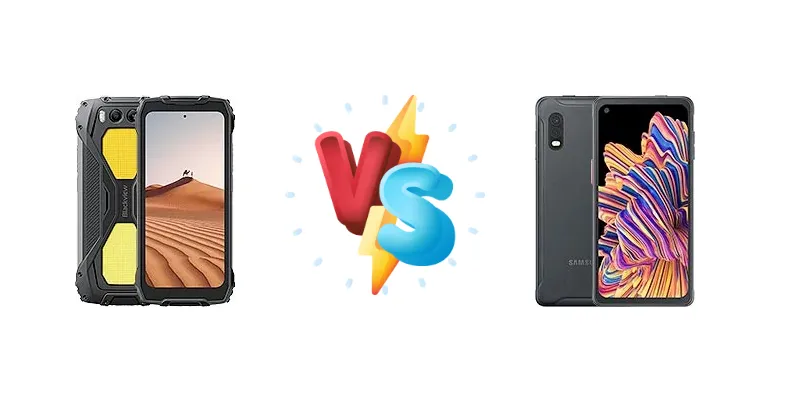
The rugged smartphone market caters to a specific need: durability. Both the Blackview BV7300 and Samsung Galaxy XCover Pro aim to deliver that, but they approach it with different philosophies. The BV7300 prioritizes battery endurance and aggressive pricing, while the XCover Pro leverages Samsung’s brand recognition and a more refined software experience. This comparison dissects their core components to determine which phone truly reigns supreme for demanding users.
🏆 Quick Verdict
For the average user needing a reliable, long-lasting rugged phone, the Blackview BV7300 offers superior value. Its significantly longer battery life (166:39h endurance) and faster 45W charging outweigh the XCover Pro’s Samsung branding and slightly more powerful, but less efficient, chipset.
| Network |
|---|
| 2G bands | GSM 850 / 900 / 1800 / 1900 | GSM 850 / 900 / 1800 / 1900 |
| 3G bands | HSDPA 850 / 900 / 1700(AWS) / 1900 / 2100 | HSDPA 850 / 900 / 1900 / 2100 - International |
| 4G bands | 1, 2, 3, 4, 5, 7, 8, 12, 13, 17, 20, 19, 26, 28, 40, 41, 38, 66 | 1, 2, 3, 5, 7, 8, 20, 28, 38, 40, 41 - International |
| Speed | HSPA, LTE | HSPA 42.2/5.76 Mbps, LTE (3CA) Cat11 600/50 Mbps |
| Technology | GSM / HSPA / LTE | GSM / HSPA / LTE |
| | - | 1, 2, 3, 4, 5, 7, 12, 13, 14, 20, 29, 38, 40, 41, 66 - Canada |
| Launch |
|---|
| Announced | 2025, April | 2020, January |
| Status | Available. Released 2025, May | Available. Released 2020, January |
| Body |
|---|
| Dimensions | 186 x 85 x 24 mm (7.32 x 3.35 x 0.94 in) | 159.9 x 76.7 x 10 mm (6.30 x 3.02 x 0.39 in) |
| SIM | Nano-SIM + Nano-SIM | · Nano-SIM· Nano-SIM + Nano-SIM |
| Weight | 528 g (1.16 lb) | 218 g (7.69 oz) |
| | - | IP68 dust/water resistant (up to 1.5m for 35 min)
Drop-to-concrete resistance from up to 1.5m
MIL-STD-810G compliant*
*does not guarantee ruggedness or use in extreme conditions |
| Display |
|---|
| Protection | Corning Gorilla Glass 5, Mohs level 5 | Corning Gorilla Glass 5 |
| Resolution | 720 x 1604 pixels, 20:9 ratio (~264 ppi density) | 1080 x 2340 pixels, 19.5:9 ratio (~409 ppi density) |
| Size | 6.67 inches, 107.2 cm2 (~67.8% screen-to-body ratio) | 6.3 inches, 97.4 cm2 (~79.4% screen-to-body ratio) |
| Type | IPS LCD, 90Hz, 700 nits | IPS LCD |
| Platform |
|---|
| CPU | Octa-core (2x2.0 GHz Cortex-A75 & 6x1.8 GHz Cortex-A55) | Octa-core (4x2.3 GHz Cortex-A73 & 4x1.7 GHz Cortex-A53) |
| Chipset | Mediatek Helio G81 (12 nm) | Exynos 9611 (10 nm) |
| GPU | Mali-G52 MC2 | Mali-G72 MP3 |
| OS | Android 14, DokeOS 4.0 | Android 10, upgradable to Android 13, One UI 5 |
| Memory |
|---|
| Card slot | microSDXC (uses shared SIM slot) | microSDXC (dedicated slot) |
| Internal | 256GB 6GB RAM | 64GB 4GB RAM |
| Main Camera |
|---|
| Dual | 50 MP, f/1.8, (wide), 1/2.76", PDAF
20 MP, f/2.0, (night vision), 1/2.8", 2 infrared night vision lights | 25 MP, f/1.7, 26mm (wide), PDAF
8 MP, f/2.2, 123˚ (ultrawide), 1/4.0", 1.12µm |
| Features | LED flash, HDR, panorama | Dual-LED flash, HDR, panorama |
| Video | 1080p@30fps | 1080p@30fps |
| Selfie camera |
|---|
| Features | - | HDR |
| Single | 32 MP, f/2.2, (wide) | 13 MP, f/2.0, (wide), 1/3.1", 1.12µm |
| Video | 1080p@30fps | 1080p@30fps |
| Sound |
|---|
| 3.5mm jack | - | Yes |
| 35mm jack | No | Yes |
| Loudspeaker | Yes, with stereo speakers | Yes |
| Comms |
|---|
| Bluetooth | 5.3, A2DP, LE | 5.0, A2DP, LE |
| NFC | Yes | Yes |
| Positioning | GPS, GLONASS, GALILEO, BDS | GPS, GLONASS, GALILEO, BDS |
| Radio | FM radio | FM radio (market/region dependent) |
| USB | USB Type-C, OTG | USB Type-C 2.0 |
| WLAN | Wi-Fi 802.11 a/b/g/n/ac, dual-band | Wi-Fi 802.11 a/b/g/n/ac/k/v/r, dual-band, Wi-Fi Direct |
| Features |
|---|
| Sensors | Accelerometer, gyro, proximity, compass | Fingerprint (side-mounted), accelerometer, gyro, proximity, compass |
| | - | ANT+ |
| Battery |
|---|
| Charging | 45W wired
7W reverse wired | 15W wired |
| Type | 15000 mAh | Li-Po 4050 mAh, removable |
| Misc |
|---|
| Colors | Black, Orange | Black |
| Models | - | SM-G715FN/DS, SM-G715FN, SM-G715F, SM-G715W, SM-G715U, SM-G715U1 |
| Price | - | About 120 EUR |
| SAR EU | - | 0.47 W/kg (head) 1.23 W/kg (body) |
| EU LABEL |
|---|
| Battery | 166:39h endurance, 800 cycles | - |
| Energy | Class A | - |
| Free fall | Class A (270 falls) | - |
| Repairability | Class C | - |
Blackview BV7300
- Exceptional battery life (166:39h endurance)
- Fast 45W wired charging
- 800 charge cycle battery longevity
- More affordable price point
- Less established brand reputation
- Potentially less refined software experience
Samsung Galaxy XCover Pro
- Samsung brand recognition and reliability
- Knox security features for enterprise use
- Potentially smoother software experience
- More powerful CPU cores (on paper)
- Significantly shorter battery life
- Slow 15W charging
- Higher price point
Display Comparison
Neither device boasts a cutting-edge display. Details on panel type and resolution are missing, but the focus is clearly on practicality over aesthetics. The lack of high refresh rates is expected in this segment. The key difference lies in charging; the BV7300’s 45W charging is a significant advantage over the XCover Pro’s 15W, reducing downtime considerably.
Camera Comparison
Camera details are sparse, but the focus on ruggedness suggests image quality isn’t the primary concern. The presence of a 2MP macro camera on both devices is largely a marketing tactic, offering minimal practical benefit. Without sensor size information, it’s difficult to definitively declare a winner. However, the XCover Pro’s Samsung image processing algorithms might offer slightly more refined results, assuming similar hardware. The lack of OIS on either device suggests reliance on software stabilization.
Performance
The chipset battle pits MediaTek’s Helio G81 (12nm) against Samsung’s Exynos 9611 (10nm). While the Exynos 9611 features Cortex-A73 cores clocked at 2.3 GHz compared to the BV7300’s 2.0 GHz Cortex-A75 cores, the architectural improvements in the A75 and the more efficient 12nm process of the Helio G81 suggest comparable real-world performance with potentially better thermal management. The Exynos 9611’s 10nm process, while denser, doesn’t necessarily translate to efficiency gains in this context. The BV7300’s CPU configuration (2x2.0 GHz A75 + 6x1.8 GHz A55) is optimized for sustained performance, crucial for demanding tasks in the field.
Battery Life
This is where the BV7300 truly shines. Its 166:39h endurance is a massive advantage over the XCover Pro, which lacks published endurance data but is expected to be significantly lower. The 45W charging capability further solidifies the BV7300’s lead, allowing for rapid replenishment of the battery. The 7W reverse wired charging is a useful addition for topping up accessories in the field, a feature absent on the XCover Pro. The BV7300’s battery also boasts an impressive 800 charge cycles, indicating long-term reliability.
Buying Guide
Buy the Blackview BV7300 if you need maximum battery life for extended field work, prioritize value for money, and aren't heavily invested in the Samsung ecosystem. It’s ideal for construction workers, outdoor enthusiasts, or anyone who frequently finds themselves away from a power outlet. Buy the Samsung Galaxy XCover Pro if you prefer a more polished software experience, value Samsung’s enterprise features like Knox security, and are willing to trade some battery life for a potentially smoother, albeit less power-efficient, application performance.
Frequently Asked Questions
❓ Does the Exynos 9611 in the Galaxy XCover Pro tend to overheat during prolonged use, like extended GPS navigation or video recording?
The Exynos 9611 is known to throttle under sustained load, particularly in less well-cooled devices. While the XCover Pro’s rugged design might offer some passive cooling, it’s unlikely to match the thermal performance of the BV7300’s Helio G81, which benefits from a more efficient 12nm process and potentially better thermal design.
❓ How useful is the 2MP macro camera found on both the Blackview BV7300 and Samsung Galaxy XCover Pro?
The 2MP macro cameras on both devices are largely a marketing feature. The low resolution and lack of autofocus result in images that are often soft and lack detail. They are best avoided in favor of the main camera, even for close-up shots.
❓ Can the Blackview BV7300 reliably maintain performance while running demanding applications like mapping software or industrial tools for extended periods?
The Helio G81’s CPU configuration, with its two Cortex-A75 cores, is well-suited for sustained performance. Combined with the 12nm process, the BV7300 is likely to maintain a higher frame rate and smoother operation in demanding applications compared to the XCover Pro, which may experience more noticeable throttling.
❓ What type of water and dust resistance certifications do both phones have, and what do they actually cover in real-world usage?
Both phones are likely to have IP68 or IP69K ratings, but specific details are needed. IP68 means dust-tight and protected against immersion in 1.5 meters of freshwater for up to 30 minutes. IP69K adds protection against close-range, high-pressure, high-temperature spray downs. Real-world usage means avoiding prolonged submersion in saltwater or exposure to harsh chemicals, even with these ratings.