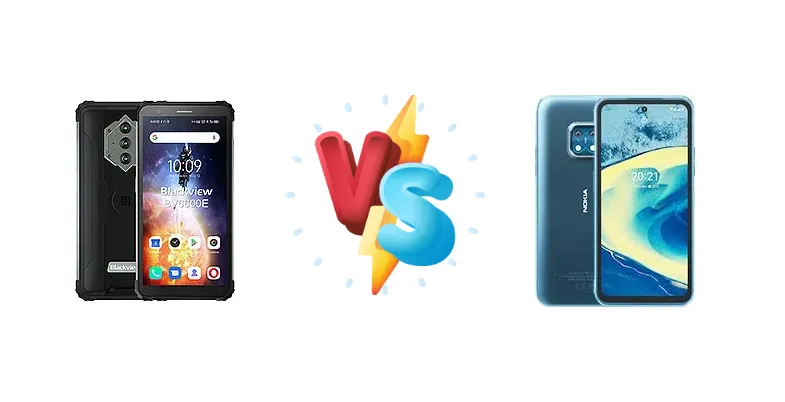
The rugged smartphone market caters to a specific need: durability. Both the Blackview BV6600E and Nokia XR20 aim to deliver on that promise, but they approach it with vastly different internal hardware. The BV6600E focuses on affordability, while the XR20 aims for a more balanced experience with 5G connectivity and a more modern chipset. This comparison dissects their strengths and weaknesses to determine which phone is the better choice for your needs.
🏆 Quick Verdict
For the average user prioritizing future-proofing and smoother performance, the Nokia XR20 is the clear winner. Its Snapdragon 480 5G chipset and 18W charging offer a significantly better experience than the Blackview BV6600E’s Unisoc SC9863A and 10W charging, despite the BV6600E’s lower price point.
| Network |
|---|
| 2G bands | GSM 850 / 900 / 1800 / 1900 | GSM 850 / 900 / 1800 / 1900 |
| 3G bands | HSDPA 900 / 2100 | HSDPA 850 / 900 / 1700(AWS) / 1900 / 2100 |
| 4G bands | 1, 3, 7, 8, 20, 40 | 1, 2, 3, 4, 5, 7, 8, 12, 13, 14, 20, 25, 26, 28, 30, 38, 40, 41, 48, 66, 71 |
| 5G bands | - | 2, 5, 25, 38, 41, 48, 66, 77, 78 SA/NSA |
| Speed | HSPA, LTE | HSPA, LTE, 5G |
| Technology | GSM / HSPA / LTE | GSM / CDMA / HSPA / EVDO / LTE / 5G |
| | - | CDMA2000 1xEV-DO |
| Launch |
|---|
| Announced | 2021, September | 2021, July 27 |
| Status | Available. Released 2021, October | Available. Released 2021, August 04 |
| Body |
|---|
| Dimensions | 159 x 79.4 x 18 mm (6.26 x 3.13 x 0.71 in) | 171.6 x 81.5 x 10.6 mm (6.76 x 3.21 x 0.42 in) |
| SIM | Nano-SIM + Nano-SIM | · Nano-SIM· Nano-SIM + Nano-SIM |
| Weight | 325 g (11.46 oz) | 248 g (8.75 oz) |
| | IP68/IP69K dust/water resistant (up to 1.5m for 30 min)
Drop-to-concrete resistance from up to 1.2m
MIL-STD-810G compliant | IP68 dust/water resistant (up to 1.5m for 60 min)
Drop-to-concrete resistance from up to 1.8m
MIL-STD-810H compliant |
| Display |
|---|
| Protection | Dragontrail Glass | Corning Gorilla Glass Victus |
| Resolution | 720 x 1440 pixels, 18:9 ratio (~282 ppi density) | 1080 x 2400 pixels, 20:9 ratio (~395 ppi density) |
| Size | 5.7 inches, 83.8 cm2 (~66.4% screen-to-body ratio) | 6.67 inches, 107.4 cm2 (~76.8% screen-to-body ratio) |
| Type | IPS LCD | IPS LCD, 550 nits |
| Platform |
|---|
| CPU | Octa-core (4x1.6 GHz Cortex-A55 & 4x1.2 GHz Cortex-A55) | Octa-core (2x2.0 GHz Kryo 460 & 6x1.8 GHz Kryo 460) |
| Chipset | Unisoc SC9863A (28 nm) | Qualcomm SM4350 Snapdragon 480 5G (8 nm) |
| GPU | IMG8322 | Adreno 619 |
| OS | Android 11 | Android 11, upgradable to Android 13 |
| Memory |
|---|
| Card slot | microSDXC | microSDXC (uses shared SIM slot) |
| Internal | 32GB 4GB RAM | 64GB 4GB RAM, 128GB 6GB RAM |
| | eMMC | - |
| Main Camera |
|---|
| Dual | - | 48 MP, f/1.8, (wide), 1/2.25", 0.8µm, PDAF
13 MP, f/2.4, 123˚ (ultrawide), 1/3.0", 1.12µm |
| Features | LED flash, HDR | Zeiss optics, Dual-LED dual-tone flash, second LED flash, HDR, panorama |
| Single | 13 MP, f/2.2, (wide), AF | 8 MP, f/2.0 (wide), 1/4.0", 1.12µm |
| Video | 1080p@30fps | 1080p@30fps |
| Selfie camera |
|---|
| Single | 5 MP, f/2.2, (wide) | 8 MP, f/2.0 (wide), 1/4.0", 1.12µm |
| Video | Yes | 1080p@30fps |
| Sound |
|---|
| 3.5mm jack | No | Yes |
| 35mm jack | No | Yes |
| Loudspeaker | Yes | Yes, with stereo speakers |
| Comms |
|---|
| Bluetooth | 4.2, A2DP, LE | 5.1, A2DP, LE, aptX Adaptive |
| NFC | No | Yes |
| Positioning | GPS, GLONASS, BDS | GPS (L1+L5), GLONASS, BDS, GALILEO, QZSS, NavIC |
| Radio | FM radio | Unspecified |
| USB | USB Type-C 2.0, OTG | USB Type-C 3.0 |
| WLAN | Wi-Fi 802.11 b/g/n | Wi-Fi 802.11 a/b/g/n/ac/6, dual-band, Wi-Fi Direct |
| Features |
|---|
| Sensors | Fingerprint (side-mounted), accelerometer, gyro, proximity, compass | Fingerprint (side-mounted), accelerometer, gyro, proximity, compass, barometer |
| Battery |
|---|
| Charging | 10W wired | 18W wired
15W wireless |
| Type | 8580 mAh | Li-Po 4630 mAh |
| Misc |
|---|
| Colors | Black, Orange, Green | Ultra Blue, Granite Gray |
| Models | - | TA-1368, TA-1362 |
| Price | About 150 EUR | About 270 EUR |
| SAR EU | - | 1.13 W/kg (head) 1.43 W/kg (body) |
Blackview BV6600E
- Significantly lower price point
- Rugged design for durability
- Acceptable for basic smartphone tasks
- Outdated and slow Unisoc chipset
- Slow 10W charging
- Lacks 5G connectivity
Nokia XR20
- 5G connectivity for faster data speeds
- More powerful Snapdragon 480 chipset
- Faster 18W wired and 15W wireless charging
- Higher price compared to the BV6600E
- May still struggle with very demanding games
- Rugged design may add bulk
Display Comparison
Neither device boasts a cutting-edge display. Details on panel type (IPS vs AMOLED) and resolution are missing, but the focus here is on durability. The lack of high refresh rates is expected in this segment. The key difference lies in processing power impacting UI smoothness, not display quality itself. Both will likely offer adequate outdoor visibility, but detailed color accuracy analysis is impossible without further specs.
Camera Comparison
Without detailed sensor information beyond the presence of cameras, a direct comparison is limited. However, the chipset difference suggests the XR20 will have a more capable image signal processor (ISP), leading to better image processing and potentially superior low-light performance. The XR20’s more powerful processor can handle more complex computational photography algorithms. The BV6600E will likely offer acceptable results in good lighting conditions, but will fall behind in challenging scenarios. We can assume both will include a standard macro lens, but its utility is limited on both devices.
Performance
The Nokia XR20’s Qualcomm SM4350 Snapdragon 480 5G, built on an 8nm process, represents a substantial leap over the Blackview BV6600E’s Unisoc SC9863A (28nm). The Snapdragon 480’s Kryo 460 cores (2x2.0 GHz & 6x1.8 GHz) offer significantly higher single-core and multi-core performance compared to the BV6600E’s Cortex-A55 based CPU (4x1.6 GHz & 4x1.2 GHz). This translates to faster app loading times, smoother multitasking, and a more responsive user experience. The 8nm process also contributes to better thermal efficiency, reducing the likelihood of throttling during sustained use. The BV6600E will be adequate for basic tasks, but will struggle with demanding games or applications.
Battery Life
Both phones likely feature large batteries, typical of rugged devices. However, the charging speeds differ significantly. The Nokia XR20 supports 18W wired charging *and* 15W wireless charging, offering greater convenience. The Blackview BV6600E is limited to 10W wired charging, meaning significantly longer charge times. While battery capacity isn’t specified, the faster charging of the XR20 mitigates any potential capacity disadvantage, allowing for quicker top-ups throughout the day.
Buying Guide
Buy the Blackview BV6600E if you need an extremely affordable, basic rugged phone for essential tasks and aren't concerned with demanding applications or 5G connectivity. Buy the Nokia XR20 if you prefer a more refined experience with 5G support, faster charging, and a chipset capable of handling more intensive workloads, even if it comes at a higher price.
Frequently Asked Questions
❓ Will the Unisoc SC9863A in the Blackview BV6600E struggle with modern apps like TikTok or Facebook?
Yes, the Unisoc SC9863A is a relatively low-end chipset. While it can handle basic apps, you may experience noticeable lag and slowdowns when using more demanding applications like TikTok, Facebook, or even web browsing with multiple tabs open. The Nokia XR20’s Snapdragon 480 will provide a much smoother experience.
❓ Does the Nokia XR20's 5G connectivity actually matter for a rugged phone used outdoors?
Yes, 5G connectivity can be beneficial even in outdoor scenarios. Faster download and upload speeds are useful for map downloads, streaming music or podcasts, and sharing photos and videos from remote locations. While 4G is sufficient for basic tasks, 5G provides a significant improvement in data speeds where available.
❓ How long will it take to fully charge the Blackview BV6600E with its 10W charging?
With 10W charging, a full charge from 0% will likely take over 4 hours, potentially even longer depending on battery capacity. This is a significant drawback compared to the Nokia XR20’s 18W wired and 15W wireless charging options, which can significantly reduce charging times.