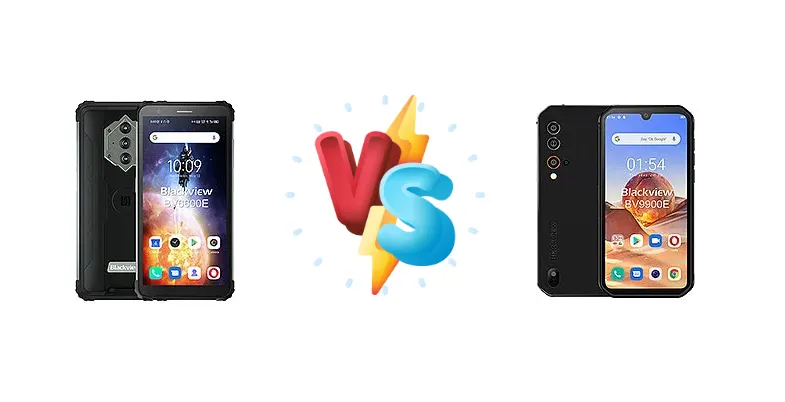
Blackview has carved a niche for itself in the rugged smartphone market, offering durable devices at competitive prices. The BV6600E and BV9900E represent two distinct approaches within their lineup: the BV6600E prioritizes affordability and essential functionality, while the BV9900E aims for a more premium experience with a significantly more powerful chipset and advanced features like wireless charging. This comparison will dissect the key differences to help you determine which model best suits your needs.
🏆 Quick Verdict
For the average user prioritizing raw performance and future-proofing, the Blackview BV9900E is the clear winner. Its Helio P90 chipset delivers a substantial performance leap over the BV6600E’s Unisoc SC9863A. However, if budget is the primary concern and your usage is limited to basic tasks, the BV6600E remains a viable, cost-effective option.
| Network |
|---|
| 2G bands | GSM 850 / 900 / 1800 / 1900 | GSM 850 / 900 / 1800 / 1900 |
| 3G bands | HSDPA 900 / 2100 | HSDPA 800 / 850 / 900 / 1700(AWS) / 1900 / 2100 |
| 4G bands | 1, 3, 7, 8, 20, 40 | 1, 2, 3, 4, 5, 7, 8, 12, 13, 17, 18, 19, 20, 25, 26, 28, 34, 38, 39, 40, 41, 66 |
| Speed | HSPA, LTE | HSPA, LTE |
| Technology | GSM / HSPA / LTE | GSM / CDMA / HSPA / CDMA2000 / LTE |
| Launch |
|---|
| Announced | 2021, September | 2020, September 10. Released 2020, September |
| Status | Available. Released 2021, October | Discontinued |
| Body |
|---|
| Dimensions | 159 x 79.4 x 18 mm (6.26 x 3.13 x 0.71 in) | 156.5 x 78.3 x 14.2 mm (6.16 x 3.08 x 0.56 in) |
| SIM | Nano-SIM + Nano-SIM | Nano-SIM + Nano-SIM |
| Weight | 325 g (11.46 oz) | 273 g (9.63 oz) |
| | IP68/IP69K dust/water resistant (up to 1.5m for 30 min)
Drop-to-concrete resistance from up to 1.2m
MIL-STD-810G compliant | - |
| Display |
|---|
| Protection | Dragontrail Glass | Corning Gorilla Glass 5 |
| Resolution | 720 x 1440 pixels, 18:9 ratio (~282 ppi density) | 1080 x 2280 pixels, 19:9 ratio (~432 ppi density) |
| Size | 5.7 inches, 83.8 cm2 (~66.4% screen-to-body ratio) | 5.84 inches, 85.1 cm2 (~69.5% screen-to-body ratio) |
| Type | IPS LCD | IPS LCD |
| Platform |
|---|
| CPU | Octa-core (4x1.6 GHz Cortex-A55 & 4x1.2 GHz Cortex-A55) | Octa-core (2x2.2 GHz Cortex-A75 & 6x2.0 GHz Cortex-A55) |
| Chipset | Unisoc SC9863A (28 nm) | Mediatek MT6779V/CE Helio P90 (12 nm) |
| GPU | IMG8322 | PowerVR GM9446 |
| OS | Android 11 | Android 10 |
| Memory |
|---|
| Card slot | microSDXC | microSDXC |
| Internal | 32GB 4GB RAM | 128GB 6GB RAM |
| | eMMC | - |
| Main Camera |
|---|
| Features | LED flash, HDR | LED flash, HDR, panorama |
| Quad | - | 48 MP, f/1.8, (wide), PDAF
16 MP, 120˚ (ultrawide)
2 MP (macro)
Auxiliary lens |
| Single | 13 MP, f/2.2, (wide), AF | - |
| Video | 1080p@30fps | 4K@30fps, 1080p@60fps |
| Selfie camera |
|---|
| Single | 5 MP, f/2.2, (wide) | 16 MP, f/2.0, (wide) |
| Video | Yes | 1080p@30fps |
| Sound |
|---|
| 3.5mm jack | No | - |
| 35mm jack | No | No |
| Loudspeaker | Yes | Yes |
| Comms |
|---|
| Bluetooth | 4.2, A2DP, LE | 5.0, A2DP, LE |
| NFC | No | Yes |
| Positioning | GPS, GLONASS, BDS | GPS, GLONASS, GALILEO, BDS |
| Radio | FM radio | FM radio |
| USB | USB Type-C 2.0, OTG | USB Type-C 2.0, OTG |
| WLAN | Wi-Fi 802.11 b/g/n | Wi-Fi 802.11 a/b/g/n/ac |
| Features |
|---|
| Sensors | Fingerprint (side-mounted), accelerometer, gyro, proximity, compass | Fingerprint (side-mounted), accelerometer, gyro, proximity, compass, barometer |
| Battery |
|---|
| Charging | 10W wired | 15W wired
18W wireless |
| Type | 8580 mAh | 4380 mAh |
| Misc |
|---|
| Colors | Black, Orange, Green | Black, Silver |
| Price | About 150 EUR | About 260 EUR |
Blackview BV6600E
- Significantly more affordable
- Excellent value for basic use
- Rugged build quality
- Weak processor for demanding tasks
- Slow charging speed (10W)
- Limited multitasking capabilities
Blackview BV9900E
- Powerful Helio P90 processor
- Faster 15W wired and 18W wireless charging
- Improved multitasking and gaming performance
- Higher price point
- May run slightly warmer under heavy load
- Still utilizes a basic camera system despite the better ISP
Display Comparison
Neither Blackview provided display specs beyond resolution, so a direct comparison is limited. However, the BV9900E’s more powerful chipset suggests a potentially higher-quality panel capable of better color reproduction and brightness. The BV6600E, given its lower price point, likely utilizes a more basic LCD panel. Bezels are expected to be similar on both, prioritizing durability over a sleek aesthetic. Color accuracy is likely to be standard on both devices, geared towards practical visibility rather than professional color grading.
Camera Comparison
Without detailed camera specifications, a precise comparison is difficult. However, the BV9900E’s more powerful ISP (Image Signal Processor) within the Helio P90 chipset will likely result in superior image processing, particularly in low-light conditions. While both phones likely feature a multi-camera setup, the BV9900E is expected to offer better dynamic range and detail. The presence of a more capable chipset suggests potential for features like improved HDR and faster autofocus. The 2MP macro cameras often found on these devices are largely marketing features and offer limited practical benefit on both phones.
Performance
The performance gap between these two devices is substantial. The BV9900E’s MediaTek Helio P90 (12nm) utilizes a more advanced architecture – specifically, two Cortex-A75 cores clocked at 2.2GHz alongside six Cortex-A55 cores at 2.0GHz – compared to the BV6600E’s Unisoc SC9863A (28nm) which features four Cortex-A55 cores at 1.6GHz and four at 1.2GHz. This translates to significantly faster processing speeds and improved multitasking capabilities on the BV9900E. The 12nm process node of the Helio P90 also offers better thermal efficiency, reducing the likelihood of throttling during prolonged use. The BV6600E will struggle with demanding games and applications, while the BV9900E can handle them with relative ease.
Battery Life
Both phones cater to the rugged lifestyle with substantial batteries, but the charging capabilities differ significantly. The BV6600E supports 10W wired charging, while the BV9900E offers 15W wired charging *and* 18W wireless charging. While battery capacity isn’t specified, the BV9900E’s faster charging speeds, especially the addition of wireless charging, provide a significant convenience advantage. The more efficient Helio P90 chipset may also contribute to slightly better battery life despite potentially similar capacity, as it requires less power to perform the same tasks.
Buying Guide
Buy the Blackview BV6600E if you need a dependable, extremely affordable rugged phone for basic communication, light social media, and occasional photography. It’s ideal for users who prioritize durability over demanding applications. Buy the Blackview BV9900E if you prefer a smoother, more responsive experience for gaming, multitasking, and running resource-intensive apps, and if the convenience of wireless charging is important to you. It’s geared towards users who need a rugged phone that can also handle a heavier workload.
Frequently Asked Questions
❓ Will the Helio P90 in the BV9900E overheat during extended gaming sessions?
While the Helio P90 is a capable chip, it's not known for exceptional thermal performance. Blackview's rugged design likely incorporates heat dissipation features, but prolonged, demanding gaming may lead to some throttling to prevent overheating. The 12nm process node is more efficient than the BV6600E's 28nm, mitigating the issue.
❓ Is the wireless charging on the BV9900E Qi-compatible, and how long does a full charge take?
The BV9900E supports 18W wireless charging, and it is likely Qi-compatible, though Blackview doesn't explicitly state this. A full wireless charge will likely take around 3-4 hours, depending on the charger used. Wired charging at 15W will be significantly faster, around 2-2.5 hours.
❓ Can the BV6600E handle popular apps like WhatsApp, Facebook, and basic web browsing without significant lag?
Yes, the BV6600E’s Unisoc SC9863A is sufficient for basic tasks like WhatsApp, Facebook, and web browsing. However, expect some lag when switching between multiple apps or loading complex web pages. It’s not designed for heavy multitasking or demanding applications.
❓ What type of storage does each phone use, and is it expandable?
While not specified, Blackview typically uses eMMC storage in this price range. Both phones likely support microSD card expansion for additional storage, but the maximum supported capacity may vary. Check the product specifications for the exact details.