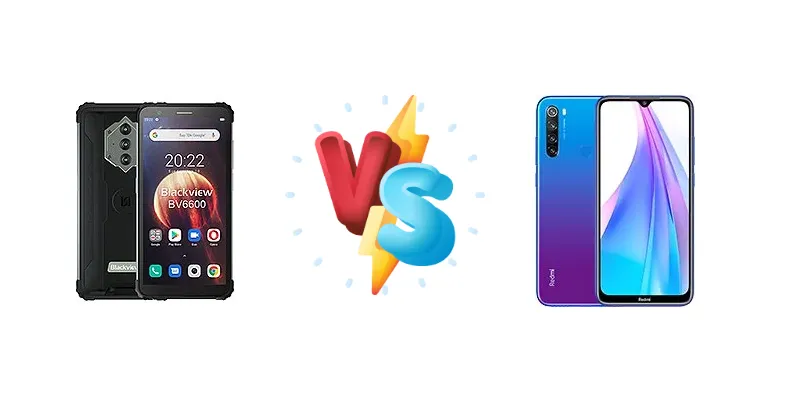
Choosing a budget phone can be tough. The Blackview BV6600 offers rugged durability, while the Xiaomi Redmi Note 8T provides a more mainstream experience. This comparison dives deep into their specs and features to help you decide which one is right for you.
🏆 Quick Verdict
The Redmi Note 8T generally wins due to its superior chipset, display, and overall polish. However, the BV6600's rugged build and water resistance make it ideal for those needing a tough, dependable device in demanding environments. It's a trade-off between durability and performance.
| Network |
|---|
| 2G bands | GSM 850 / 900 / 1800 / 1900 | GSM 850 / 900 / 1800 / 1900 |
| 3G bands | HSDPA 850 / 900 / 1900 / 2100 | HSDPA 850 / 900 / 1700(AWS) / 1900 / 2100 |
| 4G bands | 1, 3, 7, 8, 20, 40 | 1, 2, 3, 4, 5, 7, 8, 20, 28, 38, 40 |
| Speed | HSPA, LTE | HSPA 42.2/5.76 Mbps, LTE (4CA) Cat12 600/50 Mbps |
| Technology | GSM / HSPA / LTE | GSM / HSPA / LTE |
| Launch |
|---|
| Announced | 2021, March 05 | 2019, November 06. Released 2019, November 08 |
| Status | Available. Released 2021, March | Discontinued |
| Body |
|---|
| Build | - | Glass front (Gorilla Glass 5), glass back (Gorilla Glass 5), plastic frame |
| Dimensions | 159 x 79.4 x 18 mm (6.26 x 3.13 x 0.71 in) | 161.1 x 75.4 x 8.6 mm (6.34 x 2.97 x 0.34 in) |
| SIM | Nano-SIM + Nano-SIM | Nano-SIM + Nano-SIM |
| Weight | 325 g (11.46 oz) | 200 g (7.05 oz) |
| | IP68/IP69K dust/water resistant (up to 1.5m for 30 min)
Drop-to-concrete resistance from up to 1.5m
MIL-STD-810G compliant | - |
| Display |
|---|
| Protection | Corning Gorilla Glass 3 | Corning Gorilla Glass 5 |
| Resolution | 720 x 1440 pixels, 18:9 ratio (~282 ppi density) | 1080 x 2340 pixels, 19.5:9 ratio (~409 ppi density) |
| Size | 5.7 inches, 83.8 cm2 (~66.4% screen-to-body ratio) | 6.3 inches, 97.4 cm2 (~80.2% screen-to-body ratio) |
| Type | IPS LCD | IPS LCD |
| Platform |
|---|
| CPU | Octa-core (4x1.8 GHz Cortex-A53 & 4x1.5 GHz Cortex-A53) | Octa-core (4x2.0 GHz Kryo 260 Gold & 4x1.8 GHz Kryo 260 Silver) |
| Chipset | Mediatek MT6762V/WD Helio A25 (12 nm) | Qualcomm SDM665 Snapdragon 665 (11 nm) |
| GPU | PowerVR GE8320 | Adreno 610 |
| OS | Android 10 | Android 9.0 (Pie), upgradable to Android 11, MIUI 12.5 |
| Memory |
|---|
| Card slot | microSDXC | microSDXC (dedicated slot) |
| Internal | 64GB 4GB RAM | 32GB 3GB RAM, 64GB 4GB RAM, 128GB 4GB RAM |
| | eMMC | eMMC |
| Main Camera |
|---|
| Features | LED flash, HDR | LED flash, HDR, panorama |
| Quad | - | 48 MP, f/1.8, 26mm (wide), 1/2.0", 0.8µm, PDAF
8 MP, f/2.2, 13mm (ultrawide), 1/4.0", 1.12µm
2 MP (macro)
Auxiliary lens |
| Single | 16 MP, f/2.0, (wide), PDAF | - |
| Video | 1080p@30fps | 4K@30fps, 1080p@30/60/120fps; gyro-EIS |
| Selfie camera |
|---|
| Features | - | HDR, panorama |
| Single | 8 MP, f/2.0, (wide) | 13 MP, f/2.0, (wide), 1/3.1", 1.12µm |
| Video | 1080p@30fps | 1080p@30fps |
| Sound |
|---|
| 3.5mm jack | No | Yes |
| 35mm jack | No | Yes |
| Loudspeaker | Yes | Yes |
| Comms |
|---|
| Bluetooth | 5.0, A2DP, LE | 4.2, A2DP, LE |
| Infrared port | - | Yes |
| NFC | Yes | Yes |
| Positioning | GPS, GLONASS, GALILEO, BDS | GPS, GLONASS, BDS |
| Radio | FM radio | FM radio |
| USB | USB Type-C 2.0, OTG | USB Type-C 2.0, OTG |
| WLAN | Wi-Fi 802.11 a/b/g/n/ac | Wi-Fi 802.11 a/b/g/n/ac, dual-band, Wi-Fi Direct |
| Features |
|---|
| Sensors | Fingerprint (side-mounted), accelerometer, gyro, proximity, compass | Fingerprint (rear-mounted), accelerometer, gyro, proximity, compass |
| Battery |
|---|
| Charging | 18W wired | 18W wired |
| Type | 8580 mAh | Li-Po 4000 mAh, non-removable |
| Misc |
|---|
| Colors | Black, Orange, Green | Starscape Blue, Moonlight White, Moonshadow Grey |
| Models | - | M1908C3XG |
| Price | About 160 EUR | About 250 EUR |
| SAR | - | 1.02 W/kg (head) 1.18 W/kg (body) |
| SAR EU | - | 0.74 W/kg (head) 1.30 W/kg (body) |
| Tests |
|---|
| Audio quality | - |
Noise -93.9dB / Crosstalk -93.7dB |
| Battery life | - | Endurance rating 108h |
| Camera | - |
Photo / Video |
| Display | - |
Contrast ratio: 1360:1 (nominal) |
| Loudspeaker | - |
Voice 78dB / Noise 74dB / Ring 79dB |
| Performance | - |
AnTuTu: 141077 (v7), 167395 (v8)
GeekBench: 5620 (v4.4)
GFXBench: 5.9fps (ES 3.1 onscreen) |
Blackview BV6600
- Rugged and durable design
- Water and dust resistant (IP68/IP69K likely)
- Long-lasting battery (likely)
- Affordable price
- Lower performance chipset
- Less refined display
- Subpar camera
- Bulkier design
Xiaomi Redmi Note 8T
- Better performance (Snapdragon 665)
- Superior display
- Improved camera quality
- Sleeker design
- Excellent battery life
- Less durable than BV6600
- Not water resistant
- Can be slightly more expensive
Display Comparison
The Redmi Note 8T boasts a slightly brighter display (450 nits vs BV6600's likely lower brightness) and a more refined panel. While both offer a 1360:1 contrast ratio, the Redmi Note 8T's display is generally considered superior in terms of color accuracy and viewing angles. The BV6600's display is likely adequate but not exceptional.
Camera Comparison
While both phones have 'Photo / Video' listed, the Redmi Note 8T generally has a better camera system. Expect better image quality, dynamic range, and low-light performance from the Redmi Note 8T. The BV6600's camera is likely adequate for basic snapshots but won't compete with the Redmi Note 8T.
Performance
The Snapdragon 665 in the Redmi Note 8T significantly outperforms the Helio A25 in the BV6600. The Kryo 260 cores offer better processing power and efficiency, resulting in smoother multitasking, faster app loading, and a more responsive user interface. Gaming performance will also be noticeably better on the Redmi Note 8T.
Battery Life
The Redmi Note 8T's endurance rating of 108h is impressive, suggesting excellent battery life. While the BV6600 has a decent battery capacity, the Redmi Note 8T's more efficient chipset likely contributes to its superior battery performance.
Buying Guide
Buy the Blackview BV6600 if you prioritize durability, water resistance, and a rugged design for outdoor adventures or harsh work conditions. Buy the Xiaomi Redmi Note 8T if you want a smoother performance, better camera, and a more refined user experience without sacrificing too much on price.
Frequently Asked Questions
❓ Is the Blackview BV6600 waterproof?
The Blackview BV6600 is likely water and dust resistant, often with an IP68 or IP69K rating, but confirm the specific rating before submerging it.
❓ Can I play demanding games on the Redmi Note 8T?
Yes, the Redmi Note 8T's Snapdragon 665 chipset can handle most games at medium settings. However, very demanding titles may require lower graphics settings for smooth gameplay.