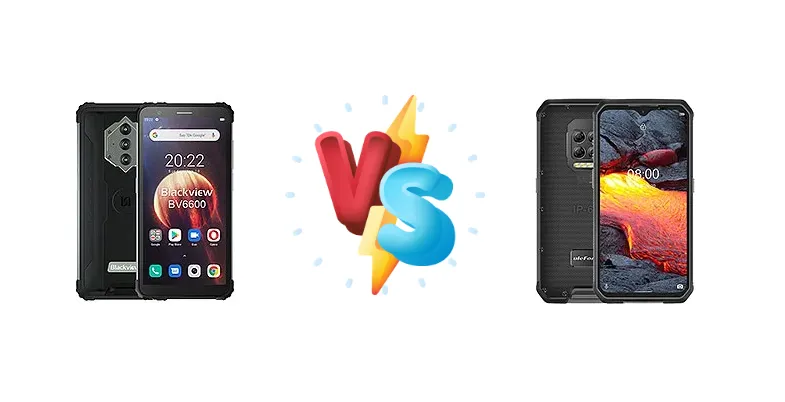
The rugged smartphone market caters to users needing durability, but performance varies greatly. We pit the Blackview BV6600, a budget-friendly option, against the Ulefone Armor 9E, which aims for a balance of toughness and processing power. This comparison focuses on how their core components translate to real-world usability for demanding tasks and everyday use.
🏆 Quick Verdict
For the average user prioritizing affordability and basic functionality, the Blackview BV6600 is a viable choice. However, the Ulefone Armor 9E emerges as the clear winner, thanks to its significantly more powerful Helio P90 chipset, offering a substantially improved user experience for multitasking, gaming, and demanding applications.
| Network |
|---|
| 2G bands | GSM 850 / 900 / 1800 / 1900 | GSM 850 / 900 / 1800 / 1900 |
| 3G bands | HSDPA 850 / 900 / 1900 / 2100 | HSDPA 850 / 900 / 1700(AWS) / 1900 / 2100 |
| 4G bands | 1, 3, 7, 8, 20, 40 | 1, 2, 3, 4, 5, 7, 8, 12, 13, 17, 18, 19, 20, 25, 26, 28, 34, 38, 39, 40, 41, 66 |
| Speed | HSPA, LTE | HSPA 42.2/11.5 Mbps, LTE Cat12 600/150 Mbps |
| Technology | GSM / HSPA / LTE | GSM / CDMA / HSPA / EVDO / LTE |
| | - | CDMA2000 1xEV-DO |
| Launch |
|---|
| Announced | 2021, March 05 | 2020, September 08. Released 2020, September 08 |
| Status | Available. Released 2021, March | Discontinued |
| Body |
|---|
| Build | - | Front glass, aluminum back with rubber, aluminum frame |
| Dimensions | 159 x 79.4 x 18 mm (6.26 x 3.13 x 0.71 in) | 168.2 x 82 x 15 mm (6.62 x 3.23 x 0.59 in) |
| SIM | Nano-SIM + Nano-SIM | Nano-SIM + Nano-SIM |
| Weight | 325 g (11.46 oz) | 324 g (11.43 oz) |
| | IP68/IP69K dust/water resistant (up to 1.5m for 30 min)
Drop-to-concrete resistance from up to 1.5m
MIL-STD-810G compliant | IP68/IP69K dust/water resistant (up to 1.5m for 30 min)
Drop-to-concrete resistance from up to 1.2m
MIL-STD-810G compliant |
| Display |
|---|
| Protection | Corning Gorilla Glass 3 | Scratch-resistant glass, oleophobic coating |
| Resolution | 720 x 1440 pixels, 18:9 ratio (~282 ppi density) | 1080 x 2340 pixels, 19.5:9 ratio (~409 ppi density) |
| Size | 5.7 inches, 83.8 cm2 (~66.4% screen-to-body ratio) | 6.3 inches, 97.4 cm2 (~70.6% screen-to-body ratio) |
| Type | IPS LCD | IPS LCD |
| Platform |
|---|
| CPU | Octa-core (4x1.8 GHz Cortex-A53 & 4x1.5 GHz Cortex-A53) | Octa-core (2x2.2 GHz Cortex-A75 & 6x2.0 GHz Cortex-A55) |
| Chipset | Mediatek MT6762V/WD Helio A25 (12 nm) | Mediatek MT6779 Helio P90 (12 nm) |
| GPU | PowerVR GE8320 | PowerVR GM9446 |
| OS | Android 10 | Android 10 |
| Memory |
|---|
| Card slot | microSDXC | microSDXC (uses shared SIM slot) |
| Internal | 64GB 4GB RAM | 128GB 8GB RAM |
| | eMMC | UFS 2.1 |
| Main Camera |
|---|
| Features | LED flash, HDR | Quad-LED flash, HDR, panorama |
| Quad | - | 64 MP, f/1.9, 26mm (wide), 1/1.72", 0.8µm, PDAF
8 MP, f/2.4, 100˚ (ultrawide), 1/4.0", 1.12µm
2 MP (macro)
Auxiliary lens |
| Single | 16 MP, f/2.0, (wide), PDAF | - |
| Video | 1080p@30fps | 4K@30fps, 1080p@30fps |
| Selfie camera |
|---|
| Features | - | HDR, panorama |
| Single | 8 MP, f/2.0, (wide) | 8 MP, f/2.2 |
| Video | 1080p@30fps | 1080p@30fps |
| Sound |
|---|
| 3.5mm jack | No | Yes |
| 35mm jack | No | Yes |
| Loudspeaker | Yes | Yes |
| Comms |
|---|
| Bluetooth | 5.0, A2DP, LE | 5.0, A2DP, LE |
| NFC | Yes | Yes |
| Positioning | GPS, GLONASS, GALILEO, BDS | GPS, GLONASS, GALILEO, BDS |
| Radio | FM radio | FM radio, RDS, recording |
| USB | USB Type-C 2.0, OTG | USB Type-C 2.0, OTG, accessory connector |
| WLAN | Wi-Fi 802.11 a/b/g/n/ac | Wi-Fi 802.11 a/b/g/n/ac, Wi-Fi Direct |
| Features |
|---|
| Sensors | Fingerprint (side-mounted), accelerometer, gyro, proximity, compass | Fingerprint (side-mounted), accelerometer, gyro, proximity, compass, coulombmeter |
| | - | Endoscope mount (camera sold separately) |
| Battery |
|---|
| Charging | 18W wired | 18W wired |
| Type | 8580 mAh | Li-Po 6600 mAh |
| Misc |
|---|
| Colors | Black, Orange, Green | Black |
| Price | About 160 EUR | About 290 EUR |
Blackview BV6600
- Highly affordable price point
- Rugged build quality for durability
- Suitable for basic smartphone tasks
- Limited processing power for demanding apps
- Potentially slow performance with multitasking
Ulefone Armor 9E
- Significantly faster processor (Helio P90)
- Improved multitasking and gaming performance
- Potentially better camera image processing
- Higher price compared to the BV6600
- May not offer a dramatically superior display
Display Comparison
Neither device's display specifications are provided, so a direct comparison is limited. However, given the BV6600's positioning, it likely features a standard IPS LCD panel. The Armor 9E, being a step up, *may* incorporate features like higher peak brightness or improved color accuracy. Rugged phones often prioritize durability over display quality, so expect practical, rather than stunning, visuals on both.
Camera Comparison
Without detailed camera specs, a precise comparison is difficult. However, rugged phones often prioritize practicality over camera excellence. Both devices likely feature a multi-camera setup, but the image processing capabilities will heavily depend on the chipset. The Helio P90 in the Armor 9E has a more powerful ISP (Image Signal Processor), potentially leading to better image quality, especially in low-light conditions. Expect both to include a standard wide-angle lens and potentially an ultra-wide or macro lens, though the usefulness of the latter is often limited.
Performance
The core difference lies in the chipsets. The Blackview BV6600 utilizes the Mediatek MT6762V/WD Helio A25, an entry-level processor with an octa-core configuration split between 1.8 GHz and 1.5 GHz Cortex-A53 cores. This is geared towards basic tasks. Conversely, the Ulefone Armor 9E boasts the Mediatek MT6779 Helio P90. Its octa-core setup, featuring 2x2.2 GHz Cortex-A75 and 6x2.0 GHz Cortex-A55 cores, represents a significant leap in performance. The Cortex-A75 cores are considerably more powerful than the A53s, resulting in faster app loading times, smoother multitasking, and a more responsive user interface. This translates to a better experience for users who frequently switch between apps or engage in moderate gaming.
Battery Life
Both phones share a common 18W wired charging capability. While battery capacity isn't specified, the Armor 9E's more efficient Helio P90 chipset *could* translate to better battery life despite potentially having a similar capacity. The P90's architecture is designed for power efficiency, meaning it can deliver more performance per watt. 18W charging is relatively slow by modern standards, so expect a full charge to take several hours on both devices.
Buying Guide
Buy the Blackview BV6600 if you need a highly affordable, extremely durable phone primarily for calls, texts, and light app usage. It’s ideal for construction workers or outdoor enthusiasts on a tight budget. Buy the Ulefone Armor 9E if you prefer a rugged phone that can handle more intensive tasks like gaming, video editing, or running multiple apps simultaneously, and you're willing to spend a bit more for the performance boost.
Frequently Asked Questions
❓ Will the Ulefone Armor 9E handle graphically intensive games like PUBG or Call of Duty?
The Helio P90 in the Armor 9E is capable of running PUBG and Call of Duty, but expect to play at medium settings for a smooth experience. The GPU isn't a flagship-level performer, so high settings may result in frame drops. The BV6600's Helio A25 would struggle significantly with these titles.
❓ Is the 18W charging speed sufficient for both phones, or should I expect long charging times?
18W charging is relatively slow compared to modern fast-charging standards. Expect both phones to take approximately 2.5 to 3.5 hours to fully charge from 0%. The Armor 9E's more efficient chipset *might* slightly reduce charging time, but the difference will be minimal.
❓ How does the ruggedness of the Armor 9E compare to the BV6600 in terms of drop and water resistance?
Both phones are built to withstand drops, dust, and water. However, specific IP ratings aren't provided. Generally, rugged phones aim for IP68 or IP69K ratings, offering comprehensive protection. Without those specifics, it's safe to assume both offer a similar level of ruggedness suitable for demanding environments.