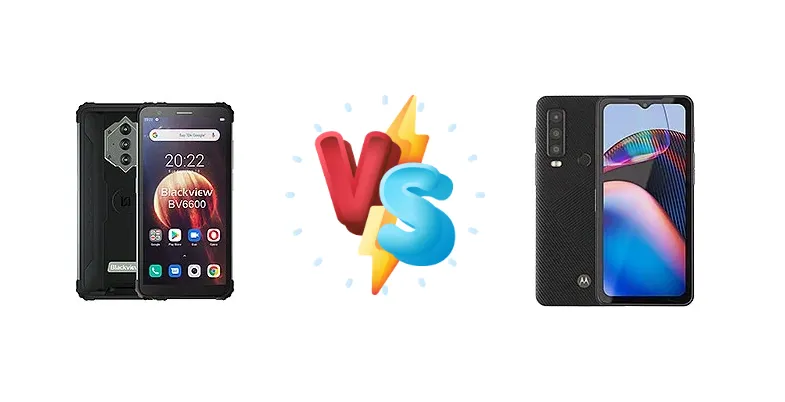
The rugged smartphone market caters to a specific need: durability. However, performance expectations vary. The Blackview BV6600 represents a budget-friendly entry point, while the Motorola Defy 2 aims for a balance of resilience and modern processing power. This comparison dissects their core components to determine which device best suits your demands.
🏆 Quick Verdict
For the average user prioritizing responsiveness and future-proofing, the Motorola Defy 2 is the clear winner. Its Dimensity 930 chipset offers significantly superior performance, and the inclusion of 15W wireless charging adds convenience. However, the Blackview BV6600 remains a viable option for those on a strict budget who prioritize extreme durability over speed.
| Network |
|---|
| 2G bands | GSM 850 / 900 / 1800 / 1900 | GSM 850 / 900 / 1800 / 1900 |
| 3G bands | HSDPA 850 / 900 / 1900 / 2100 | HSDPA 850 / 900 / 1700(AWS) / 1900 / 2100 |
| 4G bands | 1, 3, 7, 8, 20, 40 | 1, 2, 3, 4, 5, 7, 8, 12, 13, 14, 17, 20, 25, 26, 28, 30, 38, 40, 41, 46, 48, 66, 71 |
| 5G bands | - | 2, 5, 23, 25, 26, 28, 38, 41, 48, 66, 70, 71, 77, 78, 255, 256 SA/NSA/Sub6/mmWave |
| Speed | HSPA, LTE | HSPA, LTE, 5G |
| Technology | GSM / HSPA / LTE | GSM / HSPA / LTE / 5G |
| Launch |
|---|
| Announced | 2021, March 05 | 2023, February 24 |
| Status | Available. Released 2021, March | Available. Released 2023, October |
| Body |
|---|
| Build | - | Glass front (Gorilla Glass Victus), plastic back, aluminum frame |
| Dimensions | 159 x 79.4 x 18 mm (6.26 x 3.13 x 0.71 in) | 171 x 80 x 11.9 mm (6.73 x 3.15 x 0.47 in) |
| SIM | Nano-SIM + Nano-SIM | Nano-SIM + Nano-SIM |
| Weight | 325 g (11.46 oz) | 268 g (9.45 oz) |
| | IP68/IP69K dust/water resistant (up to 1.5m for 30 min)
Drop-to-concrete resistance from up to 1.5m
MIL-STD-810G compliant | IP68/IP69 dust/water resistant (up to 5m for 35 min)
Drop-to-concrete resistance from up to 1.8m
MIL-STD-810H compliant |
| Display |
|---|
| Protection | Corning Gorilla Glass 3 | Corning Gorilla Glass Victus |
| Resolution | 720 x 1440 pixels, 18:9 ratio (~282 ppi density) | 1080 x 2408 pixels, 20:9 ratio (~400 ppi density) |
| Size | 5.7 inches, 83.8 cm2 (~66.4% screen-to-body ratio) | 6.6 inches, 104.9 cm2 (~76.7% screen-to-body ratio) |
| Type | IPS LCD | IPS LCD, 120Hz |
| Platform |
|---|
| CPU | Octa-core (4x1.8 GHz Cortex-A53 & 4x1.5 GHz Cortex-A53) | Octa-core (2x2.2 GHz Cortex-A78 & 6x2.0 GHz Cortex-A55) |
| Chipset | Mediatek MT6762V/WD Helio A25 (12 nm) | Mediatek Dimensity 930 (6 nm) |
| GPU | PowerVR GE8320 | IMG BXM-8-256 |
| OS | Android 10 | Android 12 |
| Memory |
|---|
| Card slot | microSDXC | microSDXC (uses shared SIM slot) |
| Internal | 64GB 4GB RAM | 128GB 6GB RAM |
| | eMMC | - |
| Main Camera |
|---|
| Features | LED flash, HDR | Dual-LED flash, HDR, panorama |
| Single | 16 MP, f/2.0, (wide), PDAF | - |
| Triple | - | 50 MP, f/1.8, (wide), PDAF
8 MP, f/2.2, (ultrawide)
2 MP (macro) |
| Video | 1080p@30fps | 1080p@30fps |
| Selfie camera |
|---|
| Single | 8 MP, f/2.0, (wide) | 8 MP, f/2.0, (wide) |
| Video | 1080p@30fps | 1080p@30fps |
| Sound |
|---|
| 3.5mm jack | No | No |
| 35mm jack | No | No |
| Loudspeaker | Yes | Yes |
| Comms |
|---|
| Bluetooth | 5.0, A2DP, LE | 5.1, A2DP, LE |
| NFC | Yes | Yes |
| Positioning | GPS, GLONASS, GALILEO, BDS | GPS (L1+L5), GLONASS, GALILEO, BDS |
| Radio | FM radio | Unspecified |
| USB | USB Type-C 2.0, OTG | USB Type-C 2.0, OTG |
| WLAN | Wi-Fi 802.11 a/b/g/n/ac | Wi-Fi 802.11 a/b/g/n/ac, dual-band |
| Features |
|---|
| Sensors | Fingerprint (side-mounted), accelerometer, gyro, proximity, compass | Fingerprint (rear-mounted), accelerometer, gyro, proximity, compass |
| | - | Emergency SOS via satellite (Bullitt Satellite Connect service) |
| Battery |
|---|
| Charging | 18W wired | 15W wireless |
| Type | 8580 mAh | Li-Po 5000 mAh |
| Misc |
|---|
| Colors | Black, Orange, Green | Black |
| Models | - | BM1S1B |
| Price | About 160 EUR | About 570 EUR |
Blackview BV6600
- Highly durable and ruggedized design
- More affordable price point
- 18W wired charging
- Weak processor performance
- Limited multitasking capabilities
- Basic camera system
Motorola Defy 2
- Significantly faster processor (Dimensity 930)
- 15W wireless charging
- Improved power efficiency
- Potentially higher price
- Ruggedness may be slightly less extreme than BV6600
- Wired charging is slower than BV6600
Display Comparison
Neither device boasts a cutting-edge display. Details regarding panel type, resolution, and refresh rate are absent for the BV6600, suggesting a basic LCD. The Defy 2’s display specs are also unavailable, but Motorola typically prioritizes durability over display quality in this line. The key difference lies in processing power impacting UI smoothness, not display fidelity. Both will likely offer adequate outdoor visibility, a crucial feature for rugged phones.
Camera Comparison
Camera details are sparse for both devices. Without sensor size or aperture information, a direct comparison is difficult. However, the Motorola Defy 2’s Dimensity 930 chipset includes a more capable image signal processor (ISP), promising better image processing and potentially superior low-light performance. The BV6600 likely relies on basic software algorithms. The presence of a 2MP macro lens on the BV6600 is largely inconsequential; its limited resolution offers minimal practical benefit.
Performance
The performance gap is substantial. The Blackview BV6600’s MediaTek Helio A25 (12nm) is an entry-level chipset designed for basic tasks. Its octa-core configuration (4x1.8 GHz Cortex-A53 & 4x1.5 GHz Cortex-A53) will struggle with demanding applications and multitasking. Conversely, the Motorola Defy 2’s Dimensity 930 (6nm) is a mid-range powerhouse. The 2x2.2 GHz Cortex-A78 cores provide a significant performance boost, enabling smoother gaming, faster app launches, and more responsive overall operation. The 6nm process also translates to improved power efficiency and reduced thermal throttling compared to the 12nm Helio A25.
Battery Life
Battery capacity is not specified for either device. However, the Motorola Defy 2’s 15W wireless charging is a significant advantage, offering convenient top-ups without needing a cable. The Blackview BV6600’s 18W wired charging is faster, but lacks the convenience of wireless charging. The Dimensity 930’s superior power efficiency will likely offset any potential battery capacity difference, resulting in comparable real-world battery life despite the BV6600’s potentially larger cell.
Buying Guide
Buy the Blackview BV6600 if you need an exceptionally durable phone for harsh environments and are willing to compromise on processing power and modern features. It’s ideal for construction workers, outdoor enthusiasts on a budget, or anyone needing a truly resilient device. Buy the Motorola Defy 2 if you prefer a more balanced experience, demanding smoother multitasking, faster app loading times, and the convenience of wireless charging, all within a ruggedized package. This phone suits users who need a reliable daily driver that can withstand accidental drops and exposure to the elements.
Frequently Asked Questions
❓ Will the Motorola Defy 2 struggle with demanding games like PUBG or Call of Duty?
The Dimensity 930 in the Motorola Defy 2 is capable of handling PUBG and Call of Duty at medium settings. While it won't deliver flagship-level graphics, it provides a significantly smoother gaming experience than the Blackview BV6600's Helio A25, which would likely struggle even at the lowest settings.
❓ Is the Blackview BV6600 a good choice for someone who frequently drops their phone?
The Blackview BV6600 is specifically designed for extreme durability. Its ruggedized construction offers superior protection against drops, shocks, and water ingress compared to the Motorola Defy 2. If drop protection is your primary concern, the BV6600 is the better choice.
❓ Does the Motorola Defy 2 support 5G connectivity?
Yes, the MediaTek Dimensity 930 chipset in the Motorola Defy 2 includes integrated 5G modem, enabling access to faster mobile data speeds where available. The Blackview BV6600, with its Helio A25, is limited to 4G LTE.
❓ How long will it take to fully charge the Motorola Defy 2 using wireless charging?
With 15W wireless charging, a full charge from 0% will likely take around 3-4 hours. While slower than wired charging, it offers the convenience of topping up the battery overnight or during downtime without needing a cable.