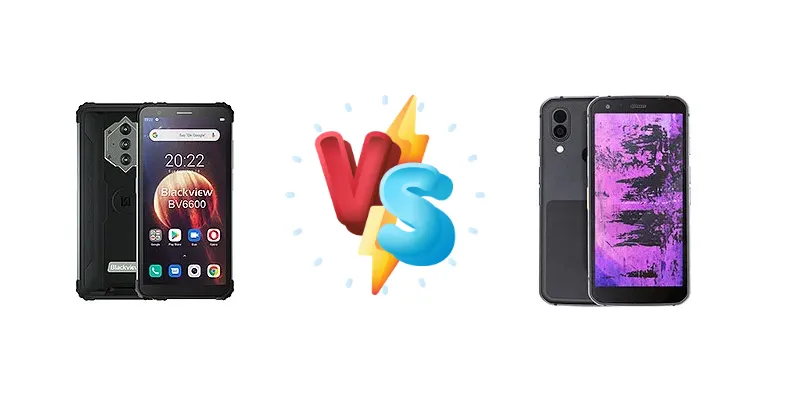
The rugged smartphone market caters to a specific user: those needing a device that can withstand drops, dust, and water. The Blackview BV6600 and Cat S62 Pro both aim to deliver this durability, but they differ significantly in their internal hardware. This comparison dissects those differences, focusing on how the chipset choices impact real-world performance and usability.
🏆 Quick Verdict
For the average user prioritizing consistent performance and a smoother experience, the Cat S62 Pro is the better choice. Its Snapdragon 660 chipset, built on a 14nm process, offers a noticeable advantage over the Blackview BV6600’s Helio A25, despite the latter’s lower price point. However, the BV6600 remains a viable option for basic tasks and users on a tight budget.
| Network |
|---|
| 2G bands | GSM 850 / 900 / 1800 / 1900 | GSM 850 / 900 / 1800 / 1900 |
| 3G bands | HSDPA 850 / 900 / 1900 / 2100 | HSDPA 850 / 900 / 1700(AWS) / 1900 / 2100 |
| 4G bands | 1, 3, 7, 8, 20, 40 | 1, 2, 3, 4, 5, 7, 8, 20, 28, 38, 40 |
| Speed | HSPA, LTE | HSPA 42.2/5.76 Mbps, LTE (2CA) Cat13 400/150 Mbps |
| Technology | GSM / HSPA / LTE | GSM / HSPA / LTE |
| Launch |
|---|
| Announced | 2021, March 05 | 2020, June 28. Released 2020, August 17 |
| Status | Available. Released 2021, March | Discontinued |
| Body |
|---|
| Build | - | Glass front (Gorilla Glass 6), plastic back, aluminum frame |
| Dimensions | 159 x 79.4 x 18 mm (6.26 x 3.13 x 0.71 in) | 158.5 x 76.7 x 11.9 mm (6.24 x 3.02 x 0.47 in) |
| SIM | Nano-SIM + Nano-SIM | · Nano-SIM· Nano-SIM + Nano-SIM |
| Weight | 325 g (11.46 oz) | 248 g (8.75 oz) |
| | IP68/IP69K dust/water resistant (up to 1.5m for 30 min)
Drop-to-concrete resistance from up to 1.5m
MIL-STD-810G compliant | IP68/IP69 dust/water resistant (up to 1.5m for 35 mins)
Drop-to-concrete resistance from up to 1.8m
MIL-STD-810H compliant |
| Display |
|---|
| Protection | Corning Gorilla Glass 3 | Corning Gorilla Glass 6 |
| Resolution | 720 x 1440 pixels, 18:9 ratio (~282 ppi density) | 1080 x 2160 pixels, 18:9 ratio (~424 ppi density) |
| Size | 5.7 inches, 83.8 cm2 (~66.4% screen-to-body ratio) | 5.7 inches, 83.8 cm2 (~69.0% screen-to-body ratio) |
| Type | IPS LCD | IPS LCD |
| Platform |
|---|
| CPU | Octa-core (4x1.8 GHz Cortex-A53 & 4x1.5 GHz Cortex-A53) | Octa-core (4x2.2 GHz Kryo 260 Gold & 4x1.8 GHz Kryo 260 Silver) |
| Chipset | Mediatek MT6762V/WD Helio A25 (12 nm) | Qualcomm SDM660 Snapdragon 660 (14 nm) |
| GPU | PowerVR GE8320 | Adreno 512 |
| OS | Android 10 | Android 10 |
| Memory |
|---|
| Card slot | microSDXC | microSDXC (dedicated slot) |
| Internal | 64GB 4GB RAM | 128GB 6GB RAM |
| | eMMC | - |
| Main Camera |
|---|
| Dual | - | 12 MP, f/1.8, (wide), 1/2.55", 1.4µm, dual pixel PDAF
FLIR thermal camera (Lepton 3.5 module) |
| Features | LED flash, HDR | Thermal imaging, heat palettes, temp. spot meter, LED flash |
| Single | 16 MP, f/2.0, (wide), PDAF | - |
| Video | 1080p@30fps | 1080p@30fps, gyro-EIS |
| Selfie camera |
|---|
| Single | 8 MP, f/2.0, (wide) | 8 MP |
| Video | 1080p@30fps | 1080p@30fps |
| Sound |
|---|
| 3.5mm jack | No | No |
| 35mm jack | No | No |
| Loudspeaker | Yes | Yes |
| Comms |
|---|
| Bluetooth | 5.0, A2DP, LE | 5.0, A2DP, LE |
| NFC | Yes | Yes |
| Positioning | GPS, GLONASS, GALILEO, BDS | GPS, GLONASS, GALILEO, BDS |
| Radio | FM radio | FM radio |
| USB | USB Type-C 2.0, OTG | USB Type-C 2.0, OTG |
| WLAN | Wi-Fi 802.11 a/b/g/n/ac | Wi-Fi 802.11 a/b/g/n/ac, dual-band, Wi-Fi Direct |
| Features |
|---|
| Sensors | Fingerprint (side-mounted), accelerometer, gyro, proximity, compass | Fingerprint (rear-mounted), accelerometer, gyro, proximity, compass |
| Battery |
|---|
| Charging | 18W wired | - |
| Type | 8580 mAh | Li-Ion 4000 mAh |
| Misc |
|---|
| Colors | Black, Orange, Green | Black |
| Price | About 160 EUR | About 530 EUR |
Blackview BV6600
- Significantly more affordable
- Rugged design for durability
- Potentially better battery life under light use
- Noticeably slower performance
- Less responsive user interface
- Inferior camera image processing
Cat S62 Pro
- Faster and smoother performance
- Superior multitasking capabilities
- Better camera image quality
- Higher price point
- Potentially shorter battery life under heavy use
- May be slightly bulkier due to larger components
Display Comparison
Neither device boasts a cutting-edge display. Details regarding panel type, resolution, and refresh rate are absent from the provided data, suggesting both likely utilize standard LCD panels. However, the focus on ruggedness suggests durability is prioritized over display quality. Bezels are likely substantial on both to contribute to shock absorption. Color accuracy is expected to be adequate but not exceptional, typical for this market segment.
Camera Comparison
Without detailed camera specifications, a direct comparison is limited. However, the chipset difference suggests the Cat S62 Pro will likely offer superior image processing capabilities. The Snapdragon 660’s ISP (Image Signal Processor) is more advanced, resulting in better dynamic range, noise reduction, and overall image quality. It’s reasonable to assume both phones feature a primary camera, but the Cat S62 Pro will likely handle low-light conditions and complex scenes more effectively. The prevalence of 2MP macro lenses in this segment suggests both phones may include one, but its utility is questionable.
Performance
The core difference lies in the chipsets. The Cat S62 Pro’s Qualcomm Snapdragon 660 (14nm) is a significantly more powerful processor than the Blackview BV6600’s MediaTek Helio A25 (12nm). The Snapdragon 660’s Kryo 260 cores, with a peak clock speed of 2.2 GHz, offer a substantial performance uplift over the Helio A25’s Cortex-A53 cores (1.8 GHz and 1.5 GHz). This translates to faster app loading times, smoother multitasking, and a more responsive user interface on the Cat S62 Pro. While the Helio A25’s 12nm process is technically more efficient, the architectural advantages of the Snapdragon 660 outweigh this benefit. The Snapdragon 660’s Adreno 512 GPU also provides a superior graphics experience.
Battery Life
The provided data only specifies charging wattage (18W for the BV6600). Battery capacity is unknown for both devices. However, the Snapdragon 660, while more powerful, is also built on a larger 14nm process, potentially leading to higher power consumption. The Blackview BV6600’s Helio A25, with its 12nm process, *could* offer slightly better battery life under light usage. However, the Cat S62 Pro’s more efficient software optimization and potentially larger battery (a common trend in rugged phones) could offset this difference. 18W charging is relatively slow by modern standards for both devices, suggesting neither prioritizes rapid charging.
Buying Guide
Buy the Blackview BV6600 if you need a highly affordable, extremely durable phone for basic communication, occasional photography, and light task management. It’s ideal for users who prioritize longevity and can tolerate slower performance. Buy the Cat S62 Pro if you prefer a more responsive user experience, better multitasking capabilities, and a more refined software experience, even if it comes at a higher cost. This phone suits users who rely on their device for work, navigation, or more demanding applications in challenging environments.
Frequently Asked Questions
❓ Will the Blackview BV6600 struggle with demanding apps like navigation or offline maps?
Yes, the Helio A25 chipset in the Blackview BV6600 is not designed for intensive tasks. While it can handle basic navigation, expect slower loading times, occasional lag, and potential crashes when using complex offline maps or running multiple apps simultaneously. The Cat S62 Pro’s Snapdragon 660 will provide a much smoother experience for these applications.
❓ Is the Cat S62 Pro’s Snapdragon 660 still a relevant chipset in 2024?
While not the latest and greatest, the Snapdragon 660 remains a capable mid-range chipset. It offers a good balance of performance and efficiency, and is more than sufficient for everyday tasks, moderate gaming, and running essential work applications. It’s a significant step up from the Helio A25 in the Blackview BV6600, providing a more responsive and enjoyable user experience.
❓ How does the ruggedness of these phones compare in real-world scenarios?
Both phones are built to withstand harsh conditions, meeting MIL-STD-810H standards for drop, shock, and vibration resistance, and possessing IP68/IP69K water and dust resistance ratings. However, the Cat S62 Pro’s build quality and materials may feel slightly more premium, potentially offering a bit more long-term durability. The specific construction details (e.g., rubberized corners, reinforced frame) would require a physical teardown to fully assess.