
Blackview BV6600 Pro vs Ulefone Power Armor 18T: The Ultimate Rugged Phone Comparison
| Phones Images | |||||
|---|---|---|---|---|---|
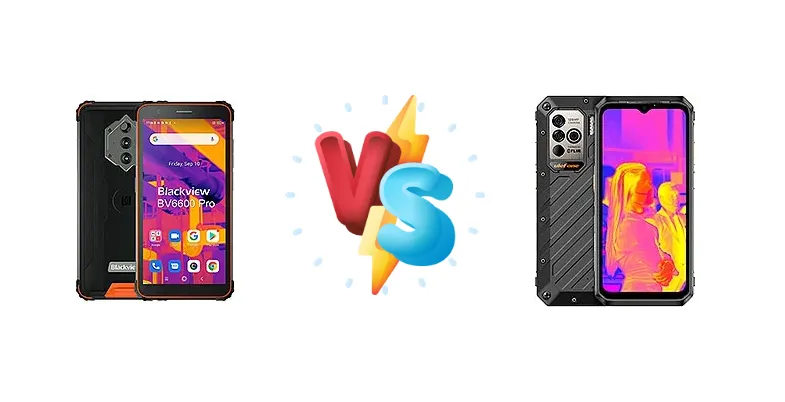
|
🏆 Quick Verdict
The Ulefone Power Armor 18T decisively wins thanks to its significantly faster Dimensity 900 chipset, blazing-fast 66W charging, and wireless charging capabilities. While the BV6600 Pro offers decent ruggedness, the 18T's performance and charging speed make it the superior choice.
| PHONES | ||
|---|---|---|
| Phone Names | Blackview BV6600 Pro | Ulefone Power Armor 18T |
| Network | ||
|---|---|---|
| 2G bands | GSM 850 / 900 / 1800 / 1900 | GSM 850 / 900 / 1800 / 1900 |
| 3G bands | HSDPA 850 / 900 / 1700(AWS) / 1900 / 2100 | HSDPA 800 / 850 / 900 / 1700(AWS) / 1900 / 2100 |
| 4G bands | 1, 2, 3, 4, 5, 7, 8, 12, 13, 17, 19, 18, 20, 28, 25, 26, 38, 40, 41, 66 | 1, 2, 3, 4, 5, 7, 8, 12, 13, 17, 18, 19, 20, 25, 26, 28, 34, 38, 39, 40, 41, 66, 71 |
| 5G bands | - | 1, 2, 3, 5, 7, 8, 20, 25, 28, 38, 41, 66, 77, 78, 79 SA/NSA/Sub6 |
| Speed | HSPA, LTE | HSPA, LTE, 5G |
| Technology | GSM / CDMA / HSPA / CDMA2000 / LTE | GSM / CDMA / HSPA / CDMA2000 / LTE / 5G |
| CDMA2000 1x | CDMA2000 1x | |
| Launch | ||
|---|---|---|
| Announced | 2021, September 28 | 2022, October 31 |
| Status | Available. Released 2021, October | Available. Released 2022, October 31 |
| Body | ||
|---|---|---|
| Dimensions | 159 x 79.4 x 18 mm (6.26 x 3.13 x 0.71 in) | 175.2 x 83.4 x 18.8 mm (6.90 x 3.28 x 0.74 in) |
| SIM | Nano-SIM + Nano-SIM | Nano-SIM + Nano-SIM |
| Weight | 325 g (11.46 oz) | 409 g (14.43 oz) |
| IP68/IP69K dust/water resistant (up to 1.5m for 30 min) Drop-to-concrete resistance from up to 1.5m MIL-STD-810G compliant | IP68/IP69K dust/water resistant (up to 1.5m for 30 min) Drop-to-concrete resistance from up to 1.5m MIL-STD-810G compliant Accessory connector (ulefone endoscope, microscope) | |
| Display | ||
|---|---|---|
| Protection | Dragontrail Glass | Corning Gorilla Glass 5 |
| Resolution | 720 x 1440 pixels, 18:9 ratio (~282 ppi density) | 1080 x 2408 pixels, 20:9 ratio (~401 ppi density) |
| Size | 5.7 inches, 83.8 cm2 (~66.4% screen-to-body ratio) | 6.58 inches, 104.3 cm2 (~71.4% screen-to-body ratio) |
| Type | IPS LCD | IPS LCD, 120Hz |
| Platform | ||
|---|---|---|
| CPU | Octa-core (4x2.35 GHz Cortex-A53 & 4x1.8 GHz Cortex-A53) | Octa-core (2x2.4 GHz Cortex-A78 & 6x2.0 GHz Cortex-A55) |
| Chipset | Mediatek MT6765V/CA Helio P35 (12 nm) | Mediatek Dimensity 900 (6 nm) |
| GPU | PowerVR GE8320 | Mali-G68 MC4 |
| OS | Android 11 | Android 12 |
| Memory | ||
|---|---|---|
| Card slot | microSDXC | microSDXC (uses shared SIM slot) |
| Internal | 64GB 4GB RAM | 256GB 12GB RAM |
| eMMC | - | |
| Main Camera | ||
|---|---|---|
| Features | Thermal imaging, LED flash | Hexa-LED flash, HDR, panorama |
| Single | 8 MP, f/2.0, (wide) | 32 MP, f/2.0, (wide), 1.2µm |
| Triple | 16 MP, f/2.0, (wide), PDAF 5 MP, thermal assisted camera FLIR thermal camera (Lepton module) | 108 MP, f/1.9, (wide), 1/1.52", 0.7µm, PDAF 5 MP (macro) FLIR thermal camera (Lepton module) 5 MP (for thermal module) |
| Video | 1080p@30fps | 4K@30fps, 1080p@30fps |
| Selfie camera | ||
|---|---|---|
| Single | 8 MP, f/2.0, (wide) | 32 MP, f/2.0, (wide), 1.2µm |
| Video | 1080p@30fps | 1080p@30fps |
| Sound | ||
|---|---|---|
| 3.5mm jack | No | Yes |
| 35mm jack | No | Yes |
| Loudspeaker | Yes | Yes |
| Comms | ||
|---|---|---|
| Bluetooth | 5.0, A2DP, LE | 5.0, A2DP, LE |
| NFC | Yes | Yes |
| Positioning | GPS, GLONASS, GALILEO, BDS | GPS (L1+L5), GLONASS, GALILEO, BDS, NavIC |
| Radio | FM radio | Wireless FM radio, RDS, recording |
| USB | USB Type-C 2.0, OTG | USB Type-C 2.0, OTG, magnetic connector |
| WLAN | Wi-Fi 802.11 a/b/g/n/ac | Wi-Fi 802.11 a/b/g/n/ac/6, dual-band |
| Features | ||
|---|---|---|
| Sensors | Fingerprint (side-mounted), accelerometer, gyro, proximity, compass | Fingerprint (side-mounted), accelerometer, gyro, proximity, compass, barometer |
| Battery | ||
|---|---|---|
| Charging | 18W wired | 66W wired, 52% in 30 min 15W wireless 5W wireless reversed |
| Type | 8580 mAh | Li-Po 9600 mAh |
| Misc | ||
|---|---|---|
| Colors | Black, Orange, Green | Black |
| Price | About 260 EUR | About 640 EUR |
Blackview BV6600 Pro
- Affordable
- Rugged design
- Decent battery life (relative to price)
- Water and dust resistant
- Outdated chipset
- Slow charging
- Lower performance
- Basic camera
Ulefone Power Armor 18T
- Powerful Dimensity 900 chipset
- Blazing-fast 66W charging
- Wireless charging (including reverse)
- Large battery capacity
- Rugged design
- Higher price
- Potentially bulkier design
- Camera may not compete with flagship phones
Display Comparison
Both phones feature large displays, likely around 6.5-6.8 inches, with resolutions around 1080 x 2400. However, the Ulefone Power Armor 18T likely has a slightly brighter and more color-accurate display due to its more modern chipset and potentially better panel technology. Expect both to be durable, with Gorilla Glass protection.
Camera Comparison
Both phones likely feature multi-lens camera setups, potentially including a main sensor, ultrawide, and macro lens. The Ulefone Power Armor 18T's more powerful processor should allow for better image processing and potentially improved low-light performance. Expect both to offer decent image quality for a rugged phone.
Performance
This is where the Ulefone Power Armor 18T shines. The Dimensity 900 chipset is significantly more powerful than the Helio P35. Expect smoother multitasking, faster app loading, and better gaming performance on the 18T. The BV6600 Pro will handle basic tasks adequately, but will struggle with demanding applications.
Battery Life
The Ulefone Power Armor 18T boasts a larger battery capacity (likely 6000-7000mAh) and significantly faster charging (66W wired, 15W wireless). The BV6600 Pro likely has a smaller battery and slower 18W charging. The 18T will offer considerably longer battery life and much quicker top-ups.
Buying Guide
The Blackview BV6600 Pro is ideal for users prioritizing affordability and basic ruggedness. The Ulefone Power Armor 18T is perfect for those needing a powerful, fast-charging, and feature-rich rugged phone, even if it comes at a slightly higher price.