
Blackview BV6600 Pro vs Ulefone Armor 8 Pro: The Ultimate Rugged Phone Comparison
| Phones Images | |||||
|---|---|---|---|---|---|
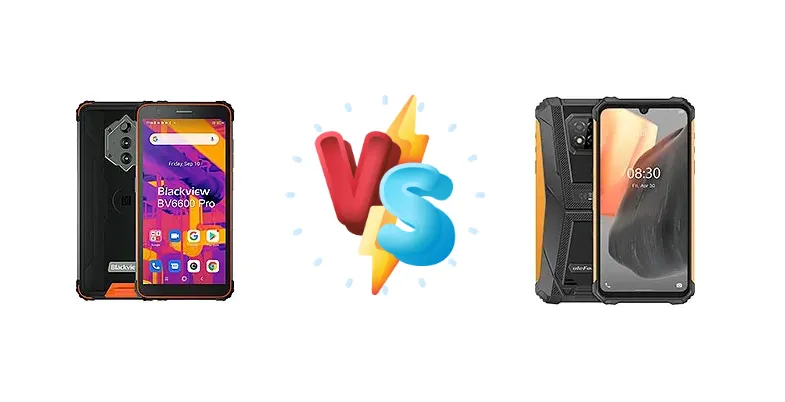
|
🏆 Quick Verdict
The Ulefone Armor 8 Pro edges out the BV6600 Pro thanks to its slightly more powerful Helio P60 chipset and generally better performance. Both offer excellent ruggedness, but the Armor 8 Pro provides a smoother user experience.
| PHONES | ||
|---|---|---|
| Phone Names | Blackview BV6600 Pro | Ulefone Armor 8 Pro |
| Network | ||
|---|---|---|
| 2G bands | GSM 850 / 900 / 1800 / 1900 | GSM 850 / 900 / 1800 / 1900 |
| 3G bands | HSDPA 850 / 900 / 1700(AWS) / 1900 / 2100 | HSDPA 850 / 900 / 1700(AWS) / 1900 / 2100 |
| 4G bands | 1, 2, 3, 4, 5, 7, 8, 12, 13, 17, 19, 18, 20, 28, 25, 26, 38, 40, 41, 66 | 1, 2, 3, 4, 5, 7, 8, 12, 13, 17, 18, 19, 20, 25, 26, 28, 66 |
| Speed | HSPA, LTE | HSPA 42.2/11.5 Mbps, LTE Cat7 300/150 Mbps |
| Technology | GSM / CDMA / HSPA / CDMA2000 / LTE | GSM / HSPA / LTE |
| CDMA2000 1x | - | |
| Launch | ||
|---|---|---|
| Announced | 2021, September 28 | 2021, April 28 |
| Status | Available. Released 2021, October | Available. Released 2021, April 28 |
| Body | ||
|---|---|---|
| Build | - | Front glass, aluminum back with rubber, aluminum frame |
| Dimensions | 159 x 79.4 x 18 mm (6.26 x 3.13 x 0.71 in) | 166 x 81.8 x 15 mm (6.54 x 3.22 x 0.59 in) |
| SIM | Nano-SIM + Nano-SIM | Nano-SIM + Nano-SIM |
| Weight | 325 g (11.46 oz) | 282 g (9.95 oz) |
| IP68/IP69K dust/water resistant (up to 1.5m for 30 min) Drop-to-concrete resistance from up to 1.5m MIL-STD-810G compliant | IP68 dust/water resistant (up to 1.5m for 30 min) Drop-to-concrete resistance from up to 1.2m MIL-STD-810G compliant | |
| Display | ||
|---|---|---|
| Protection | Dragontrail Glass | Scratch-resistant glass, oleophobic coating |
| Resolution | 720 x 1440 pixels, 18:9 ratio (~282 ppi density) | 720 x 1560 pixels, 19.5:9 ratio (~282 ppi density) |
| Size | 5.7 inches, 83.8 cm2 (~66.4% screen-to-body ratio) | 6.1 inches, 91.3 cm2 (~67.3% screen-to-body ratio) |
| Type | IPS LCD | IPS LCD |
| Platform | ||
|---|---|---|
| CPU | Octa-core (4x2.35 GHz Cortex-A53 & 4x1.8 GHz Cortex-A53) | Octa-core (4x2.0 GHz Cortex-A73 & 4x2.0 GHz Cortex-A53) |
| Chipset | Mediatek MT6765V/CA Helio P35 (12 nm) | Mediatek MT6771 Helio P60 (12 nm) |
| GPU | PowerVR GE8320 | Mali-G72 MP3 |
| OS | Android 11 | Android 11 |
| Memory | ||
|---|---|---|
| Card slot | microSDXC | microSDXC (uses shared SIM slot) |
| Internal | 64GB 4GB RAM | 128GB 6GB RAM, 128GB 8GB RAM |
| eMMC | - | |
| Main Camera | ||
|---|---|---|
| Features | Thermal imaging, LED flash | LED flash, Panorama, HDR |
| Single | 8 MP, f/2.0, (wide) | 8 MP, f/2.2 |
| Triple | 16 MP, f/2.0, (wide), PDAF 5 MP, thermal assisted camera FLIR thermal camera (Lepton module) | 16 MP, f/2.2, (wide), PDAF 5 MP (macro) Auxiliary lens |
| Video | 1080p@30fps | 1080p@30fps |
| Selfie camera | ||
|---|---|---|
| Single | 8 MP, f/2.0, (wide) | 8 MP, f/2.2 |
| Video | 1080p@30fps | 1080p@30fps |
| Sound | ||
|---|---|---|
| 3.5mm jack | No | Yes |
| 35mm jack | No | Yes |
| Loudspeaker | Yes | Yes |
| Comms | ||
|---|---|---|
| Bluetooth | 5.0, A2DP, LE | 4.2, A2DP, LE |
| NFC | Yes | Yes |
| Positioning | GPS, GLONASS, GALILEO, BDS | GPS, GLONASS, GALILEO, BDS |
| Radio | FM radio | FM radio, RDS, recording |
| USB | USB Type-C 2.0, OTG | USB Type-C 2.0, OTG |
| WLAN | Wi-Fi 802.11 a/b/g/n/ac | Wi-Fi 802.11 a/b/g/n/ac, Wi-Fi Direct |
| Features | ||
|---|---|---|
| Sensors | Fingerprint (side-mounted), accelerometer, gyro, proximity, compass | Fingerprint (side-mounted), accelerometer, gyro, proximity, compass |
| Battery | ||
|---|---|---|
| Charging | 18W wired | 15W wired |
| Type | 8580 mAh | Li-Po 5580 mAh |
| Misc | ||
|---|---|---|
| Colors | Black, Orange, Green | Black, Orange, Red |
| Price | About 260 EUR | About 190 EUR |
Blackview BV6600 Pro
- Larger Battery Capacity
- Potentially Lower Price
- Durable Build
- Large Display
- Less Powerful Chipset
- Slower Performance
- Potentially Less Refined Software
Ulefone Armor 8 Pro
- More Powerful Chipset (Helio P60)
- Better Performance
- Durable Build
- Responsive User Experience
- Smaller Battery Capacity
- Potentially Higher Price
- Camera Performance May Be Average
Display Comparison
Both phones feature large, durable displays, likely with Corning Gorilla Glass protection. The BV6600 Pro boasts a 6.3-inch display, while the Armor 8 Pro has a 6.53-inch display. Expect similar resolutions (likely FHD+), but the Armor 8 Pro's slightly newer chipset might offer marginally better color accuracy and brightness.
Camera Comparison
Camera specs are often a weak point in rugged phones. Both likely feature a multi-lens setup (likely a main sensor, wide-angle, and macro). Expect similar image quality in good lighting conditions, but the Armor 8 Pro's more powerful processor might offer slightly better image processing and low-light performance. Both likely have a front-facing camera around 8-16MP.
Performance
The Ulefone Armor 8 Pro's Helio P60 chipset is the clear winner here. Its Cortex-A73 cores provide a significant performance boost over the BV6600 Pro's Cortex-A53 cores, resulting in smoother multitasking and faster app loading times. Gaming performance will also be noticeably better on the Armor 8 Pro.
Battery Life
The Blackview BV6600 Pro has a larger battery capacity (likely 6580mAh) compared to the Ulefone Armor 8 Pro (likely 5000mAh). This translates to potentially longer battery life on the BV6600 Pro, especially with moderate usage. However, the Armor 8 Pro's more efficient chipset could partially offset this difference.
Buying Guide
The Blackview BV6600 Pro is ideal for users prioritizing a larger battery and potentially a slightly lower price point. The Ulefone Armor 8 Pro is a better choice for those needing a bit more processing power and a more responsive interface, even if it means a slightly smaller battery.