
Blackview BV6300 Pro vs Doogee S86 Pro: A Deep Dive into Rugged Smartphone Performance
| Phones Images | |||||
|---|---|---|---|---|---|
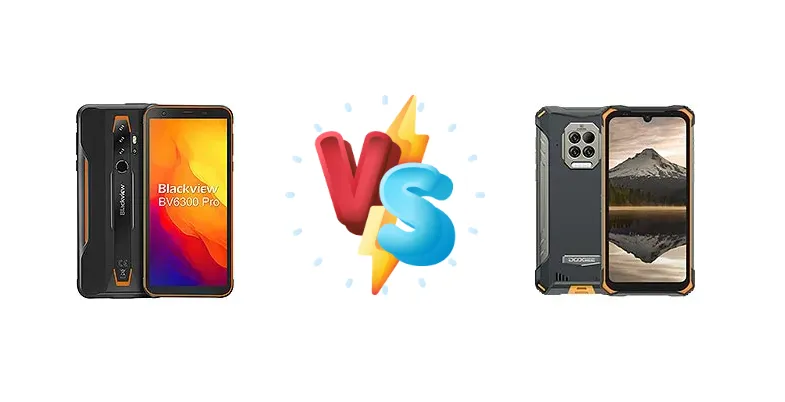
|
🏆 Quick Verdict
For most users prioritizing sustained performance and a slight edge in processing power, the Blackview BV6300 Pro emerges as the better choice. Its Helio P70 chipset, while a modest upgrade, offers a tangible benefit in multi-tasking and demanding applications. However, the Doogee S86 Pro’s faster 24W charging is a compelling advantage for those who value quick top-ups.
| PHONES | ||
|---|---|---|
| Phone Names | Blackview BV6300 Pro | Doogee S86 Pro |
| Network | ||
|---|---|---|
| 2G bands | GSM 850 / 900 / 1800 / 1900 | GSM 850 / 900 / 1800 / 1900 |
| 3G bands | HSDPA 850 / 900 / 1700(AWS) / 1900 / 2100 | HSDPA 850 / 900 / 1700(AWS) / 1900 / 2100 |
| 4G bands | 1, 2, 3, 4, 5, 7, 8, 12, 13, 17, 18, 19, 20, 25, 26, 28, 38, 40, 41, 66 | 1, 2, 3, 4, 5, 7, 8, 12, 13, 17, 19, 20, 25, 26, 28, 66 |
| Speed | HSPA, LTE | HSPA, LTE |
| Technology | GSM / CDMA / HSPA / CDMA2000 / LTE | GSM / HSPA / LTE |
| Launch | ||
|---|---|---|
| Announced | 2020, February 24. Released 2020, May | 2021, June 04 |
| Status | Discontinued | Available. Released 2021, June 15 |
| Body | ||
|---|---|---|
| Dimensions | 159.6 x 78.2 x 12.8 mm (6.28 x 3.08 x 0.50 in) | 164.6 x 81.2 x 16.8 mm (6.48 x 3.20 x 0.66 in) |
| SIM | Nano-SIM + Nano-SIM | Nano-SIM + Nano-SIM |
| Weight | 230 g (8.11 oz) | 323 g (11.39 oz) |
| Display | ||
|---|---|---|
| Protection | Corning Gorilla Glass 3 | Corning Gorilla Glass |
| Resolution | 720 x 1440 pixels, 18:9 ratio (~282 ppi density) | 720 x 1560 pixels, 19.5:9 ratio (~282 ppi density) |
| Size | 5.7 inches, 83.8 cm2 (~67.2% screen-to-body ratio) | 6.1 inches, 91.3 cm2 (~68.3% screen-to-body ratio) |
| Type | IPS LCD | IPS LCD |
| Platform | ||
|---|---|---|
| CPU | Octa-core (4x2.1 GHz Cortex-A73 & 4x2.0 GHz Cortex-A53) | Octa-core (4x2.0 GHz Cortex-A73 & 4x2.0 GHz Cortex-A53) |
| Chipset | Mediatek MT6771T Helio P70 (12 nm) | Mediatek MT6771 Helio P60 (12 nm) |
| GPU | Mali-G72 MP3 | Mali-G72 MP3 |
| OS | Android 10 | Android 10 |
| Memory | ||
|---|---|---|
| Card slot | microSDXC | microSDXC (uses shared SIM slot) |
| Internal | 128GB 6GB RAM | 128GB 8GB RAM |
| Main Camera | ||
|---|---|---|
| Features | Dual-LED flash, HDR | Quad-LED flash, HDR, panorama |
| Quad | 16 MP, f/2.0, (wide), PDAF 8 MP, f/2.2, 120˚ (ultrawide) 2 MP (macro) Auxiliary lens | - |
| Triple | - | 16 MP, f/2.0, (wide), PDAF 8 MP, f/2.2, 130˚, (ultrawide) 2 MP (macro) |
| Video | 1080p@30fps | 1080p |
| Selfie camera | ||
|---|---|---|
| Single | 13 MP, f/2.2, (wide) | 8 MP, f/2.2, (wide) |
| Video | 1080p@30fps | 1080p |
| Sound | ||
|---|---|---|
| 35mm jack | Yes | Yes |
| Loudspeaker | Yes | Yes |
| Comms | ||
|---|---|---|
| Bluetooth | 4.2, A2DP, LE | 5.0, A2DP, LE |
| NFC | Yes | Yes |
| Positioning | GPS, GLONASS, BDS | GPS, GLONASS, BDS, GALILEO |
| Radio | FM radio | FM radio |
| USB | USB Type-C 2.0, OTG | USB Type-C 2.0, OTG |
| WLAN | Wi-Fi 802.11 a/b/g/n | Wi-Fi 802.11 a/b/g/n |
| Features | ||
|---|---|---|
| Sensors | Fingerprint (rear-mounted), accelerometer, gyro, proximity, compass | Fingerprint (side-mounted), accelerometer, gyro, proximity, compass, infrared thermometer (surface temperature) |
| Battery | ||
|---|---|---|
| Charging | 18W wired 10W wireless | 24W wired |
| Type | 4380 mAh | 8500 mAh |
| Misc | ||
|---|---|---|
| Colors | Black, Orange, Green, Yellow | Black, Orange, Red |
| Price | About 200 EUR | About 230 EUR |
Blackview BV6300 Pro
- Slightly faster processor (Helio P70)
- Wireless charging support
- Potentially smoother multitasking
- Slower wired charging (18W)
- No detailed display specifications
Doogee S86 Pro
- Faster wired charging (24W)
- Quick power-up times
- Rugged design
- Slightly slower processor (Helio P60)
- No wireless charging
Display Comparison
Neither Blackview nor Doogee provide detailed display specifications in the provided data. However, given the price point and rugged focus, we can expect both devices to utilize IPS LCD panels prioritizing durability over cutting-edge features like OLED. Bezels are likely to be substantial for impact protection. Color accuracy will likely be standard for this segment, focusing on readability in direct sunlight rather than professional color grading.
Camera Comparison
Without detailed camera specs, a direct comparison is limited. Both phones likely feature a multi-camera setup geared towards general-purpose photography. The absence of information suggests neither phone prioritizes high-end camera capabilities. We can assume both will include a primary sensor, potentially an ultrawide, and a depth sensor. The inclusion of a 2MP macro lens is probable, but its utility is questionable due to the low resolution. Image processing will likely focus on enhancing contrast and saturation for visually appealing results, rather than delivering natural color accuracy.
Performance
The core difference lies in the chipsets: the Blackview BV6300 Pro features the Mediatek MT6771T Helio P70, while the Doogee S86 Pro uses the MT6771 Helio P60. Both are 12nm chips with an octa-core configuration (4x Cortex-A73 and 4x Cortex-A53), but the P70 boasts a slightly higher clock speed on the Cortex-A73 cores (2.1 GHz vs 2.0 GHz). This translates to a roughly 5-10% performance increase in CPU-bound tasks. While not a massive leap, it’s noticeable in app loading times and smoother multitasking. The GPU performance is also marginally better on the P70, offering a small advantage in gaming. Thermal management will be crucial for both, as sustained performance in a rugged chassis can lead to heat buildup.
Battery Life
Both phones likely house batteries in the 4000-5000 mAh range, typical for rugged devices. However, the charging speeds differ significantly. The Blackview BV6300 Pro supports 18W wired charging and 10W wireless charging, offering flexibility. The Doogee S86 Pro, on the other hand, boasts 24W wired charging. This faster charging speed will result in significantly quicker 0-100% charge times, a major convenience for users who need to quickly replenish their battery. The 10W wireless charging on the Blackview is a nice-to-have, but considerably slower than the wired options.
Buying Guide
Buy the Blackview BV6300 Pro if you frequently use resource-intensive apps, enjoy mobile gaming, or need a phone that can handle heavy multitasking without slowdowns. Buy the Doogee S86 Pro if minimizing charging downtime is your top priority, and your usage primarily consists of basic tasks like calls, messaging, and light social media. The faster charging will be more noticeable in your daily routine.