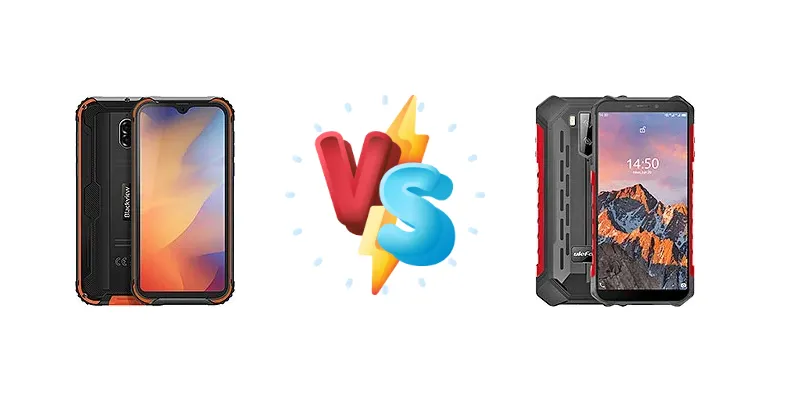
The Blackview BV5900 and Ulefone Armor X5 Pro represent the entry-level segment of the rugged smartphone market. Both aim to provide durability without breaking the bank, but they differ significantly in internal hardware. This comparison dissects those differences to determine which device delivers the best value for users prioritizing resilience and affordability.
🏆 Quick Verdict
For most users, the Ulefone Armor X5 Pro is the better choice. While both offer 10W charging and rugged builds, the X5 Pro’s Helio P22 chipset with its octa-core CPU provides a noticeable performance advantage over the BV5900’s quad-core Helio A22, making it more capable for multitasking and demanding applications.
| Network |
|---|
| 2G bands | GSM 850 / 900 / 1800 / 1900 | GSM 850 / 900 / 1800 / 1900 |
| 3G bands | HSDPA 850 / 1900 / 900 / 1800 | HSDPA 850 / 900 / 1700(AWS) / 1900 / 2100 |
| 4G bands | 1, 3, 7, 8, 20, 40 | 1, 2, 3, 4, 5, 7, 8, 12, 13, 17, 19, 20, 28 |
| Speed | HSPA, LTE | HSPA 42.2/11.5 Mbps, LTE Cat7 300/150 Mbps |
| Technology | GSM / HSPA / LTE | GSM / HSPA / LTE |
| Launch |
|---|
| Announced | 2019, August 14. Released 2019, August | 2020, September 08. Released 2020, September 08 |
| Status | Discontinued | Discontinued |
| Body |
|---|
| Dimensions | 159 x 80 x 15 mm (6.26 x 3.15 x 0.59 in) | 158 x 77.5 x 13.9 mm (6.22 x 3.05 x 0.55 in) |
| SIM | Nano-SIM + Nano-SIM | Nano-SIM + Nano-SIM |
| Weight | 268 g (9.45 oz) | 235 g (8.29 oz) |
| | - | IP68 dust/water resistant (up to 1.5m for 30 min)
Drop-to-concrete resistance from up to 1.2m
MIL-STD-810G compliant |
| Display |
|---|
| Resolution | 720 x 1520 pixels, 19:9 ratio (~295 ppi density) | 720 x 1440 pixels, 18:9 ratio (~293 ppi density) |
| Size | 5.7 inches, 81.1 cm2 (~63.8% screen-to-body ratio) | 5.5 inches, 78.1 cm2 (~63.8% screen-to-body ratio) |
| Type | IPS LCD | IPS LCD |
| Platform |
|---|
| CPU | Quad-core 2.0 GHz Cortex-A53 | Octa-core 2.0 GHz Cortex-A53 |
| Chipset | Mediatek MT6761 Helio A22 (12 nm) | Mediatek MT6762V/WD Helio P22 (12 nm) |
| GPU | PowerVR GE8320 | PowerVR GE8320 |
| OS | Android 9.0 (Pie) | Android 10 |
| Memory |
|---|
| Card slot | microSD | microSDXC (uses shared SIM slot) |
| Internal | 32GB 3GB RAM | 64GB 4GB RAM |
| | - | eMMC 5.1 |
| Main Camera |
|---|
| Dual | 13 MP, f/2.2, (wide), AF
0.3 MP, f/2.8 | 13 MP, f/2.0, (wide), PDAF
Auxiliary lens |
| Features | LED flash | LED flash, Panorama, HDR |
| Video | 1080p@30fps | 1080p@30fps |
| Selfie camera |
|---|
| Single | 5 MP, f/2.2, (wide) | 5 MP, f/2.2 |
| Video | Yes | - |
| Sound |
|---|
| 3.5mm jack | - | Yes |
| 35mm jack | Yes | Yes |
| Loudspeaker | Yes | Yes |
| Comms |
|---|
| Bluetooth | 4.2, A2DP | 5.0, A2DP, LE |
| NFC | Yes | No |
| Positioning | GPS, GLONASS, GALILEO, BDS | GPS, GLONASS, GALILEO, BDS |
| Radio | FM radio | FM radio, RDS, recording |
| USB | USB Type-C 2.0, OTG | microUSB 2.0 |
| WLAN | Wi-Fi 802.11 a/b/g/n | Wi-Fi 802.11 a/b/g/n/ac, Wi-Fi Direct |
| Features |
|---|
| Sensors | Fingerprint (side-mounted), accelerometer, gyro, proximity, compass | Accelerometer, proximity, compass |
| Battery |
|---|
| Charging | 10W wired | 10W wired |
| Type | 5580 mAh | Li-Po 5000 mAh |
| Misc |
|---|
| Colors | Black, Orange, Green | Black, Orange, Red |
| Price | About 80 EUR | About 110 EUR |
Blackview BV5900
- Ultra-affordable price point
- Rugged build quality for basic protection
- Simple and straightforward user experience
- Significantly weaker processor performance
- Limited multitasking capabilities
- Slow app loading times
Ulefone Armor X5 Pro
- Octa-core processor for improved performance
- Better multitasking and app responsiveness
- Slightly more modern chipset
- Still limited by budget components
- 10W charging is relatively slow
- Camera quality likely basic
Display Comparison
Neither Blackview nor Ulefone provide detailed display specifications beyond resolution. However, given the price point, both likely utilize IPS LCD panels. The real difference lies within the processing power driving them. While both will suffice for basic viewing, the X5 Pro’s more capable chipset will contribute to smoother scrolling and faster app loading times, indirectly improving the display experience.
Camera Comparison
Detailed camera specs are unavailable, but both phones likely feature basic camera setups geared towards functionality rather than photography excellence. Given the market segment, expect a primary sensor and potentially a depth or macro lens on both. The image processing capabilities will be limited by the chipsets. The Ulefone Armor X5 Pro’s more powerful processor *could* offer slightly faster image processing times, but the sensor quality will be the primary determinant of image quality. Focusing on the primary sensor resolution would be more impactful than analyzing the often-useless 2MP macro lenses commonly found in this price range.
Performance
The core distinction between these devices is the chipset. The Ulefone Armor X5 Pro’s MediaTek Helio P22 (MT6762V/WD) is a significant upgrade over the Blackview BV5900’s Helio A22 (MT6761). The P22 boasts an octa-core CPU clocked at 2.0 GHz, compared to the A22’s quad-core configuration, also at 2.0 GHz. This translates to substantially better multitasking and application performance. While both are Cortex-A53 based, the increased core count on the P22 allows for more parallel processing, resulting in a smoother user experience, especially when switching between apps. Both are built on a 12nm process, so thermal efficiency differences will be minimal, but the P22 will complete tasks faster, reducing sustained load.
Battery Life
Both devices feature 10W wired charging, indicating a similar charging experience – relatively slow by modern standards. Battery capacity isn’t specified, but typical rugged phones in this class range from 4000mAh to 5000mAh. The Ulefone Armor X5 Pro’s more efficient chipset, despite having more cores, may offer slightly better battery life due to completing tasks faster and spending more time in idle states. However, the difference will likely be marginal, and real-world battery life will heavily depend on usage patterns.
Buying Guide
Buy the Blackview BV5900 if you need a truly basic, ultra-affordable rugged phone for essential communication and minimal app usage. It’s ideal for those prioritizing extreme durability over performance. Buy the Ulefone Armor X5 Pro if you prefer a more responsive user experience, better multitasking capabilities, and a slightly more modern chipset, even within the budget rugged category. It’s suited for users who need to run more apps or occasionally play light games.
Frequently Asked Questions
❓ Will the Ulefone Armor X5 Pro struggle with demanding games like PUBG Mobile?
While the Helio P22 can handle some gaming, PUBG Mobile will likely require the lowest graphics settings and may still experience occasional frame drops. It's not a gaming-focused device, but it's capable of light gaming better than the BV5900.
❓ Is the Blackview BV5900 suitable for someone who primarily uses their phone for calls and texts?
Absolutely. The BV5900 excels as a basic communication device. Its rugged build ensures durability, and the Helio A22 is sufficient for making calls, sending texts, and using essential apps like a contacts list.
❓ How does the 10W charging affect the daily usability of both phones?
10W charging is slow. Expect a full charge to take around 3-4 hours. This means you'll need to charge overnight or during extended periods of inactivity. It's a compromise for the rugged design and affordability.
❓ Are these phones easily repairable if the screen cracks or the battery fails?
Repairability is a mixed bag. While rugged phones are designed to withstand drops, damage can still occur. Finding official repair services might be challenging, but independent repair shops specializing in Android devices should be able to handle common issues. Blackview and Ulefone both offer some parts availability, but it varies.