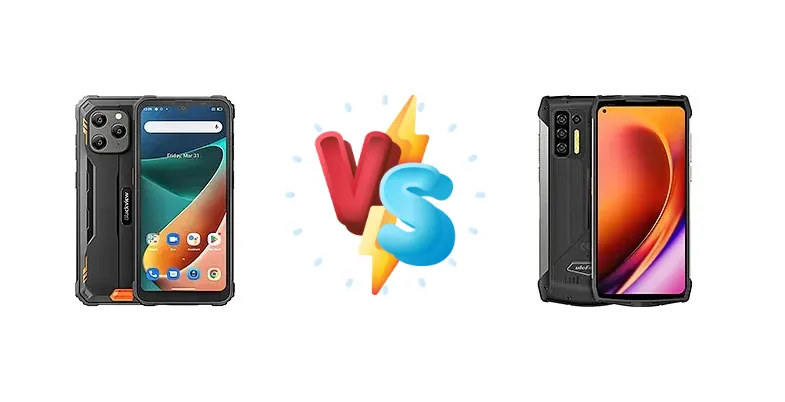
The rugged smartphone market caters to a specific need: durability. Both the Blackview BV5300 Pro and the Ulefone Power Armor 13 aim to deliver on that promise, but they diverge significantly in their approach to performance and battery technology. This comparison dissects these differences to determine which device best suits your needs, from extended fieldwork to simply surviving daily life.
🏆 Quick Verdict
For the average user prioritizing longevity and fast charging, the Ulefone Power Armor 13 is the better choice. While the Blackview BV5300 Pro boasts impressive battery endurance in lab tests, the Ulefone’s Helio G95 chipset and 33W charging offer a more responsive user experience and quicker power-ups, outweighing the Blackview’s longer theoretical runtime.
| Network |
|---|
| 2G bands | GSM 850 / 900 / 1800 / 1900 | GSM 850 / 900 / 1800 / 1900 |
| 3G bands | HSDPA 900 / 2100 | HSDPA 850 / 900 / 1700(AWS) / 1900 / 2100 |
| 4G bands | 1, 3, 7, 8, 19, 20, 28, 40 | 1, 2, 3, 4, 5, 7, 8, 12, 13, 17, 18, 19, 20, 25, 26, 28, 38, 40, 66 |
| Speed | HSPA, LTE | HSPA 42.2/11.5 Mbps, LTE Cat12 600/150 Mbps |
| Technology | GSM / HSPA / LTE | GSM / HSPA / LTE |
| Launch |
|---|
| Announced | 2023, May | 2021, July 22 |
| Status | Available. Released 2023, May | Available. Released 2021, July 26 |
| Body |
|---|
| Dimensions | 161.5 x 77.6 x 15 mm (6.36 x 3.06 x 0.59 in) | 183.7 x 85.4 x 20.8 mm (7.23 x 3.36 x 0.82 in) |
| SIM | Nano-SIM + Nano-SIM | Nano-SIM + Nano-SIM |
| Weight | 273 g (9.63 oz) | 492 g (1.08 lb) |
| | - | IP68 dust/water resistant (up to 1.5m for 30 min)
Drop-to-concrete resistance from up to 1.2m
MIL-STD-810G compliant |
| Display |
|---|
| Protection | Mohs level 5 | Corning Gorilla Glass 3 |
| Resolution | 720 x 1560 pixels, 19.5:9 ratio (~282 ppi density) | 1080 x 2400 pixels, 20:9 ratio (~386 ppi density) |
| Size | 6.1 inches, 91.3 cm2 (~72.9% screen-to-body ratio) | 6.81 inches, 112.0 cm2 (~71.4% screen-to-body ratio) |
| Type | IPS LCD, 500 nits | IPS LCD |
| Platform |
|---|
| CPU | Octa-core (4x2.35 GHz Cortex-A53 & 4x1.8 GHz Cortex-A53) | Octa-core (2x2.05 GHz Cortex-A76 & 6x2.0 GHz Cortex-A55) |
| Chipset | Mediatek MT6765 Helio P35 (12 nm) | Mediatek MT6785V/CD Helio G95 (12 nm) |
| GPU | PowerVR GE8320 | Mali-G76 MC4 |
| OS | Android 12, DokeOS 3.1 | Android 11 |
| Memory |
|---|
| Card slot | microSDXC (dedicated slot) | microSDXC (uses shared SIM slot) |
| Internal | 64GB 4GB RAM | 256GB 8GB RAM |
| Main Camera |
|---|
| Features | LED flash, HDR, panorama | Quad-LED flash, HDR, panorama |
| Penta | - | 48 MP, f/1.8, 26mm (wide), 1/2.0", 0.8µm, PDAF
8 MP, f/2.2, (ultrawide)
2 MP (macro)
Auxiliary lens |
| Triple | 13 MP, (wide), 1/3.06", PDAF
other unspecified cameras | - |
| Video | 1080p@30fps | 4K@30fps, 1080p@30fps |
| Selfie camera |
|---|
| Features | - | HDR, panorama |
| Single | 8 MP | 16 MP, f/2.2 |
| Video | Yes | 1080p@30fps |
| Sound |
|---|
| 3.5mm jack | - | Yes |
| 35mm jack | No | Yes |
| Loudspeaker | Yes | Yes |
| Comms |
|---|
| Bluetooth | 5.0, A2DP, LE | 5.0, A2DP, LE |
| NFC | Yes | Yes |
| Positioning | GPS, GLONASS, GALILEO, BDS | GPS, GLONASS, GALILEO, BDS |
| Radio | FM radio | FM radio, RDS, recording |
| USB | USB Type-C 2.0, OTG | - |
| WLAN | Wi-Fi 802.11 a/b/g/n/ac, dual-band | Wi-Fi 802.11 a/b/g/n/ac, dual-band |
| Features |
|---|
| Sensors | Accelerometer, proximity, compass | Fingerprint (side-mounted), accelerometer, gyro, proximity, compass, baroceptor, coulombmeter |
| | - | Infrared distance measure (error range: 1~20m, ±10mm; 20~40m, ±25mm) |
| Battery |
|---|
| Charging | 10W wired
2.5W reverse wired | 33W wired
15W wireless
5W reverse wireless |
| Type | 6580 mAh | Li-Po 13200 mAh |
| Misc |
|---|
| Colors | Black, Orange, Green | Black |
| Price | About 110 EUR | About 300 EUR |
| Tests |
|---|
| Battery life | - |
Endurance rating 296h
|
| Camera | - |
Photo / Video |
| Display | - |
Contrast ratio: 1306:1 (nominal) |
| Loudspeaker | - |
-28.3 LUFS (Average)
|
| Performance | - |
AnTuTu: 294194 (v8), 351678 (v9)
GeekBench: 1610 (v5.1)
GFXBench: 18fps (ES 3.1 onscreen) |
| EU LABEL |
|---|
| Battery | 59:23h endurance, 1000 cycles | - |
| Energy | Class B | - |
| Free fall | Class A (270 falls) | - |
| Repairability | Class C | - |
Blackview BV5300 Pro
- Exceptional battery endurance (59:23h)
- Long battery lifespan (1000 cycles)
- Potentially lower cost due to older chipset
- Slow 10W charging
- Less powerful Helio P35 chipset
- Likely slower app loading and multitasking
Ulefone Power Armor 13
- Faster Helio G95 chipset for smoother performance
- 33W wired and 15W wireless charging
- Brighter display (401 nits)
- Shorter battery endurance (296h)
- Potentially higher price
- No detailed camera specifications
Display Comparison
The Ulefone Power Armor 13 features a display with a measured peak brightness of 401 nits and a 1306:1 contrast ratio. While the Blackview BV5300 Pro’s display specifications are not provided, the Ulefone’s brightness is a significant advantage for outdoor visibility. Both share the same contrast ratio, suggesting similar panel technology, but the Ulefone’s higher brightness makes it more practical in direct sunlight. The lack of refresh rate information for both devices suggests standard 60Hz panels, prioritizing battery life over visual fluidity.
Camera Comparison
Both devices list 'Photo / Video' capabilities, but lack specific details regarding sensor size, aperture, or image processing. This suggests a focus on basic functionality rather than photographic excellence. Without further information, it’s difficult to assess camera quality. However, the Ulefone’s more powerful chipset could potentially enable more sophisticated image processing algorithms, leading to better results. The absence of details suggests neither phone will compete with dedicated camera phones.
Performance
The Ulefone Power Armor 13’s Mediatek Helio G95 chipset represents a substantial leap in performance over the Blackview BV5300 Pro’s Helio P35. The G95 utilizes a more modern CPU architecture – Cortex-A76 cores versus the P35’s Cortex-A53 – resulting in significantly faster processing speeds. The G95’s octa-core configuration (2x2.05 GHz Cortex-A76 & 6x2.0 GHz Cortex-A55) is optimized for gaming and multitasking, while the P35 (4x2.35 GHz Cortex-A53 & 4x1.8 GHz Cortex-A53) is geared towards efficiency. This translates to a noticeably snappier experience on the Ulefone, especially when running demanding applications.
Battery Life
The Blackview BV5300 Pro claims an impressive 59:23h endurance rating and a 1000-cycle battery lifespan, suggesting exceptional longevity. However, this is achieved with a slower 10W charging speed. The Ulefone Power Armor 13, while reporting a shorter 296h endurance, compensates with significantly faster charging options: 33W wired, 15W wireless, and 5W reverse wireless. This means the Ulefone can be rapidly topped up when needed, a crucial advantage for users on the go. The Ulefone’s wireless charging capability is also a notable convenience feature absent in the Blackview.
Buying Guide
Buy the Blackview BV5300 Pro if you absolutely need the longest possible battery life between charges and are willing to sacrifice processing power and charging speed. This phone is ideal for users in remote locations with limited access to power. Buy the Ulefone Power Armor 13 if you prioritize a smoother, more responsive user experience, faster charging, and a brighter display, making it better suited for everyday use and media consumption, even in outdoor conditions.
Frequently Asked Questions
❓ Does the Ulefone Power Armor 13’s Helio G95 chipset generate excessive heat during prolonged gaming sessions?
The Helio G95 is known for its balance of performance and thermal efficiency. While it will generate heat under heavy load, its architecture is designed to manage temperatures effectively, minimizing throttling. The Ulefone’s rugged design likely incorporates heat dissipation features to further mitigate thermal issues, making it a more suitable choice for mobile gaming than the Blackview BV5300 Pro.
❓ How does the 10W charging on the Blackview BV5300 Pro impact real-world usability?
10W charging is significantly slower than the 33W offered by the Ulefone. Expect a full charge to take several hours, potentially overnight. This is acceptable if you primarily charge overnight, but inconvenient if you need a quick top-up during the day. The Ulefone’s faster charging is a major advantage for users who frequently need to replenish their battery.
❓ What type of USB port do both phones use, and does this affect charging speeds?
Both phones likely utilize USB-C, the current standard. However, the charging speed is dictated by the Power Delivery (PD) protocol supported by the device and charger. The Ulefone Power Armor 13 supports faster PD charging, allowing it to take full advantage of the 33W adapter, while the Blackview BV5300 Pro is limited to 10W even with a more powerful charger.