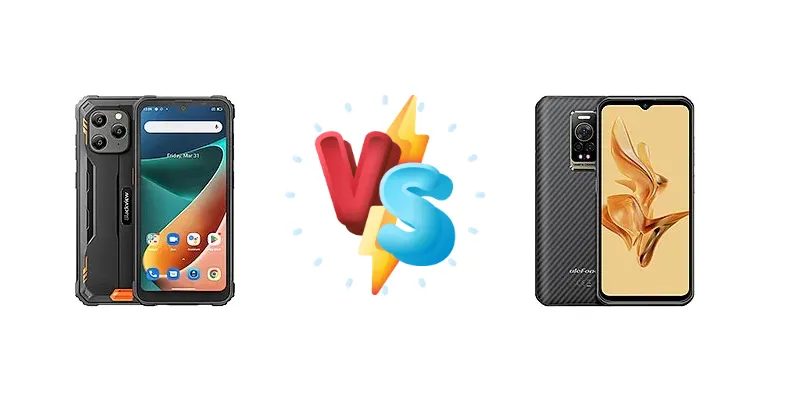
The rugged phone market caters to a specific need: durability. However, within this niche, priorities diverge. The Blackview BV5300 Pro focuses on maximizing battery life and affordability, while the Ulefone Armor 17 Pro aims for a significant performance upgrade with a modern chipset and faster charging, representing a shift towards more capable rugged devices.
🏆 Quick Verdict
For the average user prioritizing longevity and cost-effectiveness, the Blackview BV5300 Pro remains a solid choice. However, the Ulefone Armor 17 Pro’s Helio G99 chipset and 66W charging deliver a demonstrably faster and more responsive experience, making it the better option for power users and those demanding more from their rugged phone.
| Network |
|---|
| 2G bands | GSM 850 / 900 / 1800 / 1900 | GSM 850 / 900 / 1800 / 1900 |
| 3G bands | HSDPA 900 / 2100 | HSDPA 800 / 850 / 900 / 1700(AWS) / 1900 / 2100 |
| 4G bands | 1, 3, 7, 8, 19, 20, 28, 40 | 1, 2, 3, 4, 5, 7, 8, 12, 13, 17, 18, 19, 20, 25, 26, 28, 34, 38, 39, 40, 41, 66 |
| Speed | HSPA, LTE | HSPA, LTE |
| Technology | GSM / HSPA / LTE | GSM / HSPA / LTE |
| Launch |
|---|
| Announced | 2023, May | 2022, October 31 |
| Status | Available. Released 2023, May | Available. Released 2022, October 31 |
| Body |
|---|
| Dimensions | 161.5 x 77.6 x 15 mm (6.36 x 3.06 x 0.59 in) | 172.7 x 80.4 x 12.5 mm (6.80 x 3.17 x 0.49 in) |
| SIM | Nano-SIM + Nano-SIM | Nano-SIM + Nano-SIM |
| Weight | 273 g (9.63 oz) | 290 g (10.23 oz) |
| | - | IP68/IP69K dust/water resistant (up to 1.5m for 30 min)
Drop-to-concrete resistance from up to 1.5m
MIL-STD-810G compliant |
| Display |
|---|
| Protection | Mohs level 5 | Corning Gorilla Glass 5 |
| Resolution | 720 x 1560 pixels, 19.5:9 ratio (~282 ppi density) | 1080 x 2408 pixels, 20:9 ratio (~401 ppi density) |
| Size | 6.1 inches, 91.3 cm2 (~72.9% screen-to-body ratio) | 6.58 inches, 104.3 cm2 (~75.1% screen-to-body ratio) |
| Type | IPS LCD, 500 nits | IPS LCD, 120Hz |
| Platform |
|---|
| CPU | Octa-core (4x2.35 GHz Cortex-A53 & 4x1.8 GHz Cortex-A53) | Octa-core (2x2.2 GHz Cortex-A76 & 6x2.0 GHz Cortex-A55) |
| Chipset | Mediatek MT6765 Helio P35 (12 nm) | Mediatek Helio G99 (6 nm) |
| GPU | PowerVR GE8320 | Mali-G57 MC2 |
| OS | Android 12, DokeOS 3.1 | Android 12 |
| Memory |
|---|
| Card slot | microSDXC (dedicated slot) | microSDXC (dedicated slot) |
| Internal | 64GB 4GB RAM | 256GB 8GB RAM |
| Main Camera |
|---|
| Features | LED flash, HDR, panorama | Triple-LED flash, HDR, panorama |
| Single | - | 16 MP, f/2.2, (wide), 1.0µm |
| Triple | 13 MP, (wide), 1/3.06", PDAF
other unspecified cameras | 108 MP, f/1.9, (wide), 1/1.52”, 0.7µm, PDAF
8 MP, f/2.2, 119˚, (ultrawide), 1/4.0", 1.12µm
8 MP, (night vision), 2 infrared night vision lights |
| Video | 1080p@30fps | 1440p@30fps, 1080p@30fps |
| Selfie camera |
|---|
| Single | 8 MP | 16 MP, f/2.2, (wide), 1.0µm |
| Video | Yes | 1080p@30fps |
| Sound |
|---|
| 3.5mm jack | - | Yes |
| 35mm jack | No | Yes |
| Loudspeaker | Yes | Yes |
| Comms |
|---|
| Bluetooth | 5.0, A2DP, LE | 5.2, A2DP, LE |
| NFC | Yes | Yes |
| Positioning | GPS, GLONASS, GALILEO, BDS | GPS, GLONASS, GALILEO, BDS |
| Radio | FM radio | Wireless FM radio, RDS, recording |
| USB | USB Type-C 2.0, OTG | USB Type-C 2.0, OTG |
| WLAN | Wi-Fi 802.11 a/b/g/n/ac, dual-band | Wi-Fi 802.11 a/b/g/n/ac, dual-band |
| Features |
|---|
| Sensors | Accelerometer, proximity, compass | Fingerprint (side-mounted), accelerometer, gyro, proximity, compass |
| | - | MagSafe compatible accessories |
| Battery |
|---|
| Charging | 10W wired
2.5W reverse wired | 66W wired, 53% in 15 min
15W wireless
Wireless reversed |
| Type | 6580 mAh | Li-Po 5380 mAh |
| Misc |
|---|
| Colors | Black, Orange, Green | Black |
| Price | About 110 EUR | About 260 EUR |
| EU LABEL |
|---|
| Battery | 59:23h endurance, 1000 cycles | - |
| Energy | Class B | - |
| Free fall | Class A (270 falls) | - |
| Repairability | Class C | - |
Blackview BV5300 Pro
- Exceptional battery endurance (59:23h)
- High charge cycle count (1000 cycles)
- More affordable price point
- Outdated Helio P35 chipset
- Slow 10W charging
- Limited performance for demanding tasks
Ulefone Armor 17 Pro
- Modern Helio G99 chipset for improved performance
- Ultra-fast 66W wired charging
- Wireless charging and reverse wireless charging
- Potentially lower battery endurance compared to BV5300 Pro
- Higher price point
- May run warmer under heavy load
Display Comparison
Display specifications are not provided, but given the price points, both likely utilize IPS LCD panels. The key difference will be resolution and brightness. The Armor 17 Pro, being newer, may benefit from improved color calibration. However, without specific data, it's difficult to assess the viewing experience beyond speculation. Expect both to prioritize durability over display fidelity.
Camera Comparison
Camera details are limited. However, the chipset difference suggests the Armor 17 Pro will have a more capable image signal processor (ISP), leading to better image processing and potentially improved low-light performance. Without sensor size or aperture information, it’s impossible to definitively declare a winner, but the G99’s processing power gives Ulefone a clear advantage. The presence of a 2MP macro lens on either device is unlikely to significantly impact image quality.
Performance
The Ulefone Armor 17 Pro’s Mediatek Helio G99 (6nm) represents a substantial leap over the Blackview BV5300 Pro’s Helio P35 (12nm). The G99’s Cortex-A76 cores, clocked at 2.2 GHz, offer significantly higher single-core performance than the P35’s Cortex-A53 cores (2.35 GHz). The 6nm process also translates to improved power efficiency. This means the Armor 17 Pro will handle demanding apps and games with greater ease and less thermal throttling. The P35 is adequate for basic tasks, but will struggle with resource-intensive applications.
Battery Life
The Blackview BV5300 Pro boasts impressive endurance with 59:23h of usage, and a claimed 1000 charge cycles, suggesting a focus on long-term battery health. However, the Ulefone Armor 17 Pro compensates for potentially lower endurance with its 66W wired charging, capable of reaching 53% charge in just 15 minutes. This drastically reduces downtime. The Armor 17 Pro also offers 15W wireless charging and reverse wireless charging, features absent on the BV5300 Pro’s 10W wired charging system. The faster charging speed is a significant convenience factor.
Buying Guide
Buy the Blackview BV5300 Pro if you need a dependable, long-lasting phone for basic tasks and infrequent use in harsh environments, and your budget is a primary concern. Buy the Ulefone Armor 17 Pro if you prefer a smoother, more responsive experience for gaming, multitasking, and demanding applications, and you value fast charging and a more modern chipset.
Frequently Asked Questions
❓ Does the Ulefone Armor 17 Pro’s Helio G99 chipset generate excessive heat during prolonged gaming sessions?
While the Helio G99 is a capable chipset, its thermal performance will depend on the Armor 17 Pro’s cooling solution. The 6nm process is more efficient than the P35, but sustained gaming will still generate heat. Expect some throttling, but likely less than the BV5300 Pro due to the G99’s superior architecture.
❓ How does the 66W charging on the Ulefone Armor 17 Pro compare to the 10W charging on the Blackview BV5300 Pro in real-world usage?
The difference is dramatic. The Ulefone can gain a substantial charge in a short period – 53% in 15 minutes – while the Blackview will take hours to fully charge. This makes the Armor 17 Pro ideal for users who need to quickly top up their battery before heading out.
❓ Is the 1000 charge cycle claim for the Blackview BV5300 Pro realistic, and what does it mean for long-term battery health?
1000 charge cycles is a significant claim. It suggests the battery is designed to retain a substantial portion of its capacity after that many full charge/discharge cycles. However, actual battery degradation will also depend on usage patterns and environmental factors. It's a strong indicator of long-term reliability.