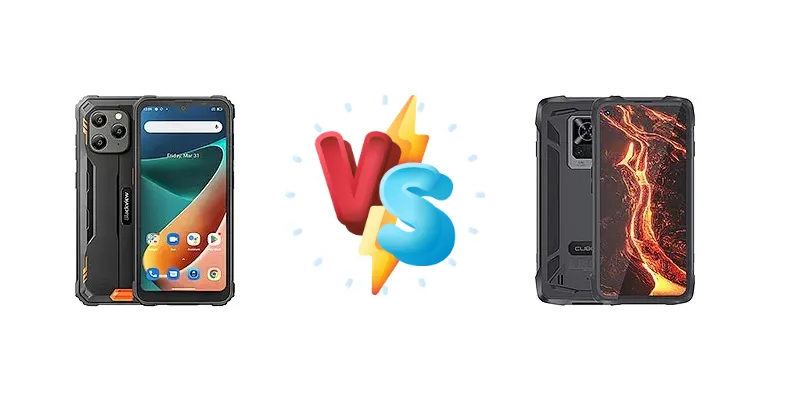
The rugged smartphone market caters to a specific need: durability. Both the Blackview BV5300 Pro and Cubot KingKong 7 aim to deliver on that promise, but they differ significantly in their internal hardware. This comparison dissects those differences, focusing on how they translate to real-world performance and user experience, particularly concerning processing power and battery longevity.
🏆 Quick Verdict
For the average user prioritizing long-term battery life and consistent, if not blazing-fast, performance, the Blackview BV5300 Pro is the better choice. Its exceptional 59:23h endurance significantly outweighs the Cubot KingKong 7’s slightly more powerful chipset, especially given the similar price points.
| Network |
|---|
| 2G bands | GSM 850 / 900 / 1800 / 1900 | GSM 850 / 900 / 1800 / 1900 |
| 3G bands | HSDPA 900 / 2100 | HSDPA 850 / 900 / 1700(AWS) / 1900 / 2100 |
| 4G bands | 1, 3, 7, 8, 19, 20, 28, 40 | 1, 2, 3, 4, 5, 7, 8, 12, 13, 17, 18, 19, 20, 25, 26, 28, 38, 40, 41, 66 |
| Speed | HSPA, LTE | HSPA, LTE |
| Technology | GSM / HSPA / LTE | GSM / CDMA / HSPA / LTE |
| Launch |
|---|
| Announced | 2023, May | 2022 |
| Status | Available. Released 2023, May | Available. Released 2022 |
| Body |
|---|
| Dimensions | 161.5 x 77.6 x 15 mm (6.36 x 3.06 x 0.59 in) | 166.8 x 83.5 x 14 mm (6.57 x 3.29 x 0.55 in) |
| SIM | Nano-SIM + Nano-SIM | Nano-SIM + Nano-SIM |
| Weight | 273 g (9.63 oz) | 267 g (9.42 oz) |
| Display |
|---|
| Protection | Mohs level 5 | - |
| Resolution | 720 x 1560 pixels, 19.5:9 ratio (~282 ppi density) | 1080 x 2300 pixels (~400 ppi density) |
| Size | 6.1 inches, 91.3 cm2 (~72.9% screen-to-body ratio) | 6.36 inches, 100.4 cm2 (~72.1% screen-to-body ratio) |
| Type | IPS LCD, 500 nits | IPS LCD |
| Platform |
|---|
| CPU | Octa-core (4x2.35 GHz Cortex-A53 & 4x1.8 GHz Cortex-A53) | Octa-core (4x2.0 GHz Cortex-A73 & 4x2.0 GHz Cortex-A53) |
| Chipset | Mediatek MT6765 Helio P35 (12 nm) | Mediatek MT6771V/CA Helio P60 (12 nm) |
| GPU | PowerVR GE8320 | Mali-G72 MP3 |
| OS | Android 12, DokeOS 3.1 | Android 11 |
| Memory |
|---|
| Card slot | microSDXC (dedicated slot) | microSDXC (uses shared SIM slot) |
| Internal | 64GB 4GB RAM | 128GB 8GB RAM |
| Main Camera |
|---|
| Features | LED flash, HDR, panorama | LED flash |
| Triple | 13 MP, (wide), 1/3.06", PDAF
other unspecified cameras | 64 MP, (wide), AF
16 MP, (ultrawide)
5 MP (macro) |
| Video | 1080p@30fps | Yes |
| Selfie camera |
|---|
| Single | 8 MP | 32 MP |
| Video | Yes | Yes |
| Sound |
|---|
| 35mm jack | No | Unspecified |
| Loudspeaker | Yes | Yes |
| Comms |
|---|
| Bluetooth | 5.0, A2DP, LE | 4.2, A2DP |
| NFC | Yes | Yes |
| Positioning | GPS, GLONASS, GALILEO, BDS | GPS, GLONASS, BDS |
| Radio | FM radio | Unspecified |
| USB | USB Type-C 2.0, OTG | USB Type-C, OTG |
| WLAN | Wi-Fi 802.11 a/b/g/n/ac, dual-band | Wi-Fi 802.11 a/b/g/n |
| Features |
|---|
| Sensors | Accelerometer, proximity, compass | Fingerprint (rear-mounted), accelerometer, gyro, proximity, compass |
| Battery |
|---|
| Charging | 10W wired
2.5W reverse wired | - |
| Type | 6580 mAh | 5000 mAh |
| Misc |
|---|
| Colors | Black, Orange, Green | Black |
| Price | About 110 EUR | - |
| EU LABEL |
|---|
| Battery | 59:23h endurance, 1000 cycles | - |
| Energy | Class B | - |
| Free fall | Class A (270 falls) | - |
| Repairability | Class C | - |
Blackview BV5300 Pro
- Exceptional battery life (59:23h endurance)
- Reliable performance for everyday tasks
- Potential for 1000 charge cycles, increasing longevity
- Slow 10W charging
- Less powerful CPU compared to the competition
Cubot KingKong 7
- More powerful Helio P60 chipset
- Potentially smoother multitasking and app launches
- Modern CPU architecture
- Likely shorter battery life
- May experience more thermal throttling under sustained load
Display Comparison
Neither device's display specifications are provided, so a direct comparison is limited. However, given their price bracket, both likely utilize IPS LCD panels. The focus here will be on the impact of the chipsets on display responsiveness. The more powerful GPU in the KingKong 7 *could* translate to smoother scrolling and animations, but this is heavily dependent on software optimization. Bezels are likely comparable, and color accuracy will be standard for this segment.
Camera Comparison
Without detailed camera specifications, a thorough comparison is impossible. Both phones likely feature multiple rear cameras, but image quality will depend heavily on sensor size and image processing. The presence of a 2MP macro camera on either device is largely a marketing tactic, offering minimal practical benefit. The chipset’s ISP (Image Signal Processor) plays a role, and the P60 in the KingKong 7 *may* offer slightly better image processing capabilities, but this is speculative without further data.
Performance
The Cubot KingKong 7 boasts the Mediatek MT6771V/CA Helio P60, featuring a more modern CPU architecture with 4x2.0 GHz Cortex-A73 cores alongside 4x2.0 GHz Cortex-A53 cores. This contrasts with the Blackview BV5300 Pro’s MT6765 Helio P35, which uses 4x2.35 GHz Cortex-A53 and 4x1.8 GHz Cortex-A53 cores. While the P35 has higher clocked A53 cores, the A73 cores in the P60 offer significantly better single-core performance, resulting in snappier app launches and improved multitasking. The P60’s architecture is a generation ahead, offering a noticeable advantage in CPU-intensive tasks. However, the P35’s efficiency contributes to the BV5300 Pro’s exceptional battery life.
Battery Life
This is where the Blackview BV5300 Pro truly shines. Its reported 59:23h endurance is exceptional for a rugged phone, and significantly surpasses what is typically expected from a 4000-5000mAh battery (estimated capacity based on segment). The Cubot KingKong 7’s battery capacity is unknown, but its Helio P60 chipset, while more powerful, is also less power-efficient. The BV5300 Pro’s 10W charging is slow by modern standards, but the extended battery life mitigates this drawback. The 2.5W reverse wired charging on the BV5300 Pro is a niche feature, useful for topping up small accessories.
Buying Guide
Buy the Blackview BV5300 Pro if you need a phone that can genuinely last for days on a single charge, and your usage primarily involves everyday tasks like communication, navigation, and light media consumption. Buy the Cubot KingKong 7 if you prioritize slightly faster application loading times and occasional gaming, and are willing to compromise on overall battery endurance. Both are excellent choices for outdoor workers or adventurers, but their strengths cater to different priorities.
Frequently Asked Questions
❓ Will the Cubot KingKong 7 struggle with demanding games like PUBG Mobile?
The Helio P60 is capable of running PUBG Mobile, but likely at medium settings to maintain a stable frame rate. Expect some frame drops during intense action. The Blackview BV5300 Pro’s Helio P35 will likely require even lower settings and may not provide a consistently smooth gaming experience.
❓ How does the Blackview BV5300 Pro’s battery life hold up with GPS navigation and frequent calls?
The BV5300 Pro’s exceptional battery life is its key strength. Even with heavy GPS usage and frequent calls, you can expect a full day of use, and potentially two days with moderate usage. The efficient Helio P35 chipset and optimized software contribute to this impressive endurance.
❓ Is the reverse wired charging on the Blackview BV5300 Pro useful in real-world scenarios?
The 2.5W reverse wired charging is primarily useful for topping up small accessories like Bluetooth earbuds or a smartwatch in an emergency. It’s not designed to quickly charge another phone.
❓ Are both phones adequately protected against water and dust?
Both devices are marketed as rugged phones, implying IP68 or IP69K certification. However, without official confirmation, it's crucial to verify the specific ingress protection rating before exposing the phones to water or dust. Ruggedness standards can vary.