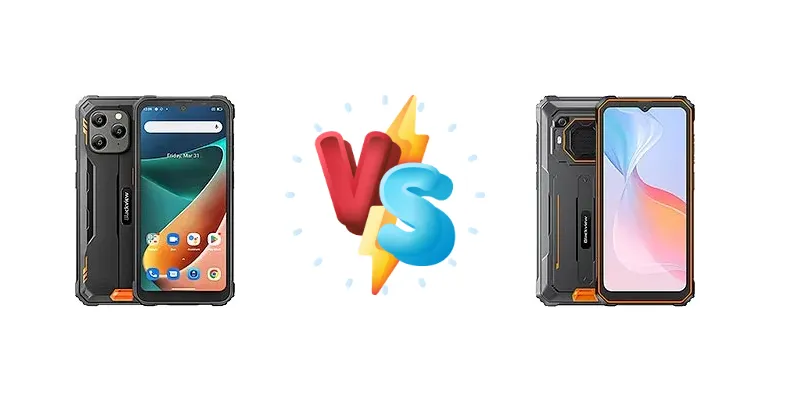
Blackview has carved a niche for itself in the rugged smartphone market, offering durable devices at competitive prices. The BV5300 Pro and BV6200 Pro represent two compelling options, but cater to different priorities. The BV5300 Pro focuses on maximizing battery longevity, while the BV6200 Pro prioritizes faster charging, despite both utilizing the same Mediatek Helio P35 chipset. This comparison dives deep into the specifics to determine which device best suits your needs.
🏆 Quick Verdict
For the average user prioritizing all-day (and multi-day) battery life, the Blackview BV6200 Pro is the clear winner. Its significantly longer 126:18h endurance, coupled with 18W fast charging, outweighs the BV5300 Pro’s 1000 charge cycle claim. While the BV5300 Pro offers respectable endurance, the BV6200 Pro’s superior battery performance is a game-changer for those frequently away from power outlets.
| Network |
|---|
| 2G bands | GSM 850 / 900 / 1800 / 1900 | GSM 850 / 900 / 1800 / 1900 |
| 3G bands | HSDPA 900 / 2100 | HSDPA 900 / 2100 |
| 4G bands | 1, 3, 7, 8, 19, 20, 28, 40 | 1, 3, 7, 8, 20, 40 |
| Speed | HSPA, LTE | HSPA, LTE |
| Technology | GSM / HSPA / LTE | GSM / HSPA / LTE |
| Launch |
|---|
| Announced | 2023, May | 2023, July |
| Status | Available. Released 2023, May | Available. Released 2023, July |
| Body |
|---|
| Dimensions | 161.5 x 77.6 x 15 mm (6.36 x 3.06 x 0.59 in) | 174.4 x 82 x 19.2 mm (6.87 x 3.23 x 0.76 in) |
| SIM | Nano-SIM + Nano-SIM | Nano-SIM + Nano-SIM |
| Weight | 273 g (9.63 oz) | 438 g (15.45 oz) |
| Display |
|---|
| Protection | Mohs level 5 | Mohs level 7 |
| Resolution | 720 x 1560 pixels, 19.5:9 ratio (~282 ppi density) | 720 x 1612 pixels, 20:9 ratio (~269 ppi density) |
| Size | 6.1 inches, 91.3 cm2 (~72.9% screen-to-body ratio) | 6.56 inches, 103.4 cm2 (~72.3% screen-to-body ratio) |
| Type | IPS LCD, 500 nits | IPS LCD |
| Platform |
|---|
| CPU | Octa-core (4x2.35 GHz Cortex-A53 & 4x1.8 GHz Cortex-A53) | Octa-core (4x2.35 GHz Cortex-A53 & 4x1.8 GHz Cortex-A53) |
| Chipset | Mediatek MT6765 Helio P35 (12 nm) | Mediatek MT6765 Helio P35 (12 nm) |
| GPU | PowerVR GE8320 | PowerVR GE8320 |
| OS | Android 12, DokeOS 3.1 | Android 13, Doke OS 3.1 |
| Memory |
|---|
| Card slot | microSDXC (dedicated slot) | microSDXC (dedicated slot) |
| Internal | 64GB 4GB RAM | 128GB 4GB RAM |
| Main Camera |
|---|
| Dual | - | 13 MP
0.3 MP |
| Features | LED flash, HDR, panorama | LED flash |
| Triple | 13 MP, (wide), 1/3.06", PDAF
other unspecified cameras | - |
| Video | 1080p@30fps | 1080p@30fps |
| Selfie camera |
|---|
| Single | 8 MP | 8 MP |
| Video | Yes | 1080p@30fps |
| Sound |
|---|
| 35mm jack | No | No |
| Loudspeaker | Yes | Yes |
| Comms |
|---|
| Bluetooth | 5.0, A2DP, LE | 5.0, A2DP, LE |
| NFC | Yes | Yes |
| Positioning | GPS, GLONASS, GALILEO, BDS | GPS, GLONASS, GALILEO, BDS |
| Radio | FM radio | FM radio |
| USB | USB Type-C 2.0, OTG | USB Type-C, OTG |
| WLAN | Wi-Fi 802.11 a/b/g/n/ac, dual-band | Wi-Fi 802.11 a/b/g/n/ac, dual-band |
| Features |
|---|
| Sensors | Accelerometer, proximity, compass | Fingerprint (side-mounted), accelerometer, proximity, compass |
| Battery |
|---|
| Charging | 10W wired
2.5W reverse wired | 18W wired
Reverse wired |
| Type | 6580 mAh | 13000 mAh |
| Misc |
|---|
| Colors | Black, Orange, Green | Black, Orange, Green |
| Price | About 110 EUR | - |
| EU LABEL |
|---|
| Battery | 59:23h endurance, 1000 cycles | 126:18h endurance, 500 cycles |
| Energy | Class B | Class B |
| Free fall | Class A (270 falls) | Class A (276 falls) |
| Repairability | Class C | Class C |
Blackview BV5300 Pro
- Longer battery cycle life (1000 cycles)
- Rugged design for durability
- Affordable price point
- Significantly shorter battery endurance (59:23h)
- Slower 10W charging
- Lacks reverse wireless charging
Blackview BV6200 Pro
- Exceptional battery endurance (126:18h)
- Faster 18W charging
- Includes reverse wired charging
- Fewer battery charge cycles (500 cycles)
- Rugged design may be bulky
- Potentially higher price
Display Comparison
Both devices share the same Mediatek Helio P35 chipset, suggesting similar display capabilities. However, specific display specs (resolution, panel type, brightness) are not provided. Given the price point, we can assume both utilize IPS LCD panels. The lack of information prevents a detailed comparison, but the focus here is clearly on durability rather than display fidelity.
Camera Comparison
Camera specifications are not detailed beyond the presence of cameras. Given the market segment, we can anticipate basic camera performance suitable for casual snapshots. The absence of information regarding sensor size, aperture, or image stabilization makes a meaningful comparison impossible. It's likely both phones feature a multi-camera setup, but image quality will likely be similar and not a key differentiating factor.
Performance
Both the BV5300 Pro and BV6200 Pro are powered by the Mediatek MT6765 Helio P35 (12 nm) chipset, featuring an octa-core CPU configuration (4x2.35 GHz Cortex-A53 & 4x1.8 GHz Cortex-A53). This indicates identical processing power for everyday tasks like browsing, social media, and light app usage. Performance will be similar, with neither phone excelling in demanding applications or gaming. The 12nm process node suggests reasonable thermal efficiency, but sustained heavy workloads may still lead to throttling.
Battery Life
The battery is where the BV6200 Pro truly shines. Its 126:18h endurance is more than double the BV5300 Pro’s 59:23h. This translates to significantly longer usage between charges, a critical advantage for a rugged phone intended for outdoor use. While the BV5300 Pro boasts 1000 battery cycles, the BV6200 Pro’s 18W wired charging (compared to the BV5300 Pro’s 10W) drastically reduces the time needed to replenish the battery, mitigating the lower cycle count. The BV6200 Pro also offers 2.5W reverse wired charging, a feature absent on the BV5300 Pro, allowing it to top up smaller accessories.
Buying Guide
Buy the Blackview BV5300 Pro if you need extreme longevity and are willing to sacrifice charging speed. This phone is ideal for users who frequently work in remote locations or engage in extended outdoor activities where access to power is limited. Buy the Blackview BV6200 Pro if you prefer quicker top-ups and value a more modern charging experience, even if it means slightly fewer battery charge cycles. This is the better choice for users who want a balance of endurance and convenience.
Frequently Asked Questions
❓ Does the Mediatek Helio P35 chipset struggle with modern app performance on either device?
The Helio P35 is an entry-level chipset. While adequate for basic tasks like calls, texts, and social media, both the BV5300 Pro and BV6200 Pro will exhibit slowdowns with demanding apps or multitasking. Expect limited gaming performance beyond casual titles.
❓ What does '500 charge cycles' or '1000 charge cycles' actually mean for the battery's lifespan?
A charge cycle is completed when you've used 100% of the battery capacity. So, using 50% of the battery twice equals one cycle. After the stated number of cycles, the battery's capacity will degrade, meaning it won't hold as much charge as it did when new. The BV5300 Pro's higher cycle count suggests it will maintain a usable capacity for a longer period, but the BV6200 Pro's superior initial endurance mitigates this concern for many users.
❓ Is the reverse wired charging on the BV6200 Pro useful for accessories like Bluetooth headphones?
Yes, the 2.5W reverse wired charging on the BV6200 Pro can provide a slow but convenient top-up for accessories like Bluetooth headphones, smartwatches, or even another phone in an emergency. It's not a fast charging solution, but it can be helpful when a power outlet isn't available.