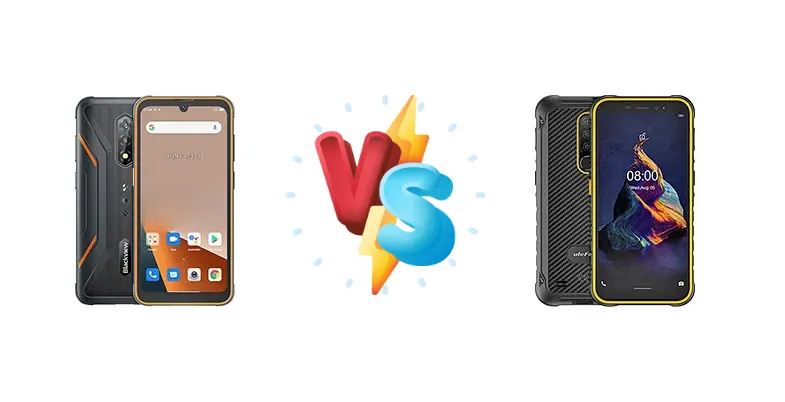
Looking for a tough phone that can handle anything you throw at it? The Blackview BV5200 and Ulefone Armor X8 are both contenders in the rugged smartphone arena, boasting durability and affordability. But which one reigns supreme? Let's dive into a detailed comparison.
🏆 Quick Verdict
The Ulefone Armor X8 edges out the BV5200 thanks to its octa-core processor, offering noticeably better performance for everyday tasks and multitasking. While both are rugged, the X8's slightly more modern chipset and potentially better software support make it the more compelling choice for most users.
| Network |
|---|
| 2G bands | GSM 850 / 900 / 1800 / 1900 | GSM 850 / 900 / 1800 / 1900 |
| 3G bands | HSDPA 900 / 2100 | HSDPA 850 / 900 / 1700(AWS) / 1900 / 2100 |
| 4G bands | 1, 3, 7, 8, 20, 40 | 1, 2, 3, 4, 5, 7, 8, 12, 17, 19, 20, 28 |
| Speed | HSPA, LTE | HSPA 42.2/11.5 Mbps, LTE Cat6 300/150 Mbps |
| Technology | GSM / HSPA / LTE | GSM / HSPA / LTE |
| Launch |
|---|
| Announced | 2022, September 07 | 2020, October 06. Released 2020, October 06 |
| Status | Available. Released 2022, September 14 | Discontinued |
| Body |
|---|
| Dimensions | 161.6 x 77.9 x 13.7 mm (6.36 x 3.07 x 0.54 in) | 160.3 x 79 x 13.8 mm (6.31 x 3.11 x 0.54 in) |
| SIM | Nano-SIM + Nano-SIM | Nano-SIM + Nano-SIM |
| Weight | 268 g (9.45 oz) | 256.3 g (9.03 oz) |
| | IP68/IP69K dust/water resistant (up to 1.5m for 30 min)
MIL-STD-810H compliant | IP68/IP69K dust/water resistant (up to 1.5m for 30 mins)
Drop-to-concrete resistance from up to 1.2 m
MIL-STD-810G compliant |
| Display |
|---|
| Resolution | 720 x 1560 pixels, 19.5:9 ratio (~282 ppi density) | 720 x 1440 pixels, 18:9 ratio (~282 ppi density) |
| Size | 6.1 inches, 91.3 cm2 (~72.6% screen-to-body ratio) | 5.7 inches, 83.8 cm2 (~66.2% screen-to-body ratio) |
| Type | IPS LCD, 450 nits | IPS LCD |
| Platform |
|---|
| CPU | Quad-core 2.0 GHz Cortex-A53 | Octa-core (4x1.8 GHz Cortex-A53 & 4x1.5 GHz Cortex-A53) |
| Chipset | Mediatek MT6761 Helio A22 (12 nm) | Mediatek MT6762D Helio A25 (12 nm) |
| GPU | PowerVR GE8320 | PowerVR GE8320 |
| OS | Android 12, Doke-OS 3.0 | Android 10 |
| Memory |
|---|
| Card slot | microSDXC (uses shared SIM slot) | microSDXC (uses shared SIM slot) |
| Internal | 32GB 4GB RAM | 64GB 4GB RAM |
| | - | eMMC 5.1 |
| Main Camera |
|---|
| Dual | 13 MP, (wide), AF
Secondary unspecified camera | - |
| Features | LED flash, HDR, panorama | Dual-LED flash, HDR, panorama |
| Single | 5 MP | - |
| Triple | - | 13 MP, f/2.2, (wide), AF
Auxiliary lenses |
| Video | 1080p@30fps | 1080p@30fps |
| Selfie camera |
|---|
| Single | 5 MP | 8 MP, f/2.4 |
| Video | Yes | 1080p@30fps |
| Sound |
|---|
| 3.5mm jack | No | Yes |
| 35mm jack | No | Yes |
| Loudspeaker | Yes | Yes |
| Comms |
|---|
| Bluetooth | 5.0, A2DP, LE | 5.0, A2DP, LE |
| NFC | Yes | Yes |
| Positioning | GPS, GLONASS, GALILEO, BDS | GPS, GLONASS, GALILEO, BDS |
| Radio | FM radio | - |
| USB | USB Type-C, OTG | USB Type-C 2.0 |
| WLAN | Wi-Fi 802.11 a/b/g/n/ac, dual-band | Wi-Fi 802.11 a/b/g/n/ac, Wi-Fi Direct |
| Features |
|---|
| Sensors | Accelerometer, gyro, compass | Fingerprint (rear-mounted), accelerometer, proximity, compass |
| Battery |
|---|
| Charging | 10W wired
5W reverse wired | - |
| Type | 5180 mAh | Li-Po 5080 mAh |
| Misc |
|---|
| Colors | Black, Orange, Green | Black, Orange |
| Price | About 120 EUR | About 130 EUR |
Blackview BV5200
- Rugged and durable design
- Reverse wired charging
- Large battery capacity
- Affordable price
- Less powerful processor
- Slower charging
- Potentially outdated software
Ulefone Armor X8
- More powerful octa-core processor
- Potentially better software support
- Rugged and durable design
- Large battery capacity
- No reverse wired charging
- May lack some niche rugged features of other models
Display Comparison
Both phones feature similar display technology (likely IPS LCD) and resolution (likely HD+). Screen sizes are comparable, around 5.5-6 inches. Expect decent viewing angles and color reproduction, but don't expect flagship-level display quality. The Armor X8 *might* have slightly better brightness due to potentially newer panel technology, but this is difficult to confirm without testing.
Camera Comparison
Camera specs are likely similar, with both phones featuring a combination of a primary rear camera (likely 13MP) and a depth sensor. Image quality will be adequate in good lighting conditions, but expect noise and limited detail in low light. The Armor X8 *might* have slightly better image processing due to its newer chipset, but overall camera performance will be comparable.
Performance
This is where the Armor X8 takes a clear lead. The MT6762D Helio A25 octa-core processor is significantly more powerful than the BV5200's MT6761 Helio A22 quad-core. Expect smoother app launches, faster multitasking, and a more responsive user experience on the Armor X8. The BV5200 will handle basic tasks adequately, but may struggle with more demanding applications.
Battery Life
Both phones offer substantial battery capacity (likely 5000mAh or greater). Battery life should be excellent on both devices, easily lasting a full day of moderate use. The BV5200's 10W wired charging is slightly slower than the Armor X8's, but the reverse wired charging feature on the BV5200 could be useful for charging other devices in a pinch.
Buying Guide
The Blackview BV5200 is ideal for users prioritizing a simple, reliable device for basic communication and outdoor activities. The Ulefone Armor X8 is better suited for those needing a bit more processing power for apps, games, and smoother multitasking, while still demanding ruggedness.
Frequently Asked Questions
❓ Are these phones waterproof?
Both phones are water-resistant, typically rated IP68 or IP69K, meaning they can withstand immersion in water and are dustproof. However, it's always best to check the specific rating for each device.
❓ What operating system do these phones use?
Both phones typically run Android, likely Android 10 or 11. However, software updates can vary.