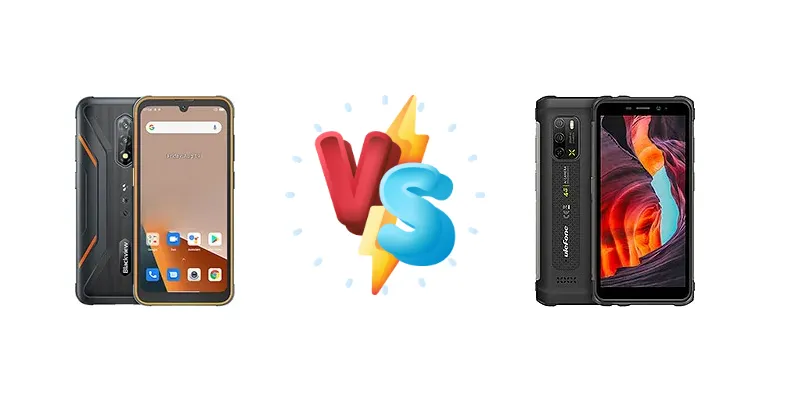
The Blackview BV5200 and Ulefone Armor X10 Pro represent the entry-level segment of the rugged smartphone market, catering to users needing durability without a flagship price tag. Both devices boast robust builds, but diverge significantly in their internal hardware, particularly in their chipset choices. This comparison will dissect those differences to determine which phone delivers the best value for users prioritizing performance and longevity.
🏆 Quick Verdict
For the average user needing a dependable, rugged phone for basic tasks, the Ulefone Armor X10 Pro emerges as the better choice. Its Helio P22 chipset, featuring an octa-core CPU, provides a noticeable performance advantage over the BV5200’s quad-core Helio A22, translating to smoother multitasking and app responsiveness.
| Network |
|---|
| 2G bands | GSM 850 / 900 / 1800 / 1900 | GSM 850 / 900 / 1800 / 1900 |
| 3G bands | HSDPA 900 / 2100 | HSDPA 850 / 900 / 1700(AWS) / 1900 / 2100 |
| 4G bands | 1, 3, 7, 8, 20, 40 | 1, 2, 3, 4, 5, 7, 8, 12, 13, 17, 18, 19, 20, 25, 26, 28 |
| Speed | HSPA, LTE | HSPA 21/5.76 Mbps, LTE Cat6 300/150 Mbps |
| Technology | GSM / HSPA / LTE | GSM / HSPA / LTE |
| Launch |
|---|
| Announced | 2022, September 07 | 2022, March 10 |
| Status | Available. Released 2022, September 14 | Available. Released 2022, March 10 |
| Body |
|---|
| Dimensions | 161.6 x 77.9 x 13.7 mm (6.36 x 3.07 x 0.54 in) | 158.2 x 76.7 x 14.6 mm (6.23 x 3.02 x 0.57 in) |
| SIM | Nano-SIM + Nano-SIM | Nano-SIM + Nano-SIM |
| Weight | 268 g (9.45 oz) | 256 g (9.03 oz) |
| | IP68/IP69K dust/water resistant (up to 1.5m for 30 min)
MIL-STD-810H compliant | IP68/IP69K dust/water resistant (up to 1.5m for 30 min)
Drop-to-concrete resistance from up to 1.2m
MIL-STD-810G compliant |
| Display |
|---|
| Resolution | 720 x 1560 pixels, 19.5:9 ratio (~282 ppi density) | 720 x 1440 pixels, 18:9 ratio (~295 ppi density) |
| Size | 6.1 inches, 91.3 cm2 (~72.6% screen-to-body ratio) | 5.45 inches, 76.7 cm2 (~63.2% screen-to-body ratio) |
| Type | IPS LCD, 450 nits | IPS LCD |
| Platform |
|---|
| CPU | Quad-core 2.0 GHz Cortex-A53 | Octa-core 2.0 GHz Cortex-A53 |
| Chipset | Mediatek MT6761 Helio A22 (12 nm) | Mediatek MT6762 Helio P22 (12 nm) |
| GPU | PowerVR GE8320 | PowerVR GE8320 |
| OS | Android 12, Doke-OS 3.0 | Android 11 |
| Memory |
|---|
| Card slot | microSDXC (uses shared SIM slot) | microSDXC (dedicated slot) |
| Internal | 32GB 4GB RAM | 64GB 4GB RAM |
| | - | eMMC 5.1 |
| Main Camera |
|---|
| Dual | 13 MP, (wide), AF
Secondary unspecified camera | 20 MP, f/1.8, 26mm (wide), 1/2.78", 1.0µm, PDAF
Auxiliary lens |
| Features | LED flash, HDR, panorama | Dual-LED flash |
| Single | 5 MP | 5 MP, f/2.2 |
| Video | 1080p@30fps | 1080p@30fps |
| Selfie camera |
|---|
| Features | - | HDR |
| Single | 5 MP | 5 MP, f/2.2 |
| Video | Yes | 1080p@30fps |
| Sound |
|---|
| 3.5mm jack | No | Yes |
| 35mm jack | No | Yes |
| Loudspeaker | Yes | Yes |
| Comms |
|---|
| Bluetooth | 5.0, A2DP, LE | 5.0, A2DP, LE |
| NFC | Yes | Yes |
| Positioning | GPS, GLONASS, GALILEO, BDS | GPS, GLONASS, GALILEO, BDS |
| Radio | FM radio | FM radio, RDS, recording |
| USB | USB Type-C, OTG | USB Type-C 2.0, OTG |
| WLAN | Wi-Fi 802.11 a/b/g/n/ac, dual-band | Wi-Fi 802.11 a/b/g/n/ac, dual-band, Wi-Fi Direct |
| Features |
|---|
| Sensors | Accelerometer, gyro, compass | Accelerometer, proximity, compass |
| Battery |
|---|
| Charging | 10W wired
5W reverse wired | 10W wired |
| Type | 5180 mAh | Li-Po 5180 mAh |
| Misc |
|---|
| Colors | Black, Orange, Green | Black/Gray |
| Price | About 120 EUR | About 170 EUR |
Blackview BV5200
- Potentially longer battery life under minimal load.
- Lower price point (likely).
- 5W reverse wired charging.
- Significantly slower performance.
- Less responsive user experience.
- Limited multitasking capabilities.
Ulefone Armor X10 Pro
- Faster and more responsive performance.
- Better multitasking capabilities.
- Improved gaming experience (casual titles).
- Potentially slightly shorter battery life under heavy load.
- May be slightly more expensive.
- Charging speed is identical to the BV5200.
Display Comparison
Neither Blackview nor Ulefone provide detailed display specifications beyond resolution. Given the price point, both likely utilize IPS LCD panels. However, the focus here isn't display quality, but rather the processing power needed to drive it. The less demanding Helio A22 in the BV5200 will put less strain on the battery when displaying static content, but the difference will be minimal in real-world use. Bezels are expected to be substantial on both devices, typical of rugged designs prioritizing drop protection.
Camera Comparison
Detailed camera specs are unavailable, but given the market segment, expectations should be tempered. Both phones likely feature a primary camera around 8-13MP. The Ulefone Armor X10 Pro may have a slight edge due to the more powerful ISP (Image Signal Processor) integrated within the Helio P22, potentially leading to better image processing and noise reduction. The presence of a 2MP macro camera on either device is largely a marketing gimmick, offering limited practical benefit due to the low resolution and lack of optical image stabilization (OIS).
Performance
The core difference lies in the chipsets. The Ulefone Armor X10 Pro’s MediaTek Helio P22 (MT6762) is a significant upgrade over the Blackview BV5200’s Helio A22 (MT6761). The P22’s octa-core Cortex-A53 CPU, clocked at 2.0 GHz, offers substantially more processing power than the A22’s quad-core configuration, also at 2.0 GHz. While both are based on a 12nm process, the architectural advantage of eight cores versus four will be noticeable in multitasking and app loading times. The P22’s slightly more capable GPU will also provide a better experience with light gaming. Both phones will likely be paired with 3GB of RAM, further emphasizing the chipset as the primary performance differentiator.
Battery Life
Both devices support 10W wired charging, indicating similar charging speeds. While battery capacity isn't specified, the less powerful Helio A22 in the BV5200 *could* translate to slightly longer battery life under light usage scenarios. However, the more efficient processing of the P22 in the X10 Pro when handling more demanding tasks may offset this advantage. The 5W reverse wired charging on the BV5200 is a niche feature, allowing it to charge other devices, but at a very slow rate.
Buying Guide
Buy the Blackview BV5200 if you need an exceptionally affordable rugged phone primarily for calls, texts, and very light app usage, and battery life is paramount. Buy the Ulefone Armor X10 Pro if you prefer a more responsive user experience, occasionally play casual games, or require slightly faster performance for everyday tasks, even if it means a marginal trade-off in potential battery longevity.
Frequently Asked Questions
❓ Will the Ulefone Armor X10 Pro struggle with popular social media apps like Facebook and Instagram?
While the Helio P22 isn't a powerhouse, it's capable of running social media apps smoothly. You might experience slight loading times with numerous tabs open or when scrolling through image-heavy feeds, but it shouldn't be a frustrating experience for typical social media usage.
❓ Is the Blackview BV5200 suitable for running navigation apps like Google Maps for extended periods?
The Blackview BV5200’s Helio A22 chipset may struggle with prolonged navigation use. The app might become sluggish, and the phone could heat up. It's best suited for short navigation segments rather than long road trips.
❓ Can either of these phones handle basic mobile gaming, like Candy Crush or Angry Birds?
The Ulefone Armor X10 Pro will provide a noticeably better gaming experience for casual titles like Candy Crush or Angry Birds. The Helio P22’s GPU is more capable, resulting in smoother frame rates. The BV5200 can run these games, but expect lower frame rates and potential lag.
❓ How durable are these phones, and what kind of protection do they offer?
Both phones are built to withstand drops, dust, and water immersion, adhering to IP68 or IP69K standards (specific ratings vary). They feature reinforced corners and ruggedized casings. However, the level of protection is similar on both, so the chipset performance is the key differentiator.