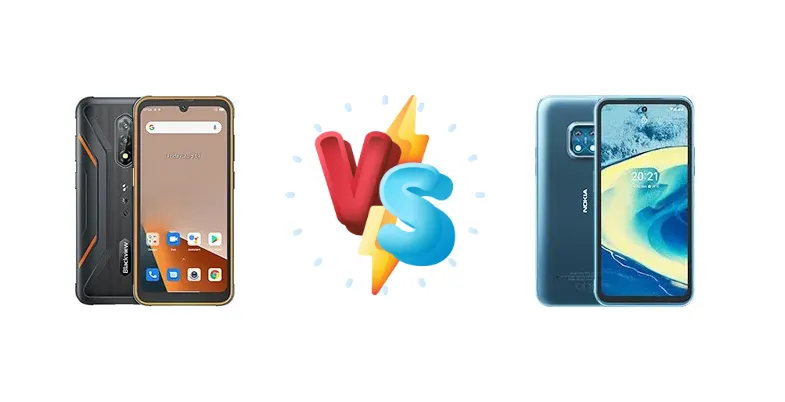
The rugged smartphone market caters to a specific need: durability. Both the Blackview BV5200 and Nokia XR20 aim to deliver on that promise, but they approach it with vastly different internal hardware and price points. This comparison dissects their strengths and weaknesses to determine which device is the better choice for users prioritizing resilience and reliability.
🏆 Quick Verdict
For the average user needing a genuinely tough phone, the Nokia XR20 is the superior choice. Its Snapdragon 480 chipset provides a significantly smoother experience and future-proofs with 5G connectivity, while the 18W wired and 15W wireless charging offer greater convenience. The BV5200 remains a viable option for those on an extremely tight budget.
| Network |
|---|
| 2G bands | GSM 850 / 900 / 1800 / 1900 | GSM 850 / 900 / 1800 / 1900 |
| 3G bands | HSDPA 900 / 2100 | HSDPA 850 / 900 / 1700(AWS) / 1900 / 2100 |
| 4G bands | 1, 3, 7, 8, 20, 40 | 1, 2, 3, 4, 5, 7, 8, 12, 13, 14, 20, 25, 26, 28, 30, 38, 40, 41, 48, 66, 71 |
| 5G bands | - | 2, 5, 25, 38, 41, 48, 66, 77, 78 SA/NSA |
| Speed | HSPA, LTE | HSPA, LTE, 5G |
| Technology | GSM / HSPA / LTE | GSM / CDMA / HSPA / EVDO / LTE / 5G |
| | - | CDMA2000 1xEV-DO |
| Launch |
|---|
| Announced | 2022, September 07 | 2021, July 27 |
| Status | Available. Released 2022, September 14 | Available. Released 2021, August 04 |
| Body |
|---|
| Dimensions | 161.6 x 77.9 x 13.7 mm (6.36 x 3.07 x 0.54 in) | 171.6 x 81.5 x 10.6 mm (6.76 x 3.21 x 0.42 in) |
| SIM | Nano-SIM + Nano-SIM | · Nano-SIM· Nano-SIM + Nano-SIM |
| Weight | 268 g (9.45 oz) | 248 g (8.75 oz) |
| | IP68/IP69K dust/water resistant (up to 1.5m for 30 min)
MIL-STD-810H compliant | IP68 dust/water resistant (up to 1.5m for 60 min)
Drop-to-concrete resistance from up to 1.8m
MIL-STD-810H compliant |
| Display |
|---|
| Protection | - | Corning Gorilla Glass Victus |
| Resolution | 720 x 1560 pixels, 19.5:9 ratio (~282 ppi density) | 1080 x 2400 pixels, 20:9 ratio (~395 ppi density) |
| Size | 6.1 inches, 91.3 cm2 (~72.6% screen-to-body ratio) | 6.67 inches, 107.4 cm2 (~76.8% screen-to-body ratio) |
| Type | IPS LCD, 450 nits | IPS LCD, 550 nits |
| Platform |
|---|
| CPU | Quad-core 2.0 GHz Cortex-A53 | Octa-core (2x2.0 GHz Kryo 460 & 6x1.8 GHz Kryo 460) |
| Chipset | Mediatek MT6761 Helio A22 (12 nm) | Qualcomm SM4350 Snapdragon 480 5G (8 nm) |
| GPU | PowerVR GE8320 | Adreno 619 |
| OS | Android 12, Doke-OS 3.0 | Android 11, upgradable to Android 13 |
| Memory |
|---|
| Card slot | microSDXC (uses shared SIM slot) | microSDXC (uses shared SIM slot) |
| Internal | 32GB 4GB RAM | 64GB 4GB RAM, 128GB 6GB RAM |
| Main Camera |
|---|
| Dual | 13 MP, (wide), AF
Secondary unspecified camera | 48 MP, f/1.8, (wide), 1/2.25", 0.8µm, PDAF
13 MP, f/2.4, 123˚ (ultrawide), 1/3.0", 1.12µm |
| Features | LED flash, HDR, panorama | Zeiss optics, Dual-LED dual-tone flash, second LED flash, HDR, panorama |
| Single | 5 MP | 8 MP, f/2.0 (wide), 1/4.0", 1.12µm |
| Video | 1080p@30fps | 1080p@30fps |
| Selfie camera |
|---|
| Single | 5 MP | 8 MP, f/2.0 (wide), 1/4.0", 1.12µm |
| Video | Yes | 1080p@30fps |
| Sound |
|---|
| 3.5mm jack | No | Yes |
| 35mm jack | No | Yes |
| Loudspeaker | Yes | Yes, with stereo speakers |
| Comms |
|---|
| Bluetooth | 5.0, A2DP, LE | 5.1, A2DP, LE, aptX Adaptive |
| NFC | Yes | Yes |
| Positioning | GPS, GLONASS, GALILEO, BDS | GPS (L1+L5), GLONASS, BDS, GALILEO, QZSS, NavIC |
| Radio | FM radio | Unspecified |
| USB | USB Type-C, OTG | USB Type-C 3.0 |
| WLAN | Wi-Fi 802.11 a/b/g/n/ac, dual-band | Wi-Fi 802.11 a/b/g/n/ac/6, dual-band, Wi-Fi Direct |
| Features |
|---|
| Sensors | Accelerometer, gyro, compass | Fingerprint (side-mounted), accelerometer, gyro, proximity, compass, barometer |
| Battery |
|---|
| Charging | 10W wired
5W reverse wired | 18W wired
15W wireless |
| Type | 5180 mAh | Li-Po 4630 mAh |
| Misc |
|---|
| Colors | Black, Orange, Green | Ultra Blue, Granite Gray |
| Models | - | TA-1368, TA-1362 |
| Price | About 120 EUR | About 270 EUR |
| SAR EU | - | 1.13 W/kg (head) 1.43 W/kg (body) |
Blackview BV5200
- Extremely affordable price point
- Rugged design for durability
- Reverse wired charging (albeit slow)
- Weak processor performance
- No 5G connectivity
- Slow charging speeds
Nokia XR20
- 5G connectivity for faster data speeds
- Faster charging (wired and wireless)
- More powerful processor for smoother performance
- Higher price compared to the BV5200
- Rugged design may add bulk
- Software update commitment unclear
Display Comparison
Neither device boasts a cutting-edge display. Details on panel type and resolution are missing for the BV5200, suggesting a basic LCD. The Nokia XR20’s display specs are also not provided, but Nokia typically uses IPS LCDs in this segment. The key difference lies in processing power impacting UI smoothness. The XR20’s more powerful chipset will translate to faster animations and a more responsive touch experience, even if the panel technology is similar. Bezels are likely substantial on both, given the rugged design focus.
Camera Comparison
Camera details are sparse for both devices. Given the price points, expect modest camera performance. The absence of information suggests neither phone will excel in photography. The BV5200 likely features a basic sensor setup, while the XR20 may offer slightly better image processing thanks to the more capable Snapdragon chipset. Focusing on sensor size and aperture would be crucial for a more detailed comparison, but without that data, the XR20’s processing advantage is the only discernible difference.
Performance
The performance gap is substantial. The Blackview BV5200’s MediaTek Helio A22, a quad-core processor built on a 12nm process, is geared towards basic tasks. It will struggle with multitasking and demanding applications. Conversely, the Nokia XR20’s Qualcomm Snapdragon 480 5G, an octa-core processor fabricated on a more efficient 8nm node, offers a significant performance boost. The 5G modem is a major advantage, providing access to faster network speeds where available. The XR20’s CPU architecture (Kryo 460) is also more modern and efficient than the Cortex-A53 cores in the BV5200, resulting in better overall responsiveness and power management.
Battery Life
Battery capacity is not specified for either device. However, the charging capabilities reveal a key difference. The Blackview BV5200 supports 10W wired charging and 5W reverse wired charging, indicating a slower charging experience. The Nokia XR20, with its 18W wired and 15W wireless charging, offers significantly faster and more convenient charging options. While a larger battery capacity on the BV5200 could partially offset the slower charging, the XR20’s wireless charging capability is a notable advantage for users who prefer cable-free power-ups.
Buying Guide
Buy the Blackview BV5200 if you need an absolutely bare-bones, ultra-affordable rugged phone for essential communication and light tasks, and are willing to compromise on performance and future-proofing. Buy the Nokia XR20 if you prioritize a responsive user experience, 5G connectivity, faster charging, and a more refined software experience, even at a higher price point. The XR20 is for users who actively use their phones for more than just calls and texts in demanding environments.
Frequently Asked Questions
❓ Is the Nokia XR20's Snapdragon 480 5G chipset capable of handling modern mobile games?
While the Snapdragon 480 isn't a flagship gaming chip, it's significantly more capable than the Helio A22 in the BV5200. It can handle most popular mobile games at medium settings, providing a playable experience. However, demanding titles may require lower graphics settings to maintain smooth frame rates.
❓ How does the ruggedness of the Nokia XR20 compare to other rugged phones with higher IP ratings?
The Nokia XR20 boasts an IP68 rating, meaning it's dust-tight and can withstand immersion in up to 1.5 meters of freshwater for 30 minutes. While some rugged phones offer higher IP ratings (e.g., IP69K), the XR20’s IP68 rating provides excellent protection against everyday hazards like drops, dust, and water exposure. Nokia also emphasizes drop testing from 1.8 meters onto concrete.
❓ Does the Blackview BV5200 receive regular software updates?
Blackview's software update track record is inconsistent. Users should expect limited software support for the BV5200, potentially including only essential security patches. The Nokia XR20, benefiting from Nokia's Android One program, promises at least three years of security updates and two major OS upgrades, offering a more secure and future-proof experience.