
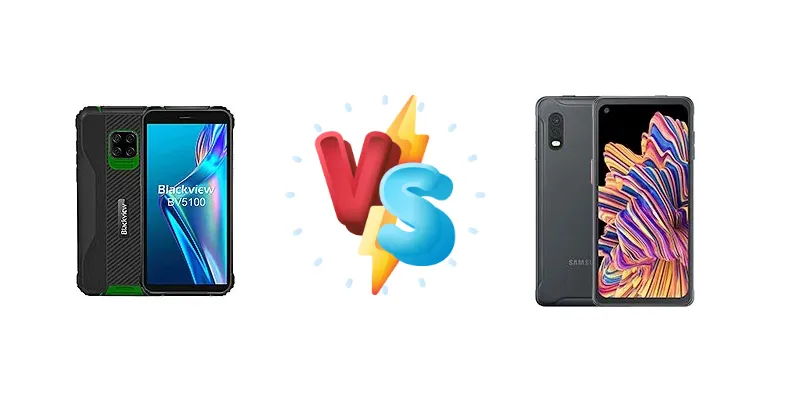
Blackview BV5100 vs. Samsung Galaxy XCover Pro: A Deep Dive into Rugged Performance
| Phones Images | |||||
|---|---|---|---|---|---|
|
🏆 Quick Verdict
For the average user needing a dependable, budget-friendly rugged phone, the Blackview BV5100 is a solid choice. However, the Samsung Galaxy XCover Pro takes the lead for users who demand smoother performance and are willing to pay a premium for the Exynos 9611 chipset and its associated benefits.
| PHONES | ||
|---|---|---|
| Phone Names | Blackview BV5100 | Samsung Galaxy XCover Pro |
| Network | ||
|---|---|---|
| 2G bands | GSM 850 / 900 / 1800 / 1900 | GSM 850 / 900 / 1800 / 1900 |
| 3G bands | HSDPA 850 / 900 / 1700(AWS) / 1900 / 2100 | HSDPA 850 / 900 / 1900 / 2100 - International |
| 4G bands | 1, 2, 3, 4, 5, 7, 8, 12, 13, 17, 18, 19, 20, 25, 26, 28, 38, 40, 41, 66 | 1, 2, 3, 5, 7, 8, 20, 28, 38, 40, 41 - International |
| Speed | HSPA, LTE | HSPA 42.2/5.76 Mbps, LTE (3CA) Cat11 600/50 Mbps |
| Technology | GSM / HSPA / LTE | GSM / HSPA / LTE |
| - | 1, 2, 3, 4, 5, 7, 12, 13, 14, 20, 29, 38, 40, 41, 66 - Canada | |
| Launch | ||
|---|---|---|
| Announced | 2020, November 13. Released 2020, November | 2020, January |
| Status | Discontinued | Available. Released 2020, January |
| Body | ||
|---|---|---|
| Dimensions | 159.4 x 77.7 x 13.7 mm (6.28 x 3.06 x 0.54 in) | 159.9 x 76.7 x 10 mm (6.30 x 3.02 x 0.39 in) |
| SIM | Nano-SIM + Nano-SIM | · Nano-SIM· Nano-SIM + Nano-SIM |
| Weight | 275 g (9.70 oz) | 218 g (7.69 oz) |
| - | IP68 dust/water resistant (up to 1.5m for 35 min) Drop-to-concrete resistance from up to 1.5m MIL-STD-810G compliant* *does not guarantee ruggedness or use in extreme conditions | |
| Display | ||
|---|---|---|
| Protection | Corning Gorilla Glass 3 | Corning Gorilla Glass 5 |
| Resolution | 720 x 1440 pixels, 18:9 ratio (~282 ppi density) | 1080 x 2340 pixels, 19.5:9 ratio (~409 ppi density) |
| Size | 5.7 inches, 83.8 cm2 (~67.7% screen-to-body ratio) | 6.3 inches, 97.4 cm2 (~79.4% screen-to-body ratio) |
| Type | IPS LCD | IPS LCD |
| Platform | ||
|---|---|---|
| CPU | Octa-core (4x1.8 GHz Cortex-A53 & 4x1.5 GHz Cortex-A53) | Octa-core (4x2.3 GHz Cortex-A73 & 4x1.7 GHz Cortex-A53) |
| Chipset | Mediatek MT6762V/WD Helio P22 (12 nm) | Exynos 9611 (10 nm) |
| GPU | PowerVR GE8320 | Mali-G72 MP3 |
| OS | Android 10 | Android 10, upgradable to Android 13, One UI 5 |
| Memory | ||
|---|---|---|
| Card slot | microSDXC | microSDXC (dedicated slot) |
| Internal | 64GB 4GB RAM | 64GB 4GB RAM |
| Main Camera | ||
|---|---|---|
| Dual | - | 25 MP, f/1.7, 26mm (wide), PDAF 8 MP, f/2.2, 123˚ (ultrawide), 1/4.0", 1.12µm |
| Features | LED flash, HDR | Dual-LED flash, HDR, panorama |
| Triple | 16 MP, f/2.0, (wide), AF 8 MP, f/2.2, 117˚ (ultrawide) 0.3 MP | - |
| Video | 1080p@30fps | 1080p@30fps |
| Selfie camera | ||
|---|---|---|
| Features | - | HDR |
| Single | 13 MP, f/2.2, (wide) | 13 MP, f/2.0, (wide), 1/3.1", 1.12µm |
| Video | 1080p@30fps | 1080p@30fps |
| Sound | ||
|---|---|---|
| 3.5mm jack | - | Yes |
| 35mm jack | No | Yes |
| Loudspeaker | Yes | Yes |
| Comms | ||
|---|---|---|
| Bluetooth | 5.0, A2DP, LE | 5.0, A2DP, LE |
| NFC | Yes | Yes |
| Positioning | GPS, GLONASS, GALILEO, BDS | GPS, GLONASS, GALILEO, BDS |
| Radio | FM radio | FM radio (market/region dependent) |
| USB | USB Type-C 2.0, OTG | USB Type-C 2.0 |
| WLAN | Wi-Fi 802.11 a/b/g/n | Wi-Fi 802.11 a/b/g/n/ac/k/v/r, dual-band, Wi-Fi Direct |
| Features | ||
|---|---|---|
| Sensors | Fingerprint (side-mounted), accelerometer, gyro, proximity, compass | Fingerprint (side-mounted), accelerometer, gyro, proximity, compass |
| - | ANT+ | |
| Battery | ||
|---|---|---|
| Charging | 18W wired Wireless | 15W wired |
| Type | 5580 mAh | Li-Po 4050 mAh, removable |
| Misc | ||
|---|---|---|
| Colors | Black, Orange, Green, Yellow | Black |
| Models | - | SM-G715FN/DS, SM-G715FN, SM-G715F, SM-G715W, SM-G715U, SM-G715U1 |
| Price | About 180 EUR | About 120 EUR |
| SAR EU | - | 0.47 W/kg (head) 1.23 W/kg (body) |
Blackview BV5100
- More affordable price point
- Potentially faster charging (18W)
- Rugged design for demanding environments
- Significantly weaker processor
- Likely lower quality display
- Limited software support
Samsung Galaxy XCover Pro
- More powerful Exynos 9611 chipset
- Samsung’s software ecosystem and support
- Potentially better camera image processing
- Higher price tag
- Slower charging (15W)
- May be less durable than the BV5100 in extreme conditions
Display Comparison
Neither device boasts a cutting-edge display. Details on panel type (IPS vs. TFT) and resolution are missing for the BV5100, suggesting a basic implementation. The XCover Pro, while also not a flagship display, benefits from Samsung's display expertise. The focus here is on visibility under direct sunlight and durability, not color accuracy. Both will likely feature reinforced glass, but specifics are unavailable. The lack of high refresh rates on either device is expected given the rugged focus.
Camera Comparison
Camera details are sparse for both devices. The BV5100 likely features a basic camera setup focused on functionality rather than image quality. The XCover Pro, while not a photography powerhouse, benefits from Samsung’s image processing algorithms. Without specific sensor sizes or aperture information, it’s difficult to make a definitive judgment. However, the XCover Pro’s processor allows for more sophisticated image processing, potentially resulting in better dynamic range and low-light performance. The presence of OIS (Optical Image Stabilization) on the XCover Pro, if equipped, would be a significant advantage.
Performance
The core difference lies in the chipsets. The Samsung Galaxy XCover Pro’s Exynos 9611, built on a 10nm process, significantly outperforms the Blackview BV5100’s MediaTek Helio P22 (12nm). The Exynos utilizes a Cortex-A73 core cluster clocked at 2.3GHz, offering a substantial CPU performance boost over the BV5100’s 1.8GHz Cortex-A53 cores. This translates to faster app loading times, smoother multitasking, and a more responsive overall experience. While both are octa-core, the architectural differences are critical. The P22 is geared towards efficiency, while the 9611 balances performance and power consumption. The XCover Pro will handle demanding apps and light gaming far better.
Battery Life
The Blackview BV5100 supports 18W wired charging, while the Samsung Galaxy XCover Pro is limited to 15W. While the wattage difference isn't massive, it could translate to slightly faster charging times for the BV5100. However, battery life is more dependent on chipset efficiency and software optimization. The Exynos 9611, despite being more powerful, is built on a smaller 10nm node, potentially mitigating some of the power draw. Real-world battery performance will depend heavily on usage patterns, but the XCover Pro’s more efficient processor could offer comparable or even better longevity despite potentially having a similar capacity battery.
Buying Guide
Buy the Blackview BV5100 if you need a highly durable phone for basic tasks, prioritize affordability, and don't require intensive multitasking or gaming. It's ideal for construction workers, outdoor enthusiasts on a budget, or as a reliable backup device. Buy the Samsung Galaxy XCover Pro if you prefer a more responsive user experience, frequently use demanding applications, and value Samsung's software ecosystem and potentially easier enterprise integration.