
Blackview BV5100 vs Nokia XR20: A Head-to-Head Rugged Smartphone Showdown
| Phones Images | |||||
|---|---|---|---|---|---|
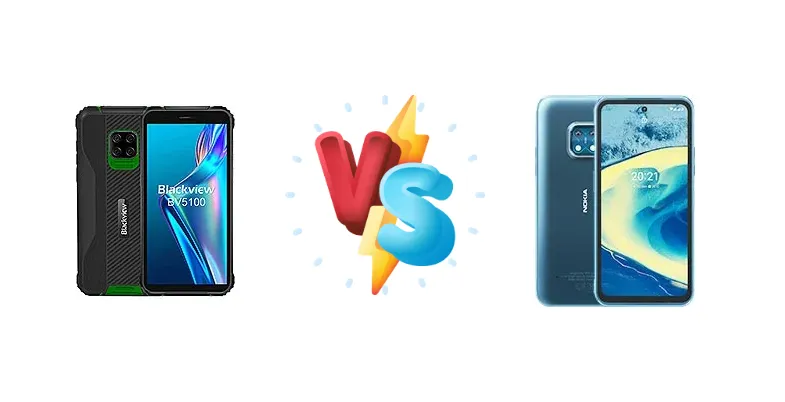
|
🏆 Quick Verdict
For the average user prioritizing future-proofing and smoother performance, the Nokia XR20 is the better choice. Its Snapdragon 480 5G chipset offers a substantial performance leap over the Blackview BV5100’s Helio P22, and the inclusion of 5G connectivity adds long-term value, despite both phones sharing the same 18W charging.
| PHONES | ||
|---|---|---|
| Phone Names | Blackview BV5100 | Nokia XR20 |
| Network | ||
|---|---|---|
| 2G bands | GSM 850 / 900 / 1800 / 1900 | GSM 850 / 900 / 1800 / 1900 |
| 3G bands | HSDPA 850 / 900 / 1700(AWS) / 1900 / 2100 | HSDPA 850 / 900 / 1700(AWS) / 1900 / 2100 |
| 4G bands | 1, 2, 3, 4, 5, 7, 8, 12, 13, 17, 18, 19, 20, 25, 26, 28, 38, 40, 41, 66 | 1, 2, 3, 4, 5, 7, 8, 12, 13, 14, 20, 25, 26, 28, 30, 38, 40, 41, 48, 66, 71 |
| 5G bands | - | 2, 5, 25, 38, 41, 48, 66, 77, 78 SA/NSA |
| Speed | HSPA, LTE | HSPA, LTE, 5G |
| Technology | GSM / HSPA / LTE | GSM / CDMA / HSPA / EVDO / LTE / 5G |
| - | CDMA2000 1xEV-DO | |
| Launch | ||
|---|---|---|
| Announced | 2020, November 13. Released 2020, November | 2021, July 27 |
| Status | Discontinued | Available. Released 2021, August 04 |
| Body | ||
|---|---|---|
| Dimensions | 159.4 x 77.7 x 13.7 mm (6.28 x 3.06 x 0.54 in) | 171.6 x 81.5 x 10.6 mm (6.76 x 3.21 x 0.42 in) |
| SIM | Nano-SIM + Nano-SIM | · Nano-SIM· Nano-SIM + Nano-SIM |
| Weight | 275 g (9.70 oz) | 248 g (8.75 oz) |
| - | IP68 dust/water resistant (up to 1.5m for 60 min) Drop-to-concrete resistance from up to 1.8m MIL-STD-810H compliant | |
| Display | ||
|---|---|---|
| Protection | Corning Gorilla Glass 3 | Corning Gorilla Glass Victus |
| Resolution | 720 x 1440 pixels, 18:9 ratio (~282 ppi density) | 1080 x 2400 pixels, 20:9 ratio (~395 ppi density) |
| Size | 5.7 inches, 83.8 cm2 (~67.7% screen-to-body ratio) | 6.67 inches, 107.4 cm2 (~76.8% screen-to-body ratio) |
| Type | IPS LCD | IPS LCD, 550 nits |
| Platform | ||
|---|---|---|
| CPU | Octa-core (4x1.8 GHz Cortex-A53 & 4x1.5 GHz Cortex-A53) | Octa-core (2x2.0 GHz Kryo 460 & 6x1.8 GHz Kryo 460) |
| Chipset | Mediatek MT6762V/WD Helio P22 (12 nm) | Qualcomm SM4350 Snapdragon 480 5G (8 nm) |
| GPU | PowerVR GE8320 | Adreno 619 |
| OS | Android 10 | Android 11, upgradable to Android 13 |
| Memory | ||
|---|---|---|
| Card slot | microSDXC | microSDXC (uses shared SIM slot) |
| Internal | 64GB 4GB RAM | 64GB 4GB RAM, 128GB 6GB RAM |
| Main Camera | ||
|---|---|---|
| Dual | - | 48 MP, f/1.8, (wide), 1/2.25", 0.8µm, PDAF 13 MP, f/2.4, 123˚ (ultrawide), 1/3.0", 1.12µm |
| Features | LED flash, HDR | Zeiss optics, Dual-LED dual-tone flash, second LED flash, HDR, panorama |
| Single | - | 8 MP, f/2.0 (wide), 1/4.0", 1.12µm |
| Triple | 16 MP, f/2.0, (wide), AF 8 MP, f/2.2, 117˚ (ultrawide) 0.3 MP | - |
| Video | 1080p@30fps | 1080p@30fps |
| Selfie camera | ||
|---|---|---|
| Single | 13 MP, f/2.2, (wide) | 8 MP, f/2.0 (wide), 1/4.0", 1.12µm |
| Video | 1080p@30fps | 1080p@30fps |
| Sound | ||
|---|---|---|
| 3.5mm jack | - | Yes |
| 35mm jack | No | Yes |
| Loudspeaker | Yes | Yes, with stereo speakers |
| Comms | ||
|---|---|---|
| Bluetooth | 5.0, A2DP, LE | 5.1, A2DP, LE, aptX Adaptive |
| NFC | Yes | Yes |
| Positioning | GPS, GLONASS, GALILEO, BDS | GPS (L1+L5), GLONASS, BDS, GALILEO, QZSS, NavIC |
| Radio | FM radio | Unspecified |
| USB | USB Type-C 2.0, OTG | USB Type-C 3.0 |
| WLAN | Wi-Fi 802.11 a/b/g/n | Wi-Fi 802.11 a/b/g/n/ac/6, dual-band, Wi-Fi Direct |
| Features | ||
|---|---|---|
| Sensors | Fingerprint (side-mounted), accelerometer, gyro, proximity, compass | Fingerprint (side-mounted), accelerometer, gyro, proximity, compass, barometer |
| Battery | ||
|---|---|---|
| Charging | 18W wired Wireless | 18W wired 15W wireless |
| Type | 5580 mAh | Li-Po 4630 mAh |
| Misc | ||
|---|---|---|
| Colors | Black, Orange, Green, Yellow | Ultra Blue, Granite Gray |
| Models | - | TA-1368, TA-1362 |
| Price | About 180 EUR | About 270 EUR |
| SAR EU | - | 1.13 W/kg (head) 1.43 W/kg (body) |
Blackview BV5100
- Significantly lower price point
- Rugged design for durability
- Basic functionality for essential tasks
- Outdated and underpowered Helio P22 chipset
- Lacks 5G connectivity
- Potentially limited software support
Nokia XR20
- 5G connectivity for faster data speeds
- More powerful Snapdragon 480 chipset
- Nokia’s commitment to software updates and security
- Higher price compared to the Blackview BV5100
- Rugged design may be bulky
- 18W charging isn't the fastest available
Display Comparison
Neither Blackview nor Nokia provide detailed display specs beyond basic resolution. However, the core difference lies in the processing power needed to drive the display. The Helio P22 in the BV5100 is less capable of handling complex display features like high refresh rates or HDR content. While both likely utilize IPS LCD panels, the XR20’s more powerful GPU can deliver a smoother visual experience, even if the resolution is similar. Bezels are likely comparable given the rugged design focus, prioritizing protection over minimizing screen borders.
Camera Comparison
Without detailed camera specs, a direct comparison is difficult. However, the chipset plays a crucial role in image processing. The Snapdragon 480’s image signal processor (ISP) is far more advanced than the Helio P22’s, enabling better noise reduction, dynamic range, and overall image quality. While both phones likely feature a main camera and potentially auxiliary lenses, the XR20 will likely produce sharper, more detailed photos, especially in challenging lighting conditions. The XR20’s ISP also supports more advanced features like computational photography and potentially better video stabilization.
Performance
The Nokia XR20’s Qualcomm Snapdragon 480 5G (8nm) represents a significant architectural advantage over the Blackview BV5100’s MediaTek Helio P22 (12nm). The 8nm process node is more efficient, leading to better thermal management and sustained performance. The Snapdragon 480’s Kryo 460 cores, with a 2x2.0 GHz and 6x1.8 GHz configuration, outperform the Helio P22’s 4x1.8 GHz and 4x1.5 GHz Cortex-A53 cores in both single-core and multi-core tasks. This translates to faster app loading times, smoother multitasking, and a more responsive overall user experience. The XR20’s Adreno 619 GPU also provides a substantial graphics boost, making it better suited for casual gaming.
Battery Life
Both devices offer 18W wired charging, but the efficiency of the Snapdragon 480 (8nm) versus the Helio P22 (12nm) impacts real-world battery life. The XR20’s more efficient chipset will consume less power during typical usage, potentially extending battery life despite similar capacity (specs not provided). While the XR20 also offers 15W wireless charging, the BV5100 only supports wireless charging without a specified wattage, suggesting slower speeds. The 18W wired charging on both phones will likely take around 2-3 hours for a full charge, depending on battery capacity.
Buying Guide
Buy the Blackview BV5100 if you need an extremely budget-friendly rugged phone for basic tasks like calls, texts, and light app usage, and aren't concerned with 5G or demanding performance. Buy the Nokia XR20 if you prefer a more responsive user experience, require 5G connectivity for faster data speeds, and value Nokia’s commitment to software updates and security patches, even if it comes at a higher price point.