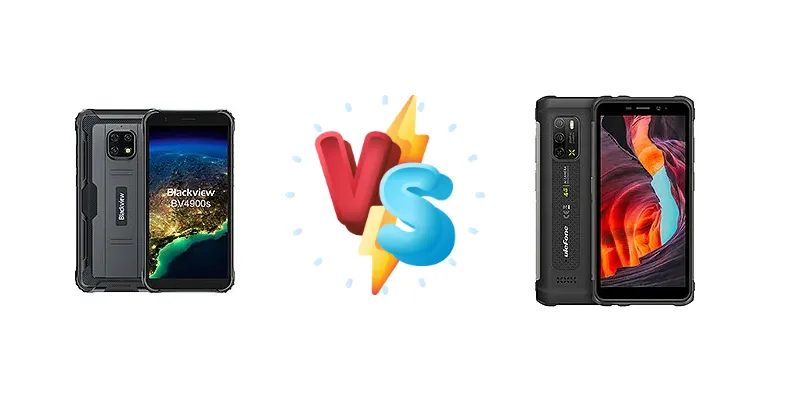
The rugged smartphone market caters to a specific need: durability. Both the Blackview BV4900s and Ulefone Armor X10 Pro aim to deliver that, but they take different approaches to internal hardware. This comparison dissects their core components to determine which phone offers the best balance of performance and resilience for demanding users.
🏆 Quick Verdict
For the average user prioritizing consistent performance and a slightly more modern chipset, the Ulefone Armor X10 Pro emerges as the better choice. Its Mediatek Helio P22, built on a 12nm process, offers a performance edge over the Blackview's older 28nm Unisoc SC9863A, despite the lower clock speeds on some cores. However, the BV4900s remains a viable option for basic tasks.
| Network |
|---|
| 2G bands | GSM 850 / 900 / 1800 / 1900 | GSM 850 / 900 / 1800 / 1900 |
| 3G bands | HSDPA 900 / 2100 | HSDPA 850 / 900 / 1700(AWS) / 1900 / 2100 |
| 4G bands | 1, 3, 7, 8, 20, 40 | 1, 2, 3, 4, 5, 7, 8, 12, 13, 17, 18, 19, 20, 25, 26, 28 |
| Speed | HSPA, LTE | HSPA 21/5.76 Mbps, LTE Cat6 300/150 Mbps |
| Technology | GSM / HSPA / LTE | GSM / HSPA / LTE |
| Launch |
|---|
| Announced | 2021, October 02 | 2022, March 10 |
| Status | Available. Released 2021, October | Available. Released 2022, March 10 |
| Body |
|---|
| Dimensions | 157.5 x 78.1 x 13.7 mm (6.20 x 3.07 x 0.54 in) | 158.2 x 76.7 x 14.6 mm (6.23 x 3.02 x 0.57 in) |
| SIM | Nano-SIM + Nano-SIM | Nano-SIM + Nano-SIM |
| Weight | 261 g (9.21 oz) | 256 g (9.03 oz) |
| | IP68/IP69K dust/water resistant (up to 1.5m for 30 min)
Drop-to-concrete resistance from up to 1.5m
MIL-STD-810G compliant | IP68/IP69K dust/water resistant (up to 1.5m for 30 min)
Drop-to-concrete resistance from up to 1.2m
MIL-STD-810G compliant |
| Display |
|---|
| Protection | Dragontrail Glass | - |
| Resolution | 720 x 1440 pixels, 18:9 ratio (~282 ppi density) | 720 x 1440 pixels, 18:9 ratio (~295 ppi density) |
| Size | 5.7 inches, 83.8 cm2 (~68.2% screen-to-body ratio) | 5.45 inches, 76.7 cm2 (~63.2% screen-to-body ratio) |
| Type | IPS LCD | IPS LCD |
| Platform |
|---|
| CPU | Octa-core (4x1.6 GHz Cortex-A55 & 4x1.2 GHz Cortex-A55) | Octa-core 2.0 GHz Cortex-A53 |
| Chipset | Unisoc SC9863A (28 nm) | Mediatek MT6762 Helio P22 (12 nm) |
| GPU | IMG8322 | PowerVR GE8320 |
| OS | Android 11 (Go edition) | Android 11 |
| Memory |
|---|
| Card slot | microSDXC | microSDXC (dedicated slot) |
| Internal | 32GB 2GB RAM | 64GB 4GB RAM |
| | eMMC | eMMC 5.1 |
| Main Camera |
|---|
| Dual | - | 20 MP, f/1.8, 26mm (wide), 1/2.78", 1.0µm, PDAF
Auxiliary lens |
| Features | LED flash | Dual-LED flash |
| Single | 8 MP, f/2.4, (wide), AF | 5 MP, f/2.2 |
| Video | 1080p@30fps | 1080p@30fps |
| Selfie camera |
|---|
| Features | - | HDR |
| Single | 5 MP, f/2.2, (wide) | 5 MP, f/2.2 |
| Video | Yes | 1080p@30fps |
| Sound |
|---|
| 3.5mm jack | Yes | Yes |
| 35mm jack | Yes | Yes |
| Loudspeaker | Yes | Yes |
| Comms |
|---|
| Bluetooth | 4.2, A2DP, LE | 5.0, A2DP, LE |
| NFC | No | Yes |
| Positioning | GPS, GLONASS, BDS | GPS, GLONASS, GALILEO, BDS |
| Radio | FM radio | FM radio, RDS, recording |
| USB | microUSB 2.0, OTG | USB Type-C 2.0, OTG |
| WLAN | Wi-Fi 802.11 b/g/n | Wi-Fi 802.11 a/b/g/n/ac, dual-band, Wi-Fi Direct |
| Features |
|---|
| Sensors | Fingerprint (side-mounted), accelerometer, gyro, proximity, compass | Accelerometer, proximity, compass |
| Battery |
|---|
| Charging | - | 10W wired |
| Type | 5580 mAh | Li-Po 5180 mAh |
| Misc |
|---|
| Colors | Black, Orange, Green, Yellow | Black/Gray |
| Price | About 120 EUR | About 170 EUR |
Blackview BV4900s
- Potentially lower price point
- Rugged design for durability
- Sufficient for basic smartphone tasks
- Older, less efficient Unisoc chipset
- Likely slower performance
- Unknown charging speed
Ulefone Armor X10 Pro
- More modern and efficient Mediatek Helio P22 chipset
- Faster CPU clock speeds
- Better overall performance
- Slower 10W charging
- Rugged design may add bulk
- Potentially higher price
Display Comparison
Neither device boasts a standout display. Given the lack of detailed display specs, we can assume both utilize IPS LCD panels common in this price bracket. The Ulefone benefits from the more modern Helio P22 chipset which *could* support a slightly higher resolution or refresh rate, though this isn't confirmed. The focus here is clearly on durability, not visual fidelity. Bezels are likely to be substantial on both to contribute to drop protection.
Camera Comparison
Without detailed camera specifications, a direct comparison is difficult. Both phones likely feature basic camera setups geared towards functional photography rather than high-quality imaging. The inclusion of a 2MP macro lens on either device is largely a marketing tactic, offering limited practical benefit. Image processing will likely be basic on both, relying heavily on software algorithms to enhance photos. The Ulefone's more capable chipset *could* allow for slightly faster image processing, but the sensor quality will be the primary determinant of image quality.
Performance
The core difference lies in the chipsets. The Ulefone Armor X10 Pro’s Mediatek Helio P22 (12nm) is a significant upgrade over the Blackview BV4900s’ Unisoc SC9863A (28nm). The 12nm fabrication process inherently offers better power efficiency and thermal performance. While the BV4900s has eight Cortex-A55 cores, split between 1.6GHz and 1.2GHz, the X10 Pro features eight Cortex-A53 cores clocked at 2.0GHz. The A53 architecture, while older than the A55, generally provides better single-core performance, crucial for app responsiveness. This translates to smoother multitasking and faster app loading times on the Ulefone.
Battery Life
Battery capacity isn't specified for either device, but rugged phones typically prioritize long battery life. The Ulefone Armor X10 Pro is limited to 10W wired charging, which is relatively slow by today’s standards. The Blackview BV4900s charging speed is unknown, but given its older chipset, it's unlikely to support faster charging technologies. The Ulefone’s more efficient Helio P22 chipset will likely result in better real-world battery endurance, offsetting the slower charging speed.
Buying Guide
Buy the Blackview BV4900s if you need a supremely budget-friendly rugged phone for very light use – primarily calls, texts, and occasional basic app usage. Its older chipset is sufficient for these tasks. Buy the Ulefone Armor X10 Pro if you prefer a more responsive experience, even with demanding apps, and value the benefits of a more efficient processor, even if it means a slightly slower charging speed.
Frequently Asked Questions
❓ Will the Helio P22 in the Ulefone Armor X10 Pro struggle with demanding games like PUBG?
While the Helio P22 isn't a gaming powerhouse, it's capable of running PUBG Mobile at medium settings with reasonable frame rates. Expect some frame drops during intense action. The Blackview BV4900s' Unisoc SC9863A will likely offer a significantly less smooth gaming experience.
❓ Is the 10W charging on the Ulefone Armor X10 Pro a significant drawback?
10W charging is slow compared to modern standards, taking several hours for a full charge. However, the Ulefone's more efficient chipset means you'll likely need to charge it less frequently, mitigating the impact of the slower charging speed. Overnight charging is recommended.
❓ How does the 28nm process of the Unisoc SC9863A affect the Blackview BV4900s' battery life?
The 28nm process is less efficient than the 12nm process used in the Helio P22. This means the Unisoc chip consumes more power for the same tasks, resulting in shorter battery life and potentially more heat generation.