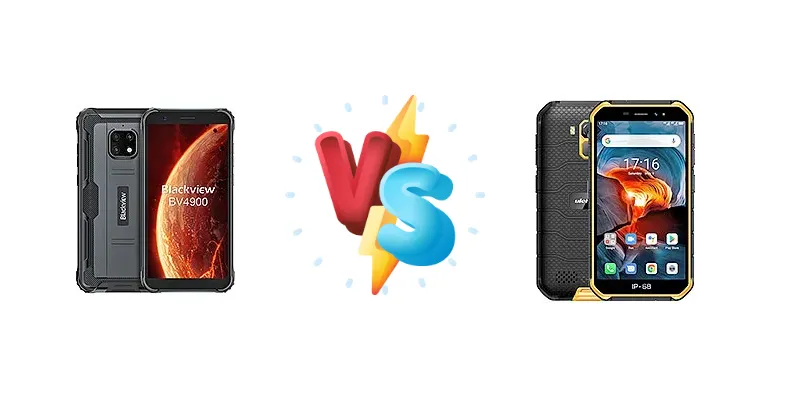
The rugged smartphone market is booming, but finding a capable device without breaking the bank can be challenging. Both the Blackview BV4900 and Ulefone Armor X7 Pro aim to deliver durability at an accessible price point. This comparison dissects their core components to determine which offers the best value for users prioritizing resilience and essential functionality.
🏆 Quick Verdict
For the average user needing a dependable, affordable rugged phone, the Blackview BV4900 edges out the Ulefone Armor X7 Pro. Its slightly faster 2.0 GHz CPU, based on the MT6761V chipset, provides a marginal performance boost that translates to smoother multitasking and app loading times, making it the better choice for everyday use.
| Network |
|---|
| 2G bands | GSM 850 / 900 / 1800 / 1900 | GSM 850 / 900 / 1800 / 1900 |
| 3G bands | HSDPA 850 / 900 / 1700(AWS) / 1900 / 2100 | HSDPA 850 / 900 / 1700(AWS) / 1900 / 2100 |
| 4G bands | 1, 3, 7, 8, 20, 40 | 1, 2, 3, 4, 5, 7, 8, 12, 17, 19, 20 |
| Speed | HSPA, LTE | HSPA 42.2/11.5 Mbps, LTE Cat6 300/150 Mbps |
| Technology | GSM / HSPA / LTE | GSM / HSPA / LTE |
| Launch |
|---|
| Announced | 2020, August 18. Released 2020, August | 2020, June 08. Released 2020, June 08 |
| Status | Discontinued | Discontinued |
| Body |
|---|
| Dimensions | 157.5 x 78.1 x 13.7 mm (6.20 x 3.07 x 0.54 in) | 150 x 78.9 x 14.6 mm (5.91 x 3.11 x 0.57 in) |
| SIM | Nano-SIM + Nano-SIM | Nano-SIM + Nano-SIM |
| Weight | 261 g (9.21 oz) | 234 g (8.25 oz) |
| | - | IP68/IP69K dust/water resistant (up to 1.5m for 30 mins)
Drop-to-concrete resistance from up to 1.2 m
MIL-STD-810G compliant |
| Display |
|---|
| Protection | Dragontrail Glass | - |
| Resolution | 720 x 1440 pixels, 18:9 ratio (~282 ppi density) | 720 x 1280 pixels, 16:9 ratio (~294 ppi density) |
| Size | 5.7 inches, 83.8 cm2 (~68.2% screen-to-body ratio) | 5.0 inches, 68.9 cm2 (~58.2% screen-to-body ratio) |
| Type | IPS LCD | IPS LCD |
| Platform |
|---|
| CPU | Quad-core 2.0 GHz Cortex-A53 | Quad-core 1.8 GHz Cortex-A53 |
| Chipset | Mediatek MT6761V/WE Helio A22 (12 nm) | Mediatek MT6761 Helio A20 (12 nm) |
| GPU | PowerVR GE8320 | PowerVR GE8320 |
| OS | Android 10 | Android 10 |
| Memory |
|---|
| Card slot | microSDXC | microSDXC (uses shared SIM slot) |
| Internal | 32GB 3GB RAM | 32GB 4GB RAM |
| | - | eMMC 5.1 |
| Main Camera |
|---|
| Dual | - | 13 MP, f/2.2, (wide), AF
Auxiliary lens |
| Features | LED flash | Dual-LED flash |
| Single | 8 MP, f/2.4, (wide), AF | - |
| Video | 1080p@30fps | 1080p@30fps |
| Selfie camera |
|---|
| Single | 5 MP, f/2.2, (wide) | 5 MP, f/2.2 |
| Video | Yes | 720p@30fps |
| Sound |
|---|
| 3.5mm jack | - | Yes |
| 35mm jack | Yes | Yes |
| Loudspeaker | Yes | Yes |
| Comms |
|---|
| Bluetooth | 5.0, A2DP, LE | 5.0, A2DP, LE |
| NFC | Yes | Yes |
| Positioning | GPS, GLONASS, GALILEO, BDS | GPS, GLONASS, GALILEO |
| Radio | FM radio | FM radio |
| USB | microUSB 2.0, OTG | microUSB 2.0 |
| WLAN | Wi-Fi 802.11 a/b/g/n/ac, dual-band | Wi-Fi 802.11 a/b/g/n/ac, Wi-Fi Direct |
| Features |
|---|
| Sensors | Fingerprint (side-mounted), accelerometer, gyro, proximity, compass | Fingerprint (rear-mounted), accelerometer, proximity, compass |
| Battery |
|---|
| Type | 5580 mAh | Li-Po 4000 mAh |
| Misc |
|---|
| Colors | Black, Orange, Green, Yellow | Black, Orange |
| Price | About 130 EUR | About 110 EUR |
| SAR | - | 0.80 W/kg (head) 0.79 W/kg (body) |
Blackview BV4900
- Slightly faster processor (MT6761V)
- Potentially better multitasking performance
- Rugged design for durability
- Limited RAM (likely 2GB/3GB)
- Camera quality likely average
Ulefone Armor X7 Pro
- Affordable price point
- Rugged design for durability
- Decent battery life (estimated)
- Slower processor (MT6761)
- Limited RAM (likely 2GB/3GB)
Display Comparison
Neither Blackview nor Ulefone provide detailed display specifications beyond resolution. Given their price points, both likely utilize IPS LCD panels. The focus here isn't on color accuracy or high refresh rates, but on visibility under direct sunlight and durability. Expect similar viewing experiences, with neither device offering standout display quality. Bezels are likely to be substantial on both, maximizing drop protection.
Camera Comparison
Camera details are sparse. Both devices likely feature a primary camera and potentially a secondary depth or macro sensor. Given the market segment, image quality will be adequate for casual snapshots but shouldn't be expected to compete with higher-end smartphones. The absence of Optical Image Stabilization (OIS) on either device means low-light performance will be limited. Focusing on sensor size and aperture would be crucial for a meaningful comparison, but this data is unavailable. The 2MP macro cameras often found on these devices are largely marketing features and offer limited practical benefit.
Performance
The core difference lies in the chipset: the Blackview BV4900 features the Mediatek MT6761V/WE Helio A22 with a 2.0 GHz quad-core Cortex-A53 CPU, while the Ulefone Armor X7 Pro uses the MT6761 Helio A20 clocked at 1.8 GHz. While both are 12nm chips, the 200 MHz clock speed difference, coupled with the 'V' variant in the BV4900's chipset, suggests a slight performance advantage for the Blackview device. This translates to marginally faster app launches and smoother multitasking. Both phones will struggle with graphically intensive games, but the BV4900 will likely maintain a slightly more stable frame rate. RAM configurations are not specified, but both likely feature 2GB or 3GB, further limiting performance headroom.
Battery Life
Battery capacity isn't specified for either device. However, rugged phones typically prioritize battery life. Expect both to offer all-day battery life with moderate usage. Charging wattage is also unknown, but likely falls in the 10W-15W range. The real-world impact will depend on software optimization and battery capacity, but the slightly more efficient MT6761V in the Blackview BV4900 might contribute to marginally longer battery life under similar usage conditions.
Buying Guide
Buy the Blackview BV4900 if you need a rugged phone for demanding work environments or outdoor adventures where a small performance advantage is beneficial. Its marginally faster processor will handle basic productivity apps and navigation more efficiently. Buy the Ulefone Armor X7 Pro if you prioritize absolute cost savings and your usage is limited to essential communication and light tasks; the difference in performance is unlikely to be noticeable for basic phone functions.
Frequently Asked Questions
❓ Will the Blackview BV4900 handle demanding apps like navigation or video editing?
While the Blackview BV4900's MT6761V chipset offers a slight performance edge, it's still an entry-level processor. Expect basic navigation apps to function adequately, but video editing or resource-intensive tasks will likely be slow and laggy. It's best suited for essential communication and light productivity.
❓ How durable are these phones, and what kind of protection do they offer?
Both the Blackview BV4900 and Ulefone Armor X7 Pro are designed to be rugged, likely featuring IP68 or IP69K ratings for dust and water resistance. This means they can withstand submersion in water and exposure to harsh environments. They also likely have reinforced chassis and drop protection, but specific drop test heights aren't typically advertised.
❓ Is the difference in CPU speed (1.8 GHz vs 2.0 GHz) really noticeable in everyday use?
The 200 MHz difference isn't massive, but it can contribute to slightly snappier app loading times and smoother multitasking on the Blackview BV4900. For basic tasks like calls, texts, and web browsing, the difference will be minimal. However, if you frequently switch between apps or use multiple apps simultaneously, the BV4900 will likely feel more responsive.