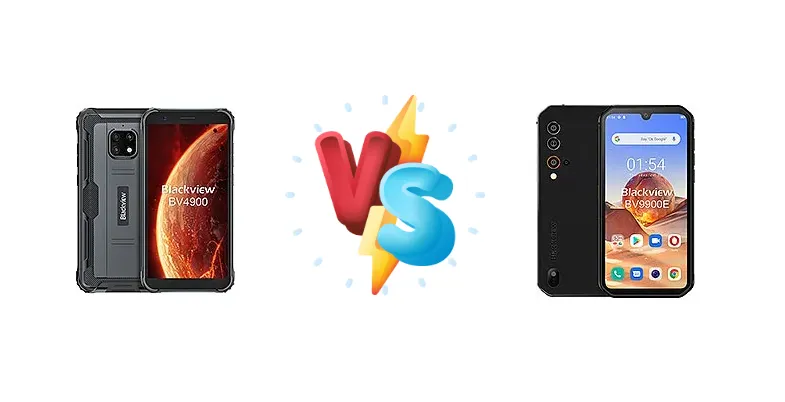
Blackview caters to a niche market: durable, rugged smartphones. The BV4900 and BV9900E represent different tiers within that offering. The BV4900 focuses on affordability, while the BV9900E aims for a more substantial performance boost. This comparison dissects the key differences to determine which device delivers the best value for users prioritizing resilience and reliability.
🏆 Quick Verdict
For the average user needing a dependable, affordable rugged phone, the Blackview BV9900E is the clear winner. Its Helio P90 chipset provides a significantly faster and more responsive experience than the BV4900’s Helio A22, justifying the price difference for those who demand more from their device.
| Network |
|---|
| 2G bands | GSM 850 / 900 / 1800 / 1900 | GSM 850 / 900 / 1800 / 1900 |
| 3G bands | HSDPA 850 / 900 / 1700(AWS) / 1900 / 2100 | HSDPA 800 / 850 / 900 / 1700(AWS) / 1900 / 2100 |
| 4G bands | 1, 3, 7, 8, 20, 40 | 1, 2, 3, 4, 5, 7, 8, 12, 13, 17, 18, 19, 20, 25, 26, 28, 34, 38, 39, 40, 41, 66 |
| Speed | HSPA, LTE | HSPA, LTE |
| Technology | GSM / HSPA / LTE | GSM / CDMA / HSPA / CDMA2000 / LTE |
| Launch |
|---|
| Announced | 2020, August 18. Released 2020, August | 2020, September 10. Released 2020, September |
| Status | Discontinued | Discontinued |
| Body |
|---|
| Dimensions | 157.5 x 78.1 x 13.7 mm (6.20 x 3.07 x 0.54 in) | 156.5 x 78.3 x 14.2 mm (6.16 x 3.08 x 0.56 in) |
| SIM | Nano-SIM + Nano-SIM | Nano-SIM + Nano-SIM |
| Weight | 261 g (9.21 oz) | 273 g (9.63 oz) |
| Display |
|---|
| Protection | Dragontrail Glass | Corning Gorilla Glass 5 |
| Resolution | 720 x 1440 pixels, 18:9 ratio (~282 ppi density) | 1080 x 2280 pixels, 19:9 ratio (~432 ppi density) |
| Size | 5.7 inches, 83.8 cm2 (~68.2% screen-to-body ratio) | 5.84 inches, 85.1 cm2 (~69.5% screen-to-body ratio) |
| Type | IPS LCD | IPS LCD |
| Platform |
|---|
| CPU | Quad-core 2.0 GHz Cortex-A53 | Octa-core (2x2.2 GHz Cortex-A75 & 6x2.0 GHz Cortex-A55) |
| Chipset | Mediatek MT6761V/WE Helio A22 (12 nm) | Mediatek MT6779V/CE Helio P90 (12 nm) |
| GPU | PowerVR GE8320 | PowerVR GM9446 |
| OS | Android 10 | Android 10 |
| Memory |
|---|
| Card slot | microSDXC | microSDXC |
| Internal | 32GB 3GB RAM | 128GB 6GB RAM |
| Main Camera |
|---|
| Features | LED flash | LED flash, HDR, panorama |
| Quad | - | 48 MP, f/1.8, (wide), PDAF
16 MP, 120˚ (ultrawide)
2 MP (macro)
Auxiliary lens |
| Single | 8 MP, f/2.4, (wide), AF | - |
| Video | 1080p@30fps | 4K@30fps, 1080p@60fps |
| Selfie camera |
|---|
| Single | 5 MP, f/2.2, (wide) | 16 MP, f/2.0, (wide) |
| Video | Yes | 1080p@30fps |
| Sound |
|---|
| 35mm jack | Yes | No |
| Loudspeaker | Yes | Yes |
| Comms |
|---|
| Bluetooth | 5.0, A2DP, LE | 5.0, A2DP, LE |
| NFC | Yes | Yes |
| Positioning | GPS, GLONASS, GALILEO, BDS | GPS, GLONASS, GALILEO, BDS |
| Radio | FM radio | FM radio |
| USB | microUSB 2.0, OTG | USB Type-C 2.0, OTG |
| WLAN | Wi-Fi 802.11 a/b/g/n/ac, dual-band | Wi-Fi 802.11 a/b/g/n/ac |
| Features |
|---|
| Sensors | Fingerprint (side-mounted), accelerometer, gyro, proximity, compass | Fingerprint (side-mounted), accelerometer, gyro, proximity, compass, barometer |
| Battery |
|---|
| Charging | - | 15W wired
18W wireless |
| Type | 5580 mAh | 4380 mAh |
| Misc |
|---|
| Colors | Black, Orange, Green, Yellow | Black, Silver |
| Price | About 130 EUR | About 260 EUR |
Blackview BV4900
- Most affordable option
- Excellent durability for basic use
- Simple and easy to use interface
- Slow performance for demanding tasks
- Limited multitasking capabilities
- Likely lower quality camera
Blackview BV9900E
- Significantly faster performance
- Wireless charging convenience
- Improved camera capabilities
- Higher price point
- Potentially shorter battery life under heavy load (despite faster charging)
- May be slightly bulkier due to added features
Display Comparison
Neither device’s display specifications are provided, so a direct comparison is limited. However, given the BV9900E’s higher tier positioning, it likely features a higher resolution panel and potentially better color accuracy. Both will likely prioritize durability with reinforced glass, but the BV9900E may benefit from a slightly higher peak brightness due to the more powerful chipset enabling more sophisticated display control.
Camera Comparison
Without detailed camera specifications, a precise comparison is difficult. However, the BV9900E’s more powerful ISP (Image Signal Processor) within the Helio P90 chipset will likely result in superior image processing, better dynamic range, and improved low-light performance. While both phones may include multiple cameras, the BV9900E is more likely to feature a higher-resolution main sensor and potentially optical image stabilization (OIS), enhancing image clarity and reducing blur. The BV4900 will likely rely on software enhancements to compensate for its less capable hardware.
Performance
The performance disparity is the most significant difference. The Blackview BV4900’s MediaTek Helio A22, with its quad-core 2.0 GHz Cortex-A53 CPU, is designed for basic smartphone functions. The BV9900E’s Helio P90, featuring an octa-core configuration (2x2.2 GHz Cortex-A75 & 6x2.0 GHz Cortex-A55), represents a substantial leap in processing power. The Cortex-A75 cores in the P90 offer significantly improved single-core performance, crucial for app responsiveness, while the six A55 cores handle background tasks efficiently. This translates to smoother multitasking, faster app loading times, and the ability to run more demanding applications on the BV9900E. The P90 also includes a more capable GPU, making it suitable for light gaming, something the A22 would struggle with.
Battery Life
Battery capacity isn’t specified for either device. However, the BV9900E’s inclusion of both 15W wired and 18W wireless charging is a significant advantage. Wireless charging adds convenience, while the higher wattage options suggest faster charging speeds. The Helio P90’s more efficient architecture may also contribute to better battery life despite potentially powering a higher-resolution display. The BV4900 will likely rely solely on wired charging, and its less efficient processor may result in shorter battery life under similar usage conditions.
Buying Guide
Buy the Blackview BV4900 if you need a basic, extremely durable phone for essential communication and light tasks, prioritizing longevity and minimal cost. It’s ideal for construction workers or those in similarly demanding environments who don’t rely heavily on smartphone features. Buy the Blackview BV9900E if you prefer a rugged phone that can handle demanding applications, multitasking, and occasional gaming, and appreciate the convenience of wireless charging and a more modern processor.
Frequently Asked Questions
❓ Will the Blackview BV9900E handle graphically intensive games like PUBG Mobile?
The Helio P90 in the BV9900E is capable of running PUBG Mobile, but likely at medium settings to maintain a stable frame rate. The A22 in the BV4900 would struggle significantly with this title. Expect a smoother gaming experience on the BV9900E, though it won't compete with flagship gaming phones.
❓ How much faster is the Blackview BV9900E in everyday tasks compared to the BV4900?
The BV9900E’s Helio P90 offers a substantial performance increase – roughly 2-3x faster in CPU benchmarks and significantly improved GPU performance. This translates to noticeably quicker app loading times, smoother multitasking, and a more responsive user interface. Basic tasks like browsing and messaging will feel much snappier on the BV9900E.
❓ Does the wireless charging on the BV9900E work with any Qi-compatible charger?
Yes, the BV9900E supports standard Qi wireless charging, meaning it will work with any Qi-certified wireless charger. However, using a higher-wattage Qi charger (up to 18W) will result in faster charging speeds.