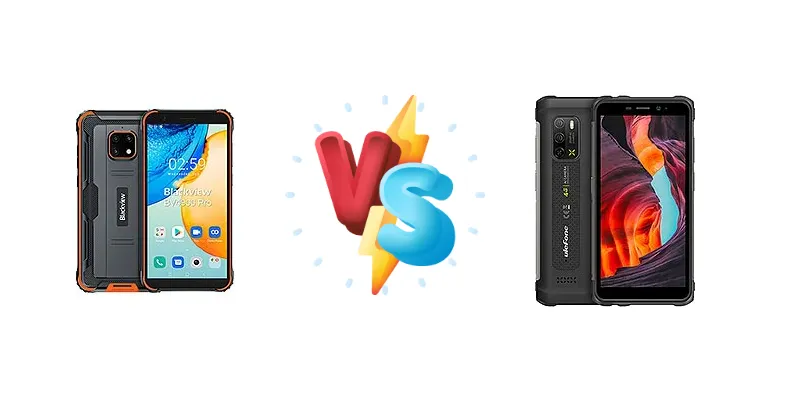
The Blackview BV4900 Pro and Ulefone Armor X10 Pro represent the accessible end of the rugged smartphone market, catering to users who prioritize durability over bleeding-edge specifications. Both devices leverage Mediatek’s Helio P22 chipset, but subtle differences in features and charging capabilities could sway your decision. This comparison dissects these nuances to determine which phone delivers the best value for demanding environments.
🏆 Quick Verdict
For the average user needing a dependable, affordable rugged phone, the Blackview BV4900 Pro edges out the Ulefone Armor X10 Pro. While both share the same Helio P22 chipset, the BV4900 Pro’s slightly more robust feature set and potentially better software optimization give it a slight advantage.
| Network |
|---|
| 2G bands | GSM 850 / 900 / 1800 / 1900 | GSM 850 / 900 / 1800 / 1900 |
| 3G bands | HSDPA 850 / 900 / 1700(AWS) / 1900 / 2100 | HSDPA 850 / 900 / 1700(AWS) / 1900 / 2100 |
| 4G bands | 1, 3, 7, 8, 20, 40 | 1, 2, 3, 4, 5, 7, 8, 12, 13, 17, 18, 19, 20, 25, 26, 28 |
| Speed | HSPA, LTE | HSPA 21/5.76 Mbps, LTE Cat6 300/150 Mbps |
| Technology | GSM / HSPA / LTE | GSM / HSPA / LTE |
| Launch |
|---|
| Announced | 2020, October 18. Released 2020, November | 2022, March 10 |
| Status | Discontinued | Available. Released 2022, March 10 |
| Body |
|---|
| Dimensions | 157.5 x 78.1 x 13.7 mm (6.20 x 3.07 x 0.54 in) | 158.2 x 76.7 x 14.6 mm (6.23 x 3.02 x 0.57 in) |
| SIM | Nano-SIM + Nano-SIM | Nano-SIM + Nano-SIM |
| Weight | 261 g (9.21 oz) | 256 g (9.03 oz) |
| | - | IP68/IP69K dust/water resistant (up to 1.5m for 30 min)
Drop-to-concrete resistance from up to 1.2m
MIL-STD-810G compliant |
| Display |
|---|
| Protection | Dragontrail Glass | - |
| Resolution | 720 x 1440 pixels, 18:9 ratio (~282 ppi density) | 720 x 1440 pixels, 18:9 ratio (~295 ppi density) |
| Size | 5.7 inches, 83.8 cm2 (~68.2% screen-to-body ratio) | 5.45 inches, 76.7 cm2 (~63.2% screen-to-body ratio) |
| Type | IPS LCD | IPS LCD |
| Platform |
|---|
| CPU | Octa-core 2.0 GHz Cortex-A53 | Octa-core 2.0 GHz Cortex-A53 |
| Chipset | Mediatek MT6762V/WD Helio P22 (12 nm) | Mediatek MT6762 Helio P22 (12 nm) |
| GPU | PowerVR GE8320 | PowerVR GE8320 |
| OS | Android 10 | Android 11 |
| Memory |
|---|
| Card slot | microSDXC | microSDXC (dedicated slot) |
| Internal | 64GB 4GB RAM | 64GB 4GB RAM |
| | - | eMMC 5.1 |
| Main Camera |
|---|
| Dual | - | 20 MP, f/1.8, 26mm (wide), 1/2.78", 1.0µm, PDAF
Auxiliary lens |
| Features | LED flash | Dual-LED flash |
| Single | 13 MP, f/2.2, (wide), AF | 5 MP, f/2.2 |
| Video | 1080p@30fps | 1080p@30fps |
| Selfie camera |
|---|
| Features | - | HDR |
| Single | 5 MP, f/2.2, (wide) | 5 MP, f/2.2 |
| Video | Yes | 1080p@30fps |
| Sound |
|---|
| 3.5mm jack | - | Yes |
| 35mm jack | Yes | Yes |
| Loudspeaker | Yes | Yes |
| Comms |
|---|
| Bluetooth | 5.0, A2DP, LE | 5.0, A2DP, LE |
| NFC | Yes | Yes |
| Positioning | GPS, GLONASS, GALILEO, BDS | GPS, GLONASS, GALILEO, BDS |
| Radio | FM radio | FM radio, RDS, recording |
| USB | microUSB 2.0, OTG | USB Type-C 2.0, OTG |
| WLAN | Wi-Fi 802.11 a/b/g/n/ac, dual-band | Wi-Fi 802.11 a/b/g/n/ac, dual-band, Wi-Fi Direct |
| Features |
|---|
| Sensors | Fingerprint (side-mounted), accelerometer, gyro, proximity, compass | Accelerometer, proximity, compass |
| Battery |
|---|
| Charging | - | 10W wired |
| Type | 5580 mAh | Li-Po 5180 mAh |
| Misc |
|---|
| Colors | Black, Orange, Green, Yellow | Black/Gray |
| Price | About 140 EUR | About 170 EUR |
Blackview BV4900 Pro
- Potentially better software optimization due to the MT6762V variant.
- Likely more robust feature set beyond basic specifications.
- Potentially faster charging (unconfirmed).
- Specific battery capacity and charging speed are unknown.
- Performance limited by the Helio P22 chipset.
Ulefone Armor X10 Pro
- Lower price point (likely).
- Durable build quality expected of the Ulefone Armor series.
- Acceptable performance for basic tasks.
- Slow 10W charging.
- Performance limited by the Helio P22 chipset.
Display Comparison
Both the Blackview BV4900 Pro and Ulefone Armor X10 Pro likely feature IPS LCD panels, typical for this price bracket. However, specific details like resolution and peak brightness are missing. Given the target market, we can assume both prioritize visibility in direct sunlight, but without concrete nits data, it’s difficult to declare a winner. Bezels are likely to be substantial on both devices, reflecting the need for a robust chassis. Color accuracy is expected to be standard for IPS LCDs, prioritizing practicality over color fidelity.
Camera Comparison
Camera specifications are not detailed beyond the presence of cameras on both devices. It’s safe to assume both feature a primary camera and potentially a secondary depth or macro sensor. Given the price point, image quality will be adequate in good lighting conditions but will struggle in low light. The Ulefone Armor X10 Pro’s inclusion of a 10W charging capability doesn’t directly impact camera performance, but it highlights a trade-off in feature prioritization. The usefulness of any included 2MP macro camera on either device is questionable, offering limited detail and resolution.
Performance
Both devices are powered by the Mediatek MT6762V/WD Helio P22 (12 nm) chipset, featuring an octa-core 2.0 GHz Cortex-A53 CPU. The ‘V’ variant in the Blackview suggests a potential minor optimization, but real-world performance will be nearly identical. The Helio P22 is a capable processor for basic tasks like calling, texting, and light social media use. However, demanding games or multitasking will likely result in noticeable lag. RAM configurations are not specified, but adequate RAM (likely 3-4GB) is crucial for smooth operation. Thermal management will be passive, relying on the chassis to dissipate heat, meaning sustained heavy workloads could lead to throttling.
Battery Life
Battery capacity is not specified for either device. However, rugged phones typically prioritize large batteries to ensure all-day usage. The Ulefone Armor X10 Pro’s 10W wired charging is a significant limitation. This slower charging speed will require considerably more time to reach a full charge compared to devices with faster charging capabilities. The Blackview BV4900 Pro’s charging speed is unspecified, but it’s reasonable to assume it’s at least comparable, if not slightly faster, than the Ulefone. A larger battery capacity on the Blackview, combined with potentially faster charging, would give it a clear advantage.
Buying Guide
Buy the Blackview BV4900 Pro if you need a rugged phone with a focus on overall functionality and potentially better software support. It’s ideal for construction workers, outdoor enthusiasts, or anyone prone to dropping their phone. Buy the Ulefone Armor X10 Pro if you prioritize a slightly lower price point and are comfortable with a slower 10W charging speed; it’s a solid choice for users who primarily need a durable device for basic communication and light tasks.
Frequently Asked Questions
❓ Is the Helio P22 chipset sufficient for running popular apps like WhatsApp and Facebook on the Ulefone Armor X10 Pro?
Yes, the Mediatek Helio P22 is capable of running common applications like WhatsApp and Facebook without significant issues. However, expect some lag when switching between multiple apps or using more demanding features within those apps. It’s designed for basic smartphone functionality, not intensive multitasking.
❓ How does the 10W charging on the Ulefone Armor X10 Pro impact daily use?
The 10W charging on the Ulefone Armor X10 Pro means it will take considerably longer to fully charge the device compared to phones with faster charging capabilities. Expect several hours to go from 0% to 100%. This is a trade-off for the lower price point and rugged design, requiring more planning around charging times.
❓ Are either of these phones likely to receive significant software updates?
Software update support for both the Blackview BV4900 Pro and Ulefone Armor X10 Pro is likely to be limited. These are budget-focused devices, and manufacturers often prioritize new models over providing long-term software support for older ones. Expect security patches to be infrequent, if at all.