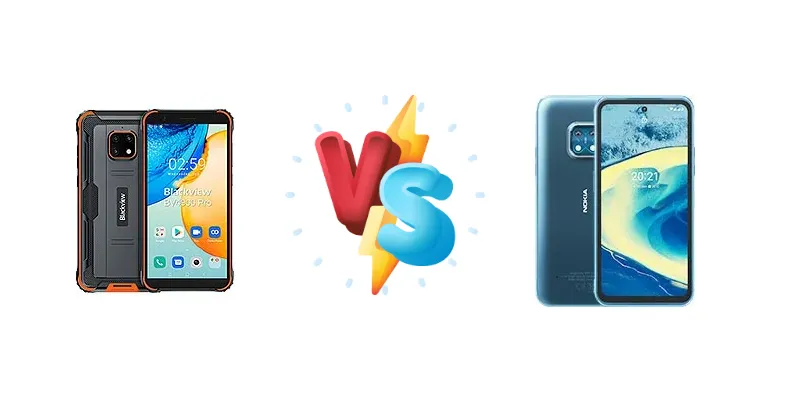
The rugged smartphone market caters to a specific need: durability. Both the Blackview BV4900 Pro and Nokia XR20 aim to deliver on that promise, but they approach it with vastly different internal hardware. The BV4900 Pro focuses on affordability, while the XR20 brings 5G connectivity and Nokia’s software experience to the table. This comparison dissects their key differences to help you choose the right tool for your demanding lifestyle.
🏆 Quick Verdict
For the average user prioritizing future-proofing and smoother performance, the Nokia XR20 is the better choice. Its Snapdragon 480 5G chipset, built on an 8nm process, offers a significant performance advantage and 5G support over the Blackview BV4900 Pro’s older Helio P22. However, the BV4900 Pro remains a compelling option for budget-conscious buyers.
| Network |
|---|
| 2G bands | GSM 850 / 900 / 1800 / 1900 | GSM 850 / 900 / 1800 / 1900 |
| 3G bands | HSDPA 850 / 900 / 1700(AWS) / 1900 / 2100 | HSDPA 850 / 900 / 1700(AWS) / 1900 / 2100 |
| 4G bands | 1, 3, 7, 8, 20, 40 | 1, 2, 3, 4, 5, 7, 8, 12, 13, 14, 20, 25, 26, 28, 30, 38, 40, 41, 48, 66, 71 |
| 5G bands | - | 2, 5, 25, 38, 41, 48, 66, 77, 78 SA/NSA |
| Speed | HSPA, LTE | HSPA, LTE, 5G |
| Technology | GSM / HSPA / LTE | GSM / CDMA / HSPA / EVDO / LTE / 5G |
| | - | CDMA2000 1xEV-DO |
| Launch |
|---|
| Announced | 2020, October 18. Released 2020, November | 2021, July 27 |
| Status | Discontinued | Available. Released 2021, August 04 |
| Body |
|---|
| Dimensions | 157.5 x 78.1 x 13.7 mm (6.20 x 3.07 x 0.54 in) | 171.6 x 81.5 x 10.6 mm (6.76 x 3.21 x 0.42 in) |
| SIM | Nano-SIM + Nano-SIM | · Nano-SIM· Nano-SIM + Nano-SIM |
| Weight | 261 g (9.21 oz) | 248 g (8.75 oz) |
| | - | IP68 dust/water resistant (up to 1.5m for 60 min)
Drop-to-concrete resistance from up to 1.8m
MIL-STD-810H compliant |
| Display |
|---|
| Protection | Dragontrail Glass | Corning Gorilla Glass Victus |
| Resolution | 720 x 1440 pixels, 18:9 ratio (~282 ppi density) | 1080 x 2400 pixels, 20:9 ratio (~395 ppi density) |
| Size | 5.7 inches, 83.8 cm2 (~68.2% screen-to-body ratio) | 6.67 inches, 107.4 cm2 (~76.8% screen-to-body ratio) |
| Type | IPS LCD | IPS LCD, 550 nits |
| Platform |
|---|
| CPU | Octa-core 2.0 GHz Cortex-A53 | Octa-core (2x2.0 GHz Kryo 460 & 6x1.8 GHz Kryo 460) |
| Chipset | Mediatek MT6762V/WD Helio P22 (12 nm) | Qualcomm SM4350 Snapdragon 480 5G (8 nm) |
| GPU | PowerVR GE8320 | Adreno 619 |
| OS | Android 10 | Android 11, upgradable to Android 13 |
| Memory |
|---|
| Card slot | microSDXC | microSDXC (uses shared SIM slot) |
| Internal | 64GB 4GB RAM | 64GB 4GB RAM, 128GB 6GB RAM |
| Main Camera |
|---|
| Dual | - | 48 MP, f/1.8, (wide), 1/2.25", 0.8µm, PDAF
13 MP, f/2.4, 123˚ (ultrawide), 1/3.0", 1.12µm |
| Features | LED flash | Zeiss optics, Dual-LED dual-tone flash, second LED flash, HDR, panorama |
| Single | 13 MP, f/2.2, (wide), AF | 8 MP, f/2.0 (wide), 1/4.0", 1.12µm |
| Video | 1080p@30fps | 1080p@30fps |
| Selfie camera |
|---|
| Single | 5 MP, f/2.2, (wide) | 8 MP, f/2.0 (wide), 1/4.0", 1.12µm |
| Video | Yes | 1080p@30fps |
| Sound |
|---|
| 3.5mm jack | - | Yes |
| 35mm jack | Yes | Yes |
| Loudspeaker | Yes | Yes, with stereo speakers |
| Comms |
|---|
| Bluetooth | 5.0, A2DP, LE | 5.1, A2DP, LE, aptX Adaptive |
| NFC | Yes | Yes |
| Positioning | GPS, GLONASS, GALILEO, BDS | GPS (L1+L5), GLONASS, BDS, GALILEO, QZSS, NavIC |
| Radio | FM radio | Unspecified |
| USB | microUSB 2.0, OTG | USB Type-C 3.0 |
| WLAN | Wi-Fi 802.11 a/b/g/n/ac, dual-band | Wi-Fi 802.11 a/b/g/n/ac/6, dual-band, Wi-Fi Direct |
| Features |
|---|
| Sensors | Fingerprint (side-mounted), accelerometer, gyro, proximity, compass | Fingerprint (side-mounted), accelerometer, gyro, proximity, compass, barometer |
| Battery |
|---|
| Charging | - | 18W wired
15W wireless |
| Type | 5580 mAh | Li-Po 4630 mAh |
| Misc |
|---|
| Colors | Black, Orange, Green, Yellow | Ultra Blue, Granite Gray |
| Models | - | TA-1368, TA-1362 |
| Price | About 140 EUR | About 270 EUR |
| SAR EU | - | 1.13 W/kg (head) 1.43 W/kg (body) |
Blackview BV4900 Pro
- Highly affordable price point
- Rugged design for demanding environments
- Potentially larger battery capacity (unconfirmed)
- Outdated Helio P22 chipset
- No 5G connectivity
- Likely slower performance and lower efficiency
Nokia XR20
- 5G connectivity for faster data speeds
- More efficient Snapdragon 480 chipset
- Nokia’s clean Android software experience
- Higher price compared to the BV4900 Pro
- Wireless charging is slower than wired
- May not be as aggressively priced as competitors
Display Comparison
Neither device boasts a cutting-edge display. Details regarding panel type (IPS vs AMOLED) and resolution are missing for the BV4900 Pro, suggesting a standard LCD. The Nokia XR20’s display specs are also not provided, but Nokia typically uses durable glass. The key difference lies in processing power; the XR20’s Snapdragon 480 can handle more complex display rendering tasks, potentially resulting in smoother animations and transitions. The lack of high refresh rate support on either device suggests a focus on battery conservation rather than visual fluidity.
Camera Comparison
Without detailed camera specifications beyond the presence of cameras, a direct comparison is difficult. However, the XR20’s Snapdragon 480 includes a more advanced image signal processor (ISP) capable of better noise reduction and dynamic range. The BV4900 Pro likely relies on older image processing algorithms. The absence of information regarding sensor sizes suggests both phones utilize budget-oriented sensors. Expect acceptable image quality in good lighting conditions, but performance will likely degrade significantly in low-light scenarios. The inclusion of a 2MP macro camera on either device is largely a marketing gimmick, offering minimal practical benefit.
Performance
The performance gap is the most significant differentiator. The Nokia XR20’s Qualcomm Snapdragon 480 5G, fabricated on an 8nm process, is a substantial upgrade over the Blackview BV4900 Pro’s MediaTek Helio P22 (12nm). The 8nm process translates to improved power efficiency and reduced thermal throttling. While both are octa-core CPUs, the Snapdragon 480’s Kryo 460 cores offer a more modern architecture and higher clock speeds (2.0 GHz vs 2.0 GHz Cortex-A53), resulting in noticeably faster app loading times and smoother multitasking. The XR20’s Adreno 619 GPU also provides a significant boost in graphics performance, making it better suited for light gaming.
Battery Life
Battery capacity details are missing for the BV4900 Pro, but rugged phones typically prioritize large batteries. The Nokia XR20 offers 18W wired and 15W wireless charging, providing convenient charging options. The Helio P22’s less efficient 12nm process in the BV4900 Pro will likely result in shorter battery life despite a potentially larger capacity. The XR20’s Snapdragon 480, with its 8nm process, offers better power management, potentially offsetting a smaller battery capacity with longer real-world usage.
Buying Guide
Buy the Blackview BV4900 Pro if you need a highly affordable, extremely durable phone for basic tasks and aren’t concerned with 5G or demanding applications. It’s ideal for construction workers or those in similarly harsh environments where a phone is a tool, not a status symbol. Buy the Nokia XR20 if you prefer a more refined software experience, require 5G connectivity for faster data speeds, and anticipate using more demanding apps or occasional gaming. It’s suited for outdoor enthusiasts who want a reliable and capable companion.
Frequently Asked Questions
❓ Does the Blackview BV4900 Pro struggle with multitasking or demanding apps?
Yes, the Helio P22 chipset is an older processor and will likely exhibit noticeable lag when running multiple apps simultaneously or handling graphically intensive tasks. It’s best suited for basic communication, navigation, and light usage.
❓ Is the Nokia XR20’s 18W charging speed considered fast charging in 2024?
18W charging is relatively slow compared to the 30W, 65W, or even 120W charging speeds found on many modern smartphones. However, it’s adequate for a rugged phone where battery longevity and durability are prioritized over rapid charging.
❓ How does the Nokia XR20’s software update policy compare to Blackview’s?
Nokia is known for its commitment to software updates, promising at least three years of security updates and two major Android version upgrades. Blackview’s update policy is less consistent and typically offers fewer updates over the device’s lifespan.
❓ Will the Nokia XR20 work with all 5G carriers?
The Nokia XR20 supports a range of 5G bands, but compatibility will depend on your specific carrier and region. It’s crucial to check with your carrier to ensure the XR20 is compatible with their 5G network before purchasing.