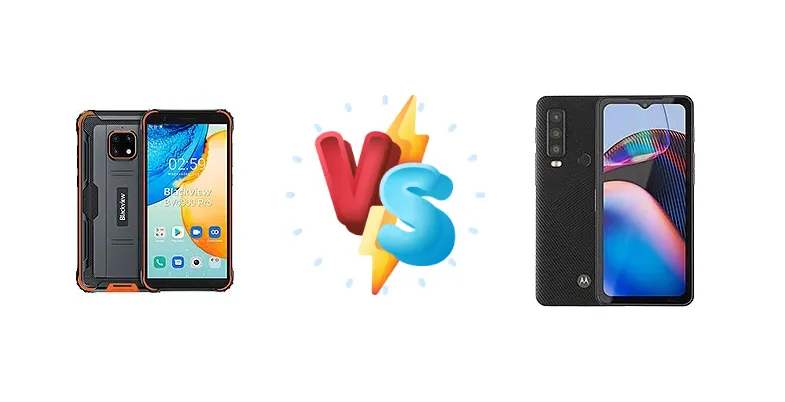
The rugged smartphone market caters to a specific need: durability. However, performance and features vary wildly. We pit the Blackview BV4900 Pro, a budget-focused option, against the Motorola Defy 2, which aims to bring modern processing power and convenience features like wireless charging to the rugged space.
🏆 Quick Verdict
For the average user prioritizing performance and future-proofing, the Motorola Defy 2 is the clear winner. Its Dimensity 930 chipset delivers a substantial upgrade over the BV4900 Pro’s Helio P22, making it significantly faster for everyday tasks and demanding applications. While the BV4900 Pro offers a lower entry price, the Defy 2’s efficiency and features justify the cost.
| Network |
|---|
| 2G bands | GSM 850 / 900 / 1800 / 1900 | GSM 850 / 900 / 1800 / 1900 |
| 3G bands | HSDPA 850 / 900 / 1700(AWS) / 1900 / 2100 | HSDPA 850 / 900 / 1700(AWS) / 1900 / 2100 |
| 4G bands | 1, 3, 7, 8, 20, 40 | 1, 2, 3, 4, 5, 7, 8, 12, 13, 14, 17, 20, 25, 26, 28, 30, 38, 40, 41, 46, 48, 66, 71 |
| 5G bands | - | 2, 5, 23, 25, 26, 28, 38, 41, 48, 66, 70, 71, 77, 78, 255, 256 SA/NSA/Sub6/mmWave |
| Speed | HSPA, LTE | HSPA, LTE, 5G |
| Technology | GSM / HSPA / LTE | GSM / HSPA / LTE / 5G |
| Launch |
|---|
| Announced | 2020, October 18. Released 2020, November | 2023, February 24 |
| Status | Discontinued | Available. Released 2023, October |
| Body |
|---|
| Build | - | Glass front (Gorilla Glass Victus), plastic back, aluminum frame |
| Dimensions | 157.5 x 78.1 x 13.7 mm (6.20 x 3.07 x 0.54 in) | 171 x 80 x 11.9 mm (6.73 x 3.15 x 0.47 in) |
| SIM | Nano-SIM + Nano-SIM | Nano-SIM + Nano-SIM |
| Weight | 261 g (9.21 oz) | 268 g (9.45 oz) |
| | - | IP68/IP69 dust/water resistant (up to 5m for 35 min)
Drop-to-concrete resistance from up to 1.8m
MIL-STD-810H compliant |
| Display |
|---|
| Protection | Dragontrail Glass | Corning Gorilla Glass Victus |
| Resolution | 720 x 1440 pixels, 18:9 ratio (~282 ppi density) | 1080 x 2408 pixels, 20:9 ratio (~400 ppi density) |
| Size | 5.7 inches, 83.8 cm2 (~68.2% screen-to-body ratio) | 6.6 inches, 104.9 cm2 (~76.7% screen-to-body ratio) |
| Type | IPS LCD | IPS LCD, 120Hz |
| Platform |
|---|
| CPU | Octa-core 2.0 GHz Cortex-A53 | Octa-core (2x2.2 GHz Cortex-A78 & 6x2.0 GHz Cortex-A55) |
| Chipset | Mediatek MT6762V/WD Helio P22 (12 nm) | Mediatek Dimensity 930 (6 nm) |
| GPU | PowerVR GE8320 | IMG BXM-8-256 |
| OS | Android 10 | Android 12 |
| Memory |
|---|
| Card slot | microSDXC | microSDXC (uses shared SIM slot) |
| Internal | 64GB 4GB RAM | 128GB 6GB RAM |
| Main Camera |
|---|
| Features | LED flash | Dual-LED flash, HDR, panorama |
| Single | 13 MP, f/2.2, (wide), AF | - |
| Triple | - | 50 MP, f/1.8, (wide), PDAF
8 MP, f/2.2, (ultrawide)
2 MP (macro) |
| Video | 1080p@30fps | 1080p@30fps |
| Selfie camera |
|---|
| Single | 5 MP, f/2.2, (wide) | 8 MP, f/2.0, (wide) |
| Video | Yes | 1080p@30fps |
| Sound |
|---|
| 3.5mm jack | - | No |
| 35mm jack | Yes | No |
| Loudspeaker | Yes | Yes |
| Comms |
|---|
| Bluetooth | 5.0, A2DP, LE | 5.1, A2DP, LE |
| NFC | Yes | Yes |
| Positioning | GPS, GLONASS, GALILEO, BDS | GPS (L1+L5), GLONASS, GALILEO, BDS |
| Radio | FM radio | Unspecified |
| USB | microUSB 2.0, OTG | USB Type-C 2.0, OTG |
| WLAN | Wi-Fi 802.11 a/b/g/n/ac, dual-band | Wi-Fi 802.11 a/b/g/n/ac, dual-band |
| Features |
|---|
| Sensors | Fingerprint (side-mounted), accelerometer, gyro, proximity, compass | Fingerprint (rear-mounted), accelerometer, gyro, proximity, compass |
| | - | Emergency SOS via satellite (Bullitt Satellite Connect service) |
| Battery |
|---|
| Charging | - | 15W wireless |
| Type | 5580 mAh | Li-Po 5000 mAh |
| Misc |
|---|
| Colors | Black, Orange, Green, Yellow | Black |
| Models | - | BM1S1B |
| Price | About 140 EUR | About 570 EUR |
Blackview BV4900 Pro
- Extremely affordable price point
- Ruggedized design for durability
- Basic functionality for essential tasks
- Outdated and slow processor
- Likely limited camera performance
- No wireless charging
Motorola Defy 2
- Significantly faster processor (Dimensity 930)
- 5G connectivity for faster data speeds
- Wireless charging for added convenience
- Higher price compared to the BV4900 Pro
- Rugged design may be bulkier
- Display specifications are not high-end
Display Comparison
Neither device boasts a cutting-edge display. The Blackview BV4900 Pro’s display specifications are not provided, but given its price point, it likely utilizes an IPS LCD panel with modest brightness. The Motorola Defy 2, while also likely IPS LCD, benefits from a more modern manufacturing process and potentially better color calibration. The lack of high refresh rates on either device is typical for this segment, prioritizing battery life over visual fluidity. Bezels are expected to be noticeable on both, reflecting their focus on durability rather than sleek aesthetics.
Camera Comparison
Detailed camera specifications for the Blackview BV4900 Pro are unavailable, but rugged phones in this price range typically feature basic camera setups. The Motorola Defy 2’s camera details are also limited in the provided data, but the chipset’s image signal processor (ISP) is far more capable than the one found in the Helio P22. This allows for better image processing, noise reduction, and dynamic range. While neither phone is likely to compete with flagship camera phones, the Defy 2 will offer a noticeably improved photography experience, particularly in challenging lighting conditions. The presence of a dedicated ISP in the Dimensity 930 also suggests better video recording capabilities.
Performance
The performance disparity is the most significant difference. The Blackview BV4900 Pro’s Mediatek MT6762V/WD Helio P22 (12nm) is a budget chipset based on older Cortex-A53 cores. This translates to noticeable lag when multitasking or running demanding apps. Conversely, the Motorola Defy 2’s Mediatek Dimensity 930 (6nm) is a substantial leap forward. Its combination of two high-performance Cortex-A78 cores and six efficiency-focused Cortex-A55 cores delivers significantly faster processing speeds and improved power efficiency. The 6nm process node further enhances efficiency, reducing heat and improving sustained performance. This means smoother gaming, faster app loading times, and a more responsive user experience on the Defy 2.
Battery Life
Battery capacity isn’t specified for either device, but the Motorola Defy 2’s 6nm Dimensity 930 chipset offers a significant advantage in power efficiency. This means it can deliver comparable or even better battery life than the BV4900 Pro, despite potentially having a similar or smaller battery capacity. Furthermore, the Defy 2 includes 15W wireless charging, a convenience feature absent on the BV4900 Pro. While 15W isn’t particularly fast, it provides a flexible charging option, especially useful in outdoor scenarios where access to a cable might be limited.
Buying Guide
Buy the Blackview BV4900 Pro if you need an extremely affordable, basic rugged phone for essential communication and light tasks, and are willing to compromise on speed and responsiveness. Buy the Motorola Defy 2 if you prefer a more modern smartphone experience with significantly faster performance, 5G connectivity, and the convenience of wireless charging, even within a ruggedized form factor.
Frequently Asked Questions
❓ Is the Mediatek Dimensity 930 in the Motorola Defy 2 prone to overheating during extended gaming sessions?
The Dimensity 930 is a relatively efficient chipset built on a 6nm process. While it will generate heat under sustained load, its thermal management is generally good, and the Motorola Defy 2’s ruggedized design likely incorporates heat dissipation features to prevent significant throttling. It’s unlikely to overheat to the point of being unusable, offering a much better gaming experience than the BV4900 Pro.
❓ How does the 15W wireless charging on the Motorola Defy 2 compare to faster wireless charging options found on other smartphones?
15W wireless charging is slower than the 30W, 50W, or even 65W wireless charging found on some flagship devices. However, it’s a valuable convenience feature for a rugged phone, allowing you to charge without needing to plug in a cable, which can be beneficial in outdoor or work environments. It’s a trade-off for the ruggedized design and lower price point.
❓ Given the Helio P22's age, will the Blackview BV4900 Pro receive software updates?
Software update support for the Blackview BV4900 Pro is likely to be limited. The Helio P22 is an older chipset, and Blackview’s track record for long-term software support is not extensive. Expect minimal security patches and potentially no major Android version updates.