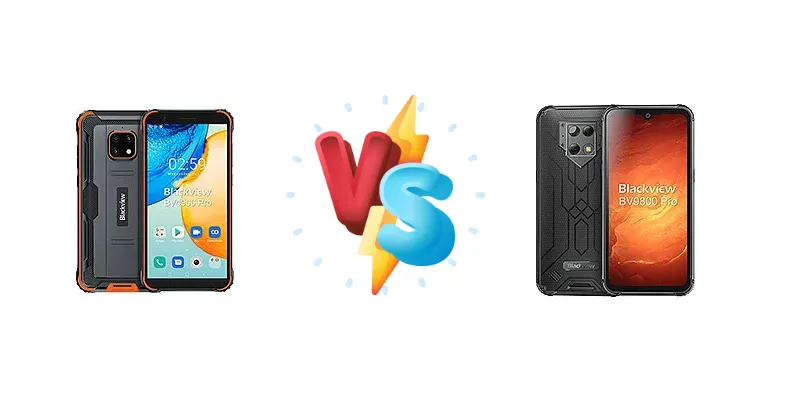
Blackview has carved a niche with its durable, rugged smartphones. We pit the BV4900 Pro, a value-focused option, against the BV9800 Pro, which aims for a more substantial performance uplift. This comparison dissects the key differences to help you determine which device best matches your needs and budget.
🏆 Quick Verdict
For most users prioritizing affordability and essential functionality, the Blackview BV4900 Pro offers a compelling package. However, the BV9800 Pro’s Helio P70 chipset delivers a noticeable performance advantage, making it the better choice for users who demand smoother multitasking and occasional gaming.
| Network |
|---|
| 2G bands | GSM 850 / 900 / 1800 / 1900 | GSM 850 / 900 / 1800 / 1900 |
| 3G bands | HSDPA 850 / 900 / 1700(AWS) / 1900 / 2100 | HSDPA 800 / 850 / 900 / 1700(AWS) / 1900 / 2100 |
| 4G bands | 1, 3, 7, 8, 20, 40 | 1, 2, 3, 4, 5, 6, 7, 8, 12, 13, 17, 18, 19, 20, 25, 26, 28, 34, 38, 39, 40, 41, 66 |
| Speed | HSPA, LTE | HSPA, LTE |
| Technology | GSM / HSPA / LTE | GSM / CDMA / HSPA / CDMA2000 / LTE |
| Launch |
|---|
| Announced | 2020, October 18. Released 2020, November | 2019, October 28. Released 2019, November |
| Status | Discontinued | Discontinued |
| Body |
|---|
| Dimensions | 157.5 x 78.1 x 13.7 mm (6.20 x 3.07 x 0.54 in) | 168.5 x 81 x 14.8 mm (6.63 x 3.19 x 0.58 in) |
| SIM | Nano-SIM + Nano-SIM | Nano-SIM + Nano-SIM |
| Weight | 261 g (9.21 oz) | 322 g (11.36 oz) |
| Display |
|---|
| Protection | Dragontrail Glass | - |
| Resolution | 720 x 1440 pixels, 18:9 ratio (~282 ppi density) | 1080 x 2340 pixels, 19.5:9 ratio (~409 ppi density) |
| Size | 5.7 inches, 83.8 cm2 (~68.2% screen-to-body ratio) | 6.3 inches, 97.4 cm2 (~71.4% screen-to-body ratio) |
| Type | IPS LCD | IPS LCD |
| Platform |
|---|
| CPU | Octa-core 2.0 GHz Cortex-A53 | Octa-core (4x2.1 GHz Cortex-A73 & 4x2.0 GHz Cortex-A53) |
| Chipset | Mediatek MT6762V/WD Helio P22 (12 nm) | Mediatek MT6771V/CT Helio P70 (12 nm) |
| GPU | PowerVR GE8320 | Mali-G72 MP3 |
| OS | Android 10 | Android 9.0 (Pie) |
| Memory |
|---|
| Card slot | microSDXC | microSDXC |
| Internal | 64GB 4GB RAM | 128GB 6GB RAM |
| Main Camera |
|---|
| Features | LED flash | Thermal imaging, LED flash |
| Single | 13 MP, f/2.2, (wide), AF | - |
| Triple | - | 48 MP, (wide), PDAF
5 MP, thermal assisted camera
FLIR thermal camera (Lepton module) |
| Video | 1080p@30fps | 1080p@30fps |
| Selfie camera |
|---|
| Single | 5 MP, f/2.2, (wide) | 16 MP, f/2.0, (wide) |
| Video | Yes | 1080p@30fps |
| Sound |
|---|
| 35mm jack | Yes | Yes |
| Loudspeaker | Yes | Yes |
| Comms |
|---|
| Bluetooth | 5.0, A2DP, LE | 4.1, A2DP |
| NFC | Yes | Yes |
| Positioning | GPS, GLONASS, GALILEO, BDS | GPS, GLONASS, GALILEO |
| Radio | FM radio | FM radio |
| USB | microUSB 2.0, OTG | USB Type-C 2.0, OTG |
| WLAN | Wi-Fi 802.11 a/b/g/n/ac, dual-band | Wi-Fi 802.11 a/b/g/n/ac |
| Features |
|---|
| Sensors | Fingerprint (side-mounted), accelerometer, gyro, proximity, compass | Fingerprint (side-mounted), accelerometer, gyro, proximity, compass, barometer |
| Battery |
|---|
| Charging | - | 18W wired |
| Type | 5580 mAh | 6580 mAh |
| Misc |
|---|
| Colors | Black, Orange, Green, Yellow | Black, Orange |
| Price | About 140 EUR | About 340 EUR |
Blackview BV4900 Pro
- More affordable price point
- Reliable performance for basic tasks
- Rugged design for durability
- Less powerful processor
- Slower charging speeds
Blackview BV9800 Pro
- Faster and more responsive performance
- 18W fast charging support
- Potentially better camera system
- Higher price tag
- May not offer a dramatically different experience for basic users
Display Comparison
Neither device’s display specifications are provided, so a direct comparison is limited. However, given the BV9800 Pro’s positioning as a more premium device, it likely features a slightly higher quality panel with potentially better color accuracy and viewing angles. Both are likely to utilize IPS LCD technology common in this price bracket. The absence of high refresh rate support on either model suggests a focus on battery conservation rather than visual fluidity.
Camera Comparison
Without detailed camera specifications, a precise comparison is difficult. However, the BV9800 Pro’s higher price point suggests a potentially more capable camera system. Both devices likely feature multiple rear cameras, but the BV9800 Pro may benefit from a larger primary sensor or improved image processing algorithms. The presence of a dedicated Night Mode or HDR functionality would be a key differentiator, but this information is unavailable. It’s reasonable to assume both phones include standard features like phase detection autofocus, but the BV9800 Pro is more likely to offer better low-light performance.
Performance
The core difference lies in the chipsets. The BV4900 Pro utilizes the Mediatek Helio P22 (MT6762V/WD), featuring an octa-core CPU clocked at 2.0 GHz, all Cortex-A53 cores. The BV9800 Pro steps up to the Helio P70 (MT6771V/CT), boasting a more sophisticated octa-core configuration: four Cortex-A73 cores at 2.1 GHz paired with four Cortex-A53 cores at 2.0 GHz. This architectural shift is significant; the A73 cores offer substantially higher single-core performance, translating to snappier app launches and smoother overall responsiveness. The P70 also includes an improved GPU, providing a better gaming experience. While both are built on a 12nm process, the P70’s more efficient design and powerful cores will result in better sustained performance under load.
Battery Life
Battery capacity isn’t specified for either device. However, the BV9800 Pro’s inclusion of 18W wired charging is a clear advantage. While the BV4900 Pro likely supports standard 10W or 15W charging, the 18W support on the BV9800 Pro will significantly reduce charging times, offering greater convenience. The actual battery life will depend on usage patterns, but the more efficient Helio P70 in the BV9800 Pro could potentially offset a slightly smaller battery capacity.
Buying Guide
Buy the Blackview BV4900 Pro if you need a reliable, durable smartphone for basic tasks like communication, navigation, and light media consumption, and prioritize a lower price point. Buy the Blackview BV9800 Pro if you prefer a more responsive experience for multitasking, enjoy mobile gaming, and appreciate the faster 18W charging, even if it comes at a higher cost.
Frequently Asked Questions
❓ Will the Helio P70 in the BV9800 Pro handle demanding games like PUBG Mobile smoothly?
The Helio P70 is a capable chipset and should provide a noticeably smoother gaming experience compared to the Helio P22 in the BV4900 Pro. While it won't match flagship-level performance, you should be able to play PUBG Mobile at medium settings with acceptable frame rates. However, sustained performance may be limited by thermal throttling, a common issue in rugged phones.
❓ Is the difference in performance between the Helio P22 and Helio P70 noticeable for everyday tasks like browsing and social media?
Yes, the difference is noticeable. The Helio P70’s Cortex-A73 cores provide a significant boost in single-core performance, which directly impacts app launch speeds and overall responsiveness. While the BV4900 Pro is adequate for basic tasks, the BV9800 Pro will feel snappier and more fluid during everyday use.
❓ Does the 18W charging on the BV9800 Pro make a significant difference in real-world charging times?
Absolutely. 18W charging is considerably faster than the standard 10W or 15W charging likely found on the BV4900 Pro. You can expect to charge the BV9800 Pro from 0% to 100% in significantly less time, offering a more convenient charging experience, especially for users who frequently need to top up their battery.