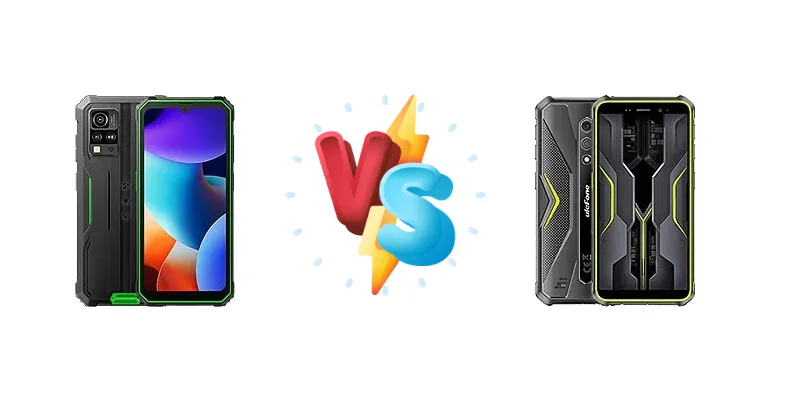
The rugged smartphone market offers a compelling alternative for users prioritizing durability and battery life. Both the Blackview BV4800 Pro and Ulefone Armor X12 Pro aim to deliver on these fronts at an accessible price point. However, they take different approaches to achieving this, particularly in their chipset and battery optimization strategies. This comparison will dissect these differences to determine which device best suits your needs.
🏆 Quick Verdict
For the average user needing a reliable, long-lasting rugged phone, the Ulefone Armor X12 Pro is the better choice. Its significantly longer 48:31h battery endurance, coupled with a respectable Helio G36 chipset, provides a more consistently usable experience despite the BV4800 Pro's slightly more modern CPU architecture.
| Network |
|---|
| 2G bands | GSM 850 / 900 / 1800 / 1900 | GSM 850 / 900 / 1800 / 1900 |
| 3G bands | HSDPA 850 / 900 / 1700(AWS) / 1900 / 2100 | HSDPA 850 / 900 / 1700(AWS) / 1900 / 2100 |
| 4G bands | 2, 3, 4, 5, 7, 12, 13, 17, 26, 28, 40, 41, 66 | 1, 2, 3, 4, 5, 7, 8, 12, 17, 19, 20, 28 |
| Speed | HSPA, LTE | HSPA, LTE |
| Technology | GSM / HSPA / LTE | GSM / HSPA / LTE |
| Launch |
|---|
| Announced | 2024, December | 2023, August |
| Status | Available. Released 2024, December | Available. Released 2023, August |
| Body |
|---|
| Dimensions | 174.7 x 81.5 x 13.5 mm (6.88 x 3.21 x 0.53 in) | 157.2 x 76.8 x 14.3 mm (6.19 x 3.02 x 0.56 in) |
| SIM | Nano-SIM + Nano-SIM | Nano-SIM + Nano-SIM |
| Weight | 285 g (10.05 oz) | 257 g (9.07 oz) |
| Display |
|---|
| Protection | Corning Gorilla Glass 5, Mohs level 5 | Mohs level 4 |
| Resolution | 720 x 1612 pixels, 20:9 ratio (~269 ppi density) | 720 x 1440 pixels, 18:9 ratio (~295 ppi density) |
| Size | 6.56 inches, 103.4 cm2 (~72.6% screen-to-body ratio) | 5.45 inches, 76.7 cm2 (~63.5% screen-to-body ratio) |
| Type | IPS LCD | IPS LCD |
| Platform |
|---|
| CPU | Octa-core (2x1.6 GHz Cortex-A75 & 6x1.6 GHz Cortex-A55) | Octa-core (4x2.2 GHz Cortex-A53 & 4x1.7 GHz Cortex-A53) |
| Chipset | Unisoc T606 (12 nm) | Mediatek Helio G36 (12 nm) |
| GPU | Mali-G57 MP1 | PowerVR GE8320 |
| OS | Android 14, DokeOS 4.0 | Android 13 |
| Memory |
|---|
| Card slot | microSDXC (dedicated slot) | microSDXC (dedicated slot) |
| Internal | 128GB 4GB RAM | 64GB 4GB RAM |
| Main Camera |
|---|
| Dual | 16 MP, f/2.2, (wide), AF
2 MP, f/2.8 | - |
| Features | LED flash | LED flash |
| Single | - | 13 MP, f/2.2, (wide), 1.12µm, PDAF |
| Video | 1080p@30fps | 1080p@30fps |
| Selfie camera |
|---|
| Single | 8 MP, f/2.2, (wide) | 8 MP, f/2.0, (wide), 1.4µm |
| Video | 720p@30fps | Yes |
| Sound |
|---|
| 35mm jack | No | Yes |
| Loudspeaker | Yes | Yes |
| Comms |
|---|
| Bluetooth | 5.0, A2DP, LE | 5.0, A2DP, LE |
| NFC | Yes | Yes |
| Positioning | GPS, GLONASS, GALILEO, BDS | GPS, GLONASS, GALILEO, BDS |
| Radio | FM radio | Wireless FM radio, RDS, recording |
| USB | USB Type-C 2.0, OTG | USB Type-C 2.0 |
| WLAN | Wi-Fi 802.11 a/b/g/n/ac, dual-band | Wi-Fi 802.11 a/b/g/n/ac, dual-band |
| Features |
|---|
| Sensors | Fingerprint (side-mounted), accelerometer, gyro, proximity, compass | Accelerometer, proximity |
| Battery |
|---|
| Charging | 10W wired | 10W wired |
| Type | 5180 mAh | Li-Po 4860 mAh |
| Misc |
|---|
| Colors | Black, Orange, Green | Black, Black/Orange, Black/Green |
| Price | - | About 130 EUR |
| EU LABEL |
|---|
| Battery | 43:06h endurance, 800 cycles | 48:31h endurance, 1000 cycles |
| Energy | Class C | Class B |
| Free fall | Class A (270 falls) | Class A (270 falls) |
| Repairability | Class C | Class C |
Blackview BV4800 Pro
- More modern CPU architecture (Unisoc T606)
- Potentially faster app launch times
- Slightly more powerful single-core performance
- Shorter battery life (43:06h endurance)
- Fewer battery cycles (800)
- Likely similar camera performance to the X12 Pro
Ulefone Armor X12 Pro
- Significantly longer battery life (48:31h endurance)
- More battery cycles (1000)
- Respectable performance from Helio G36
- Older CPU architecture (MediaTek Helio G36)
- Potentially slower app launch times
- Similar camera performance to the BV4800 Pro
Display Comparison
Neither device boasts a standout display. Both likely utilize IPS LCD panels, common in this price bracket. While specific details like peak brightness and color accuracy are unavailable, the focus here is clearly on practicality over visual fidelity. Bezels are expected to be substantial on both, prioritizing screen protection and structural integrity. The absence of high refresh rates or advanced panel technologies like LTPO is typical for rugged phones in this segment.
Camera Comparison
Camera performance is likely to be similar, with both phones likely relying on budget sensors. Details are scarce, but it's safe to assume both will feature a primary sensor, an ultra-wide, and potentially a macro lens. Given the market segment, image processing will prioritize speed and basic functionality over advanced features like computational photography. The presence of a 2MP macro lens on either device is largely for marketing purposes and offers limited practical benefit. Focusing on the primary sensor's megapixel count and aperture would be more indicative of image quality.
Performance
The chipset choice is the key differentiator here. The Blackview BV4800 Pro features the Unisoc T606, a 12nm octa-core processor with a Cortex-A75/A55 configuration. This architecture, while newer, doesn't necessarily translate to superior real-world performance compared to the Ulefone's MediaTek Helio G36. The Helio G36 utilizes a Cortex-A53 cluster, but at a higher clock speed (2.2 GHz vs 1.6 GHz). The A75 cores in the T606 offer better single-core performance, potentially benefiting app launch times, but the Helio G36’s sustained multi-core performance may be more consistent for prolonged tasks. Both chipsets are paired with likely 4GB of RAM, limiting multitasking capabilities.
Battery Life
Battery life is where the Ulefone Armor X12 Pro truly shines. Its 48:31h endurance significantly surpasses the Blackview BV4800 Pro’s 43:06h. This difference is substantial and translates to nearly a full day of additional usage. Both phones share the same 10W wired charging, meaning charge times will be comparable – slow by modern standards. The X12 Pro’s 1000 battery cycles rating also suggests a longer lifespan before significant capacity degradation compared to the BV4800 Pro’s 800 cycles.
Buying Guide
Buy the Blackview BV4800 Pro if you prioritize a newer CPU architecture and anticipate needing the slightly more powerful processing for demanding tasks, even if it comes at the cost of battery life. Buy the Ulefone Armor X12 Pro if your primary concern is maximizing uptime and you need a phone that can reliably last through multi-day use without frequent charging, making it ideal for outdoor adventures or remote work.
Frequently Asked Questions
❓ Will the Helio G36 in the Ulefone Armor X12 Pro struggle with graphically intensive games?
The Helio G36 is an entry-level gaming chipset. While it can handle less demanding titles, you'll likely need to lower graphics settings for more popular games like PUBG or Call of Duty Mobile to achieve playable frame rates. It's not designed for high-end gaming experiences.
❓ How long will it take to fully charge either the Blackview BV4800 Pro or the Ulefone Armor X12 Pro with the 10W charger?
With a 10W charger, expect a full charge to take approximately 3.5 to 4.5 hours for both devices. 10W charging is relatively slow, so overnight charging is recommended. The longer battery endurance of the Ulefone Armor X12 Pro means you won't need to charge it as frequently, mitigating the slow charging speed.
❓ Are these phones waterproof enough for swimming or prolonged submersion?
Both phones are advertised as rugged and likely possess an IP68 or IP69K rating, offering protection against dust and water. However, 'waterproof' is a strong term. They can likely withstand splashes and brief submersion, but prolonged exposure to water, especially saltwater, is not recommended and could compromise the seals.