
Blackview BV4800 Pro vs. Doogee S99: A Rugged Smartphone Showdown
| Phones Images | |||||
|---|---|---|---|---|---|
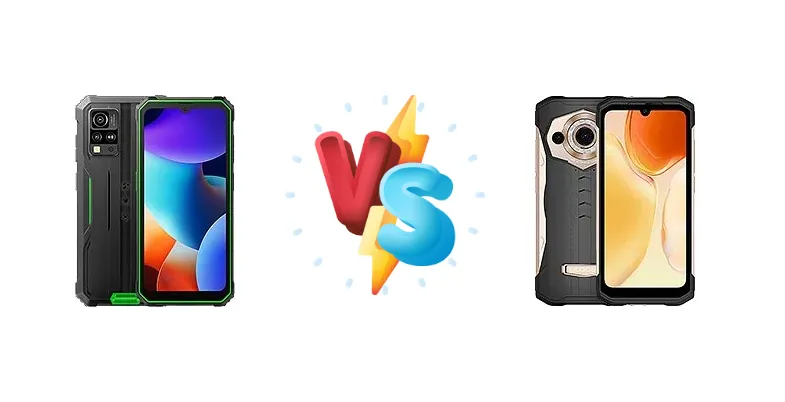
|
🏆 Quick Verdict
For the average user prioritizing all-day (and beyond) battery life and consistent, if not blazing-fast, performance, the Blackview BV4800 Pro is the better choice. However, the Doogee S99’s significantly faster charging and more powerful processor make it ideal for users who frequently push their phone’s limits and value quick power-ups.
| PHONES | ||
|---|---|---|
| Phone Names | Blackview BV4800 Pro | Doogee S99 |
| Network | ||
|---|---|---|
| 2G bands | GSM 850 / 900 / 1800 / 1900 | GSM 850 / 900 / 1800 / 1900 |
| 3G bands | HSDPA 850 / 900 / 1700(AWS) / 1900 / 2100 | HSDPA 800 / 850 / 900 / 1700(AWS) / 1900 / 2100 |
| 4G bands | 2, 3, 4, 5, 7, 12, 13, 17, 26, 28, 40, 41, 66 | 1, 2, 3, 4, 5, 7, 8, 12, 13, 17, 18, 19, 20, 25, 26, 28, 34, 38, 39, 40, 41, 66 |
| Speed | HSPA, LTE | HSPA, LTE |
| Technology | GSM / HSPA / LTE | GSM / CDMA / HSPA / LTE |
| Launch | ||
|---|---|---|
| Announced | 2024, December | 2022, December 05 |
| Status | Available. Released 2024, December | Available. Released 2022, December 05 |
| Body | ||
|---|---|---|
| Dimensions | 174.7 x 81.5 x 13.5 mm (6.88 x 3.21 x 0.53 in) | 172 x 82 x 15.5 mm (6.77 x 3.23 x 0.61 in) |
| SIM | Nano-SIM + Nano-SIM | Nano-SIM + Nano-SIM |
| Weight | 285 g (10.05 oz) | - |
| Display | ||
|---|---|---|
| Protection | Corning Gorilla Glass 5, Mohs level 5 | Corning Gorilla Glass |
| Resolution | 720 x 1612 pixels, 20:9 ratio (~269 ppi density) | 1080 x 2340 pixels, 19.5:9 ratio (~409 ppi density) |
| Size | 6.56 inches, 103.4 cm2 (~72.6% screen-to-body ratio) | 6.3 inches, 97.4 cm2 (~69.1% screen-to-body ratio) |
| Type | IPS LCD | IPS LCD |
| Platform | ||
|---|---|---|
| CPU | Octa-core (2x1.6 GHz Cortex-A75 & 6x1.6 GHz Cortex-A55) | Octa-core (2x2.05 GHz Cortex-A76 & 6x2.0 GHz Cortex-A55) |
| Chipset | Unisoc T606 (12 nm) | Mediatek MT6781 Helio G96 (12 nm) |
| GPU | Mali-G57 MP1 | Mali-G57 MC2 |
| OS | Android 14, DokeOS 4.0 | Android 12 |
| Memory | ||
|---|---|---|
| Card slot | microSDXC (dedicated slot) | microSDXC (dedicated slot) |
| Internal | 128GB 4GB RAM | 128GB 8GB RAM |
| Main Camera | ||
|---|---|---|
| Dual | 16 MP, f/2.2, (wide), AF 2 MP, f/2.8 | - |
| Features | LED flash | Dual-LED flash, HDR, panorama |
| Triple | - | 108 MP, f/1.9, (wide), 1/1.52", 0.7µm, PDAF 64 MP, f/1.8, (night vision), 2 infrared night vision lights 16 MP, f/1.8, 130˚ (ultrawide) |
| Video | 1080p@30fps | 1440p@30fps, 1080p@30fps |
| Selfie camera | ||
|---|---|---|
| Single | 8 MP, f/2.2, (wide) | 32 MP, f/2.0, (wide), 1/2.8", 0.8µm |
| Video | 720p@30fps | 1080p@30fps |
| Sound | ||
|---|---|---|
| 35mm jack | No | No |
| Loudspeaker | Yes | Yes |
| Comms | ||
|---|---|---|
| Bluetooth | 5.0, A2DP, LE | 5.1, A2DP, LE |
| NFC | Yes | Yes (market/region dependent) |
| Positioning | GPS, GLONASS, GALILEO, BDS | GPS, GLONASS, GALILEO, BDS |
| Radio | FM radio | FM radio |
| USB | USB Type-C 2.0, OTG | USB Type-C 2.0, OTG |
| WLAN | Wi-Fi 802.11 a/b/g/n/ac, dual-band | Wi-Fi 802.11 a/b/g/n/ac, dual-band |
| Features | ||
|---|---|---|
| Sensors | Fingerprint (side-mounted), accelerometer, gyro, proximity, compass | Fingerprint (side-mounted), accelerometer, gyro, proximity, compass |
| Battery | ||
|---|---|---|
| Charging | 10W wired | 33W wired, 45% in 30 min 15W wireless Reverse wired |
| Type | 5180 mAh | 6000 mAh |
| Misc | ||
|---|---|---|
| Colors | Black, Orange, Green | Gold, Black |
| Price | - | About 250 EUR |
| EU LABEL | ||
|---|---|---|
| Battery | 43:06h endurance, 800 cycles | - |
| Energy | Class C | - |
| Free fall | Class A (270 falls) | - |
| Repairability | Class C | - |
Blackview BV4800 Pro
- Exceptional battery life (43:06h endurance)
- Reliable performance for everyday tasks
- 800 charge cycles suggest long-term battery health
- Slow 10W charging
- Less powerful processor compared to the Doogee S99
Doogee S99
- Faster and more powerful MediaTek Helio G96 chipset
- 33W wired and 15W wireless charging
- Reverse wired charging for added versatility
- Likely shorter battery life compared to the Blackview BV4800 Pro
- Potentially more thermal throttling under sustained load
Display Comparison
Display specifications are not provided, so a direct comparison is limited. However, given the price points, both likely utilize IPS LCD panels. The focus here is on durability, so expect reinforced glass. The absence of high refresh rates is typical for this segment, prioritizing battery conservation. Bezels are likely to be substantial on both devices, reflecting the rugged design constraints.
Camera Comparison
Camera details are limited. Without sensor size or aperture information, a detailed analysis is difficult. However, the chipset difference suggests the Doogee S99 will have a more capable image signal processor (ISP), leading to better image processing, especially in low-light conditions. The Unisoc T606 in the BV4800 Pro is adequate for basic photography, but the G96 in the S99 offers the potential for more detailed and vibrant images. We can assume both phones will include a standard suite of camera modes, but the S99 is likely to handle complex scenes with greater fidelity.
Performance
The Doogee S99 boasts a clear advantage in processing power with its MediaTek Helio G96 chipset. Its octa-core CPU, featuring 2x2.05 GHz Cortex-A76 cores and 6x2.0 GHz Cortex-A55 cores, significantly outperforms the Blackview BV4800 Pro’s Unisoc T606 (2x1.6 GHz Cortex-A75 & 6x1.6 GHz Cortex-A55). The G96’s architecture is more modern, translating to faster app loading, smoother multitasking, and improved gaming performance. While both chipsets are built on a 12nm process, the G96’s core design provides a noticeable performance uplift. This benefits users who engage in resource-intensive tasks like video editing or mobile gaming.
Battery Life
The Blackview BV4800 Pro’s 43:06h endurance is a standout feature, indicating exceptional battery life. This is likely achieved through a combination of a larger battery capacity (not specified) and the power efficiency of the Unisoc T606 chipset. In contrast, the Doogee S99 prioritizes charging speed with its 33W wired charging (45% in 30 minutes) and 15W wireless charging. The BV4800 Pro’s 10W charging is comparatively slow. The S99’s reverse wired charging is a unique feature, allowing it to charge other devices, a useful capability for outdoor adventures. While the S99’s battery capacity isn’t specified, the faster charging suggests a smaller battery, relying on quick top-ups rather than extended runtime.
Buying Guide
Buy the Blackview BV4800 Pro if you need a phone that can reliably last through multi-day expeditions, work long shifts in remote locations, or simply avoid the daily charging routine. Buy the Doogee S99 if you prefer a more responsive experience for gaming, demanding apps, and appreciate the convenience of 33W wired and 15W wireless charging, even if it means charging more frequently.