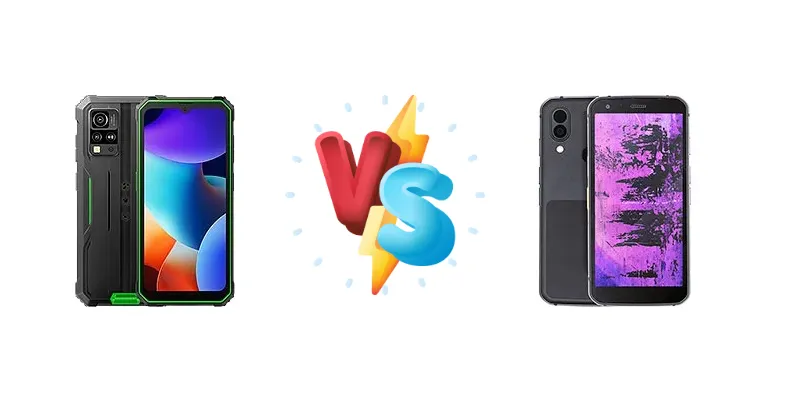
The rugged smartphone market caters to a specific user: those needing a device that can withstand drops, dust, and water. Both the Blackview BV4800 Pro and the Cat S62 Pro aim to deliver this durability, but they take different approaches to performance and longevity. This comparison dives deep into their specifications to determine which phone offers the best balance of toughness and usability.
🏆 Quick Verdict
For the average user prioritizing battery life and value, the Blackview BV4800 Pro emerges as the winner. Its impressive 43-hour endurance and 800 charge cycles significantly outweigh the Cat S62 Pro’s slightly more powerful, but older, chipset. However, users needing proven software support and a more established brand may prefer the Cat S62 Pro.
| Network |
|---|
| 2G bands | GSM 850 / 900 / 1800 / 1900 | GSM 850 / 900 / 1800 / 1900 |
| 3G bands | HSDPA 850 / 900 / 1700(AWS) / 1900 / 2100 | HSDPA 850 / 900 / 1700(AWS) / 1900 / 2100 |
| 4G bands | 2, 3, 4, 5, 7, 12, 13, 17, 26, 28, 40, 41, 66 | 1, 2, 3, 4, 5, 7, 8, 20, 28, 38, 40 |
| Speed | HSPA, LTE | HSPA 42.2/5.76 Mbps, LTE (2CA) Cat13 400/150 Mbps |
| Technology | GSM / HSPA / LTE | GSM / HSPA / LTE |
| Launch |
|---|
| Announced | 2024, December | 2020, June 28. Released 2020, August 17 |
| Status | Available. Released 2024, December | Discontinued |
| Body |
|---|
| Build | - | Glass front (Gorilla Glass 6), plastic back, aluminum frame |
| Dimensions | 174.7 x 81.5 x 13.5 mm (6.88 x 3.21 x 0.53 in) | 158.5 x 76.7 x 11.9 mm (6.24 x 3.02 x 0.47 in) |
| SIM | Nano-SIM + Nano-SIM | · Nano-SIM· Nano-SIM + Nano-SIM |
| Weight | 285 g (10.05 oz) | 248 g (8.75 oz) |
| | - | IP68/IP69 dust/water resistant (up to 1.5m for 35 mins)
Drop-to-concrete resistance from up to 1.8m
MIL-STD-810H compliant |
| Display |
|---|
| Protection | Corning Gorilla Glass 5, Mohs level 5 | Corning Gorilla Glass 6 |
| Resolution | 720 x 1612 pixels, 20:9 ratio (~269 ppi density) | 1080 x 2160 pixels, 18:9 ratio (~424 ppi density) |
| Size | 6.56 inches, 103.4 cm2 (~72.6% screen-to-body ratio) | 5.7 inches, 83.8 cm2 (~69.0% screen-to-body ratio) |
| Type | IPS LCD | IPS LCD |
| Platform |
|---|
| CPU | Octa-core (2x1.6 GHz Cortex-A75 & 6x1.6 GHz Cortex-A55) | Octa-core (4x2.2 GHz Kryo 260 Gold & 4x1.8 GHz Kryo 260 Silver) |
| Chipset | Unisoc T606 (12 nm) | Qualcomm SDM660 Snapdragon 660 (14 nm) |
| GPU | Mali-G57 MP1 | Adreno 512 |
| OS | Android 14, DokeOS 4.0 | Android 10 |
| Memory |
|---|
| Card slot | microSDXC (dedicated slot) | microSDXC (dedicated slot) |
| Internal | 128GB 4GB RAM | 128GB 6GB RAM |
| Main Camera |
|---|
| Dual | 16 MP, f/2.2, (wide), AF
2 MP, f/2.8 | 12 MP, f/1.8, (wide), 1/2.55", 1.4µm, dual pixel PDAF
FLIR thermal camera (Lepton 3.5 module) |
| Features | LED flash | Thermal imaging, heat palettes, temp. spot meter, LED flash |
| Video | 1080p@30fps | 1080p@30fps, gyro-EIS |
| Selfie camera |
|---|
| Single | 8 MP, f/2.2, (wide) | 8 MP |
| Video | 720p@30fps | 1080p@30fps |
| Sound |
|---|
| 3.5mm jack | - | No |
| 35mm jack | No | No |
| Loudspeaker | Yes | Yes |
| Comms |
|---|
| Bluetooth | 5.0, A2DP, LE | 5.0, A2DP, LE |
| NFC | Yes | Yes |
| Positioning | GPS, GLONASS, GALILEO, BDS | GPS, GLONASS, GALILEO, BDS |
| Radio | FM radio | FM radio |
| USB | USB Type-C 2.0, OTG | USB Type-C 2.0, OTG |
| WLAN | Wi-Fi 802.11 a/b/g/n/ac, dual-band | Wi-Fi 802.11 a/b/g/n/ac, dual-band, Wi-Fi Direct |
| Features |
|---|
| Sensors | Fingerprint (side-mounted), accelerometer, gyro, proximity, compass | Fingerprint (rear-mounted), accelerometer, gyro, proximity, compass |
| Battery |
|---|
| Charging | 10W wired | - |
| Type | 5180 mAh | Li-Ion 4000 mAh |
| Misc |
|---|
| Colors | Black, Orange, Green | Black |
| Price | - | About 530 EUR |
| EU LABEL |
|---|
| Battery | 43:06h endurance, 800 cycles | - |
| Energy | Class C | - |
| Free fall | Class A (270 falls) | - |
| Repairability | Class C | - |
Blackview BV4800 Pro
- Exceptional battery life (43:06h endurance)
- Long-lasting battery health (800 charge cycles)
- More power-efficient chipset (Unisoc T606 12nm)
- Less powerful CPU/GPU compared to the Snapdragon 660
- Less established brand reputation
Cat S62 Pro
- More powerful CPU/GPU (Snapdragon 660)
- Established brand with a history in rugged devices
- Potentially better software support
- Older chipset architecture (14nm)
- Likely shorter battery life and fewer charge cycles
Display Comparison
Neither device boasts a cutting-edge display. Details on panel type, resolution, and refresh rate are missing, but the focus here is clearly on durability, not visual fidelity. The absence of LTPO or high refresh rates is expected. The real-world impact will be similar viewing experiences, prioritizing visibility in direct sunlight over color accuracy.
Camera Comparison
Detailed camera specifications are lacking for both devices. Given the target audience, image quality is likely secondary to robustness. We can assume both phones feature capable cameras for documentation purposes, but don't expect flagship-level photography. The presence of a 2MP macro lens on either device is likely a marketing gimmick, offering minimal practical benefit. Sensor size and aperture are critical missing data points.
Performance
The Cat S62 Pro utilizes the Qualcomm Snapdragon 660 (14nm), a chipset known for its stable performance but now several generations old. Its octa-core CPU, with 4x2.2 GHz Kryo 260 Gold and 4x1.8 GHz Kryo 260 Silver cores, offers a performance edge over the Blackview’s Unisoc T606 (12nm). However, the T606’s newer architecture and smaller node size suggest better power efficiency. The Unisoc T606 in the BV4800 Pro, with its 2x1.6 GHz Cortex-A75 & 6x1.6 GHz Cortex-A55 configuration, will handle everyday tasks adequately, but may struggle with demanding applications compared to the Snapdragon 660. The Snapdragon 660’s Adreno 512 GPU will provide a smoother experience for gaming, though neither phone is a gaming powerhouse.
Battery Life
This is where the Blackview BV4800 Pro truly shines. Its 43:06h endurance is exceptional for a rugged phone, and the stated 800 charge cycles indicate long-term battery health. The Cat S62 Pro’s battery capacity is unknown, but its 10W charging speed is significantly slower than the BV4800 Pro’s 10W charging. While the Cat S62 Pro may have a larger capacity, the Blackview’s efficiency and longevity are clear advantages. The 800 cycle rating suggests the BV4800 Pro will maintain a usable capacity for significantly longer.
Buying Guide
Buy the Blackview BV4800 Pro if you need exceptional battery life for extended fieldwork, prioritize affordability without sacrificing durability, and are comfortable with a less-established brand. Buy the Cat S62 Pro if you prefer a brand with a strong reputation in the rugged phone space, require compatibility with specific enterprise software, and value a slightly more responsive user experience despite the older chipset.
Frequently Asked Questions
❓ How does the Unisoc T606 chipset in the Blackview BV4800 Pro handle multitasking compared to the Snapdragon 660?
While the Snapdragon 660 boasts higher clock speeds and a more mature architecture, the Unisoc T606’s newer design and efficient core configuration allow for adequate multitasking for typical rugged phone use cases. However, users frequently switching between many demanding apps may experience slightly slower performance on the Blackview.
❓ Is the Cat S62 Pro likely to receive future software updates and security patches?
Cat phones generally offer better software support than lesser-known brands. However, given the age of the Snapdragon 660, the S62 Pro may have reached the end of its major software update cycle. Expect security patches for a limited time, but don't anticipate Android version upgrades beyond its current release.
❓ What type of charging protocol does the Blackview BV4800 Pro use, and can I use a faster charger?
The Blackview BV4800 Pro supports 10W wired charging via a standard USB-C port. While you can *use* a faster charger, the phone will only draw 10W, so there's no benefit to using a higher wattage adapter. Using a faster charger won't damage the device, but it won't speed up charging times.