
Blackview BL9000 vs. Samsung Galaxy XCover6 Pro: A Rugged Smartphone Battle
| Phones Images | |||||
|---|---|---|---|---|---|
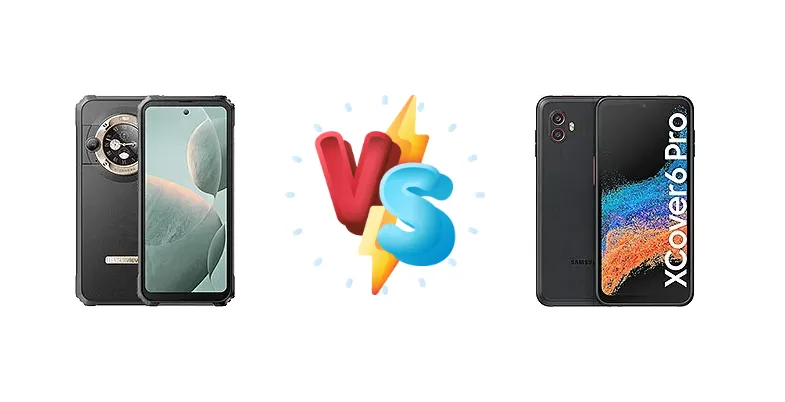
|
🏆 Quick Verdict
For users prioritizing battery life and charging speed, the Blackview BL9000 is the clear winner. Its 87:06h endurance and 120W charging significantly outperform the XCover6 Pro. However, the XCover6 Pro’s Snapdragon chipset and Samsung’s software support make it a compelling choice for those deeply invested in the Samsung ecosystem.
| PHONES | ||
|---|---|---|
| Phone Names | Blackview BL9000 | Samsung Galaxy XCover6 Pro |
| Network | ||
|---|---|---|
| 2G bands | GSM 850 / 900 / 1800 / 1900 | GSM 850 / 900 / 1800 / 1900 |
| 3G bands | HSDPA 850 / 900 / 1700(AWS) / 1900 / 2100 | HSDPA 850 / 900 / 1700(AWS) / 1900 / 2100 |
| 4G bands | 1, 2, 3, 4, 5, 7, 8, 12, 13, 17, 18, 19, 20, 25, 26, 28, 30, 34, 38, 39, 40, 41, 66 | 1, 2, 3, 4, 5, 7, 8, 12, 17, 20, 26, 28, 32, 38, 39, 40, 41, 66 - International |
| 5G bands | 1, 3, 5, 7, 8, 20, 28, 38, 40, 41, 77, 78, 79 SA/NSA | 1, 3, 5, 7, 8, 20, 28, 38, 40, 41, 78 SA/NSA |
| Speed | HSPA, LTE, 5G | HSPA, LTE, 5G |
| Technology | GSM / CDMA / HSPA / LTE / 5G | GSM / HSPA / LTE / 5G |
| Launch | ||
|---|---|---|
| Announced | 2024, January | 2022, June 29 |
| Status | Available. Released 2024, January | Available. Released 2022, July 13 |
| Body | ||
|---|---|---|
| Dimensions | 179.5 x 82.6 x 17 mm (7.07 x 3.25 x 0.67 in) | 168.8 x 79.9 x 9.9 mm (6.65 x 3.15 x 0.39 in) |
| SIM | Nano-SIM + Nano-SIM | · Nano-SIM· Nano-SIM + Nano-SIM |
| Weight | 413 g (14.57 oz) | 235 g (8.29 oz) |
| - | IP68 dust/water resistant (up to 1.5m for 35 min) Drop-to-concrete resistance from up to 1.5m MIL-STD-810H compliant* *does not guarantee ruggedness or use in extreme conditions | |
| Display | ||
|---|---|---|
| Protection | Corning Gorilla Glass Victus, Mohs level 7 | Corning Gorilla Glass Victus+ |
| Resolution | 1080 x 2460 pixels (~396 ppi density) | 1080 x 2408 pixels, 20:9 ratio (~400 ppi density) |
| Size | 6.78 inches, 109.2 cm2 (~73.6% screen-to-body ratio) | 6.6 inches, 104.9 cm2 (~77.8% screen-to-body ratio) |
| Type | IPS LCD, 120Hz | PLS LCD, 120Hz |
| Platform | ||
|---|---|---|
| CPU | Octa-core (4x2.6 GHz Cortex-A78 & 4x2.0 GHz Cortex-A55) | Octa-core (1x2.4 GHz Cortex-A78 & 3x2.2 GHz Cortex-A78 & 4x1.9 GHz Cortex-A55) |
| Chipset | Mediatek Dimensity 8020 (6 nm) | Qualcomm SM7325 Snapdragon 778G 5G (6 nm) |
| GPU | Mali-G77 MC9 | Adreno 642L |
| OS | Android 13, Doke-OS 4.0 | Android 12, upgradable to Android 15, One UI 7 |
| Memory | ||
|---|---|---|
| Card slot | No | microSDXC (dedicated slot) |
| Internal | 512GB 12GB RAM | 128GB 6GB RAM |
| Main Camera | ||
|---|---|---|
| Dual | 50 MP, (wide), 1/1.57", PDAF 13 MP, 120˚, (ultrawide), AF | 50 MP, f/1.8, (wide), 1/2.76", 0.64µm, PDAF 8 MP, f/2.2, 123˚ (ultrawide), 1/4.0", 1.12µm |
| Features | LED flash, HDR, panorama | Dual-LED flash, HDR, panorama |
| Single | - | 50 MP, f/1.8, (wide), 1/2.76", 0.64µm, PDAF 8 MP, f/2.2, 123˚ (ultrawide), 1/4.0", 1.12µm |
| Video | 4K@30fps, 1080p@30fps | 4K@30fps, 1080p@30fps |
| Selfie camera | ||
|---|---|---|
| Features | - | HDR |
| Single | 50 MP, (wide), 1/2.8" | 13 MP, f/2.2, (wide), 1/3.1", 1.12µm |
| Video | 1080p@30fps | 1080p@30fps |
| Sound | ||
|---|---|---|
| 3.5mm jack | - | Yes |
| 35mm jack | No | Yes |
| Loudspeaker | Yes, with stereo speakers | Yes |
| Comms | ||
|---|---|---|
| Bluetooth | 5.1, A2DP, LE | 5.2, A2DP, LE |
| NFC | Yes | Yes |
| Positioning | GPS, GLONASS, BDS, GALILEO | GPS, GLONASS, BDS, GALILEO, QZSS |
| Radio | FM radio | No |
| USB | USB Type-C, OTG | USB Type-C 3.2, charging connector pins |
| WLAN | Wi-Fi 802.11 a/b/g/n/ac/6, dual-band | Wi-Fi 802.11 a/b/g/n/ac/mc/6e, tri-band, Wi-Fi Direct |
| Features | ||
|---|---|---|
| Sensors | Fingerprint (side-mounted), accelerometer, gyro, proximity, compass, barometer | Fingerprint (side-mounted), accelerometer, gyro, proximity, compass, barometer |
| - | Samsung DeX support | |
| Battery | ||
|---|---|---|
| Charging | 120W wired 5W reverse wired | 25W wired (USA) 15W wired (International) |
| Type | 8800 mAh | Li-Po 4050 mAh, removable |
| Misc | ||
|---|---|---|
| Colors | Rose Gold, Interstellar Black | Black |
| Models | - | SM-G736U, SM-G736U1, SM-G736B, SM-G736B/DS |
| Price | About 490 EUR | $ 155.92 / C$ 329.97 / £ 249.00 / € 199.99 |
| SAR | - | 1.03 W/kg (head) 1.08 W/kg (body) |
| SAR EU | - | 1.48 W/kg (head) 1.23 W/kg (body) |
| EU LABEL | ||
|---|---|---|
| Battery | 87:06h endurance, 800 cycles | - |
| Energy | Class B | - |
| Free fall | Class A (271 falls) | - |
| Repairability | Class C | - |
Blackview BL9000
- Exceptional 87:06h battery endurance
- Blazing-fast 120W wired charging
- More powerful CPU (Dimensity 8020)
- Software support and updates are uncertain
- Brand recognition is lower than Samsung
Samsung Galaxy XCover6 Pro
- Samsung’s established ecosystem and software support
- Potentially brighter display for outdoor visibility
- Strong brand reputation and reliability
- Significantly slower charging speed (25W/15W)
- Less powerful CPU (Snapdragon 778G)
- Lower battery endurance
Display Comparison
While both devices are built for outdoor use, display specifics are missing. However, given the XCover6 Pro’s market positioning, it likely features a higher peak brightness for improved sunlight legibility. The BL9000’s display technology is unknown, but its focus on value suggests a potentially less advanced panel. Bezels are likely similar, prioritizing durability over minimizing screen borders. Color accuracy is also unknown, but Samsung typically excels in this area.
Camera Comparison
Camera details beyond sensor resolution are absent. However, the focus on ruggedness suggests both prioritize durability over cutting-edge camera technology. The XCover6 Pro likely benefits from Samsung’s established image processing algorithms, potentially delivering more consistent and pleasing results. The BL9000’s camera performance is harder to predict without further information. The absence of details suggests neither phone will compete with flagship camera phones.
Performance
The Blackview BL9000’s Mediatek Dimensity 8020 (6nm) boasts a more powerful CPU configuration – four Cortex-A78 cores clocked at 2.6 GHz versus the XCover6 Pro’s single 2.4 GHz Cortex-A78 and three 2.2 GHz Cortex-A78 cores. This suggests superior multi-core performance on the BL9000. The Snapdragon 778G 5G (6nm) in the XCover6 Pro is a capable chip, but the Dimensity 8020’s architecture and clock speeds provide a noticeable advantage in demanding applications. Both utilize a Cortex-A55 cluster for efficiency, but the BL9000’s 2.0 GHz clock speed is slightly higher than the XCover6 Pro’s 1.9 GHz. Thermal management will be crucial; the Dimensity 8020’s higher performance could lead to more heat generation, potentially impacting sustained performance.
Battery Life
The Blackview BL9000’s 87:06h endurance is a standout feature, significantly exceeding what’s typically expected from a smartphone. This is coupled with an astonishing 120W wired charging, allowing for incredibly fast top-ups. The XCover6 Pro’s charging speed is comparatively slow at 25W (USA) or 15W (International). While battery capacity isn’t specified, the BL9000’s endurance suggests a larger battery or significantly improved power efficiency. The 120W charging on the BL9000 translates to a drastically reduced charging time, a major convenience for users who rely heavily on their phones.
Buying Guide
Buy the Blackview BL9000 if you need unparalleled battery endurance, require the fastest possible charging speeds, and prioritize raw processing power for demanding tasks. Buy the Samsung Galaxy XCover6 Pro if you prefer a more polished software experience, value Samsung’s ecosystem integration (DeX, Knox), and need a device with guaranteed long-term software updates and a more established brand reputation.