
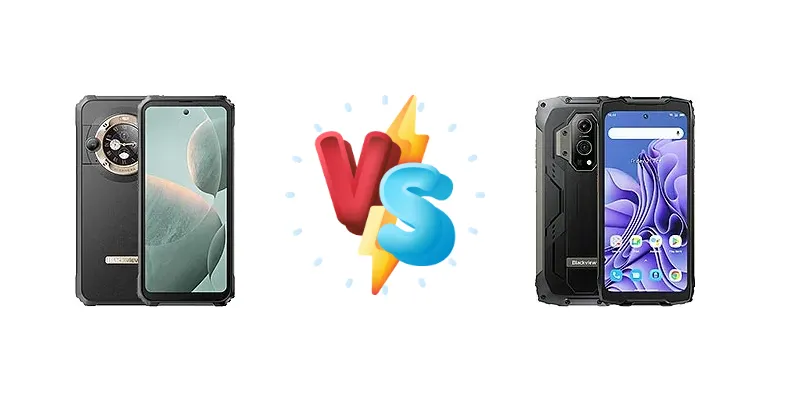
Blackview BL9000 vs BV9300: A Deep Dive into Performance and Endurance
| Phones Images | |||||
|---|---|---|---|---|---|
|
🏆 Quick Verdict
For users demanding the best possible performance and fastest charging, the Blackview BL9000 is the clear winner. Its Dimensity 8020 chipset delivers significantly more processing power. However, the BV9300 offers a compelling value proposition for those prioritizing battery longevity and a more efficient daily driver.
| PHONES | ||
|---|---|---|
| Phone Names | Blackview BL9000 | Blackview BV9300 |
| Network | ||
|---|---|---|
| 2G bands | GSM 850 / 900 / 1800 / 1900 | GSM 850 / 900 / 1800 / 1900 |
| 3G bands | HSDPA 850 / 900 / 1700(AWS) / 1900 / 2100 | HSDPA 850 / 900 / 1700(AWS) / 1900 / 2100 |
| 4G bands | 1, 2, 3, 4, 5, 7, 8, 12, 13, 17, 18, 19, 20, 25, 26, 28, 30, 34, 38, 39, 40, 41, 66 | 1, 2, 3, 4, 5, 7, 8, 12, 13, 17, 18, 19, 20, 25, 26, 28, 30, 34, 38, 39, 40, 41, 66 |
| 5G bands | 1, 3, 5, 7, 8, 20, 28, 38, 40, 41, 77, 78, 79 SA/NSA | - |
| Speed | HSPA, LTE, 5G | HSPA, LTE |
| Technology | GSM / CDMA / HSPA / LTE / 5G | GSM / CDMA / HSPA / LTE |
| - | CDMA 800 / 1900 | |
| Launch | ||
|---|---|---|
| Announced | 2024, January | 2023, May 10 |
| Status | Available. Released 2024, January | Available. Released 2023, May 10 |
| Body | ||
|---|---|---|
| Dimensions | 179.5 x 82.6 x 17 mm (7.07 x 3.25 x 0.67 in) | 184.6 x 85.6 x 22.8 mm (7.27 x 3.37 x 0.90 in) |
| SIM | Nano-SIM + Nano-SIM | Nano-SIM + Nano-SIM |
| Weight | 413 g (14.57 oz) | 520 g (1.15 lb) |
| - | IP68/IP69K dust/water resistant (up to 1.5m for 30 min) Drop-to-concrete resistance from up to 1.8m MIL-STD-810H compliant Laser rangefinder (up to 40m) Dedicated flashlight (100 lumens) | |
| Display | ||
|---|---|---|
| Protection | Corning Gorilla Glass Victus, Mohs level 7 | Corning Gorilla Glass 5 |
| Resolution | 1080 x 2460 pixels (~396 ppi density) | 1080 x 2388 pixels (~391 ppi density) |
| Size | 6.78 inches, 109.2 cm2 (~73.6% screen-to-body ratio) | 6.7 inches, 108.7 cm2 (~68.8% screen-to-body ratio) |
| Type | IPS LCD, 120Hz | IPS LCD, 120Hz |
| Platform | ||
|---|---|---|
| CPU | Octa-core (4x2.6 GHz Cortex-A78 & 4x2.0 GHz Cortex-A55) | Octa-core (2x2.2 GHz Cortex-A76 & 6x2.0 GHz Cortex-A55) |
| Chipset | Mediatek Dimensity 8020 (6 nm) | Mediatek Helio G99 (6 nm) |
| GPU | Mali-G77 MC9 | Mali-G57 MC2 |
| OS | Android 13, Doke-OS 4.0 | Android 12, Doke-OS 3.1 |
| Memory | ||
|---|---|---|
| Card slot | No | microSDXC (uses shared SIM slot) |
| Internal | 512GB 12GB RAM | 256GB 12GB RAM |
| - | UFS 2.1 | |
| Main Camera | ||
|---|---|---|
| Dual | 50 MP, (wide), 1/1.57", PDAF 13 MP, 120˚, (ultrawide), AF | - |
| Features | LED flash, HDR, panorama | LED flash, HDR, panorama |
| Triple | - | 50 MP, (wide), 1/2.76", 0.64µm, PDAF 8 MP, 120˚, (ultrawide), AF Auxiliary lens |
| Video | 4K@30fps, 1080p@30fps | 1440p@30fps, 1080p@30fps |
| Selfie camera | ||
|---|---|---|
| Single | 50 MP, (wide), 1/2.8" | 32 MP, (wide) |
| Video | 1080p@30fps | 1080p |
| Sound | ||
|---|---|---|
| 3.5mm jack | - | No |
| 35mm jack | No | No |
| Loudspeaker | Yes, with stereo speakers | Yes |
| Comms | ||
|---|---|---|
| Bluetooth | 5.1, A2DP, LE | 5.2, A2DP, LE |
| NFC | Yes | Yes |
| Positioning | GPS, GLONASS, BDS, GALILEO | GPS, GLONASS, GALILEO, BDS |
| Radio | FM radio | FM radio |
| USB | USB Type-C, OTG | USB Type-C, OTG |
| WLAN | Wi-Fi 802.11 a/b/g/n/ac/6, dual-band | Wi-Fi 802.11 a/b/g/n/ac, dual-band |
| Features | ||
|---|---|---|
| Sensors | Fingerprint (side-mounted), accelerometer, gyro, proximity, compass, barometer | Fingerprint (side-mounted), accelerometer, proximity, compass |
| Battery | ||
|---|---|---|
| Charging | 120W wired 5W reverse wired | 33W wired 5W reverse wired |
| Type | 8800 mAh | 15080 mAh |
| Misc | ||
|---|---|---|
| Colors | Rose Gold, Interstellar Black | Black, Orange, Green |
| Price | About 490 EUR | About 390 EUR |
| EU LABEL | ||
|---|---|---|
| Battery | 87:06h endurance, 800 cycles | - |
| Energy | Class B | - |
| Free fall | Class A (271 falls) | - |
| Repairability | Class C | - |
Blackview BL9000
- Significantly faster processor for demanding tasks
- Ultra-fast 120W charging for minimal downtime
- Likely superior camera processing capabilities
- Potentially shorter battery life due to higher power consumption
- Higher price point
Blackview BV9300
- Excellent battery life and efficiency
- More affordable price
- Sufficient performance for everyday tasks
- Slower charging speed
- Less powerful processor for gaming and demanding apps
Display Comparison
While both devices share a ruggedized build, display specifics are absent in the provided data. However, given the BL9000's higher positioning, it likely features a higher resolution and potentially a smoother refresh rate. The BV9300, focusing on efficiency, may prioritize power-saving display technology. Expect both to offer excellent outdoor visibility, a hallmark of Blackview's rugged line.
Camera Comparison
Camera details are missing, but the chipset difference suggests the BL9000 will have a more powerful image signal processor (ISP), enabling faster image processing and potentially better low-light performance. The BL9000 is likely to support higher resolution video recording and more advanced camera features. Without specific sensor information, it’s difficult to make a definitive statement, but the processing power advantage favors the BL9000.
Performance
The core difference lies in the chipsets. The BL9000’s Mediatek Dimensity 8020 (6nm) utilizes a more advanced architecture – Cortex-A78 cores clocked at 2.6 GHz – compared to the BV9300’s Helio G99 (6nm) with its Cortex-A76 cores at 2.2 GHz. This translates to a substantial performance advantage for the BL9000 in CPU-intensive tasks. The Dimensity 8020’s superior GPU will also deliver a smoother gaming experience. While both are 6nm, the architectural improvements in the Dimensity 8020 provide a clear edge. The BV9300’s Helio G99 is still capable for everyday use, but will struggle with graphically demanding games or applications.
Battery Life
The BL9000 boasts 120W wired charging, a game-changer for quick top-ups, while the BV9300 is limited to 33W. This means the BL9000 can likely charge from 0-100% in under 40 minutes, compared to potentially over an hour for the BV9300. While battery capacity isn't specified, the BL9000’s 87:06h endurance suggests a larger battery or more efficient power management, despite the faster charging. The BV9300 will likely prioritize longevity over speed, offering a solid day of use on a single charge for typical users.
Buying Guide
Buy the Blackview BL9000 if you need a phone for demanding tasks like mobile gaming, video editing, or running multiple apps simultaneously, and value the convenience of incredibly fast 120W charging. Buy the Blackview BV9300 if you prefer a longer-lasting battery, a more efficient processor for everyday tasks, and a lower price point, making it ideal for outdoor workers or those who frequently travel off-grid.