
Blackview BL9000 Pro vs BL8000: A Deep Dive into Performance and Endurance
| Phones Images | |||||
|---|---|---|---|---|---|
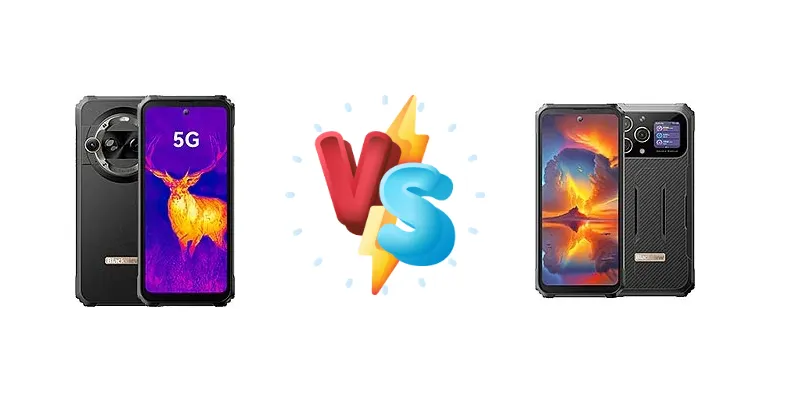
|
🏆 Quick Verdict
For users demanding the fastest possible charging and a noticeable CPU performance uplift, the Blackview BL9000 Pro is the clear winner. Its 120W charging and Dimensity 8020 chipset provide a superior experience, justifying the price premium for power users and gamers. However, the BL8000 remains a compelling option for those prioritizing value and efficient performance.
| PHONES | ||
|---|---|---|
| Phone Names | Blackview BL9000 Pro | Blackview BL8000 |
| Network | ||
|---|---|---|
| 2G bands | GSM 850 / 900 / 1800 / 1900 | GSM 850 / 900 / 1800 / 1900 |
| 3G bands | HSDPA 850 / 900 / 1700(AWS) / 1900 / 2100 | HSDPA 850 / 900 / 1700(AWS) / 1900 / 2100 |
| 4G bands | 1, 2, 3, 4, 5, 7, 8, 12, 13, 17, 18, 19, 20, 25, 26, 28, 30, 34, 38, 39, 40, 41, 66 | 1, 2, 3, 4, 5, 7, 8, 12, 13, 17, 18, 19, 20, 25, 26, 28, 30, 34, 38, 39, 40, 41, 66 |
| 5G bands | 1, 3, 5, 7, 8, 20, 28, 38, 40, 41, 77, 78, 79 SA/NSA | 1, 3, 5, 7, 8, 20, 28, 38, 40, 41, 77, 78, 79 SA/NSA |
| Speed | HSPA, LTE, 5G | HSPA, LTE, 5G |
| Technology | GSM / CDMA / HSPA / LTE / 5G | GSM / CDMA / HSPA / LTE / 5G |
| Launch | ||
|---|---|---|
| Announced | 2024, April | 2024, January |
| Status | Available. Released 2024, May | Available. Released 2024, January |
| Body | ||
|---|---|---|
| Dimensions | 179.5 x 82.6 x 17 mm (7.07 x 3.25 x 0.67 in) | 179.5 x 82.6 x 17 mm (7.07 x 3.25 x 0.67 in) |
| SIM | Nano-SIM + Nano-SIM | Nano-SIM + Nano-SIM |
| Weight | 412 g (14.53 oz) | 385 g (13.58 oz) |
| Display | ||
|---|---|---|
| Protection | Corning Gorilla Glass Victus, Mohs level 7 | Corning Gorilla Glass 5 |
| Resolution | 1080 x 2460 pixels (~396 ppi density) | 1080 x 2460 pixels (~396 ppi density) |
| Size | 6.78 inches, 109.2 cm2 (~73.6% screen-to-body ratio) | 6.78 inches, 109.2 cm2 (~73.6% screen-to-body ratio) |
| Type | IPS LCD, 120Hz | IPS LCD, 120Hz |
| Platform | ||
|---|---|---|
| CPU | Octa-core (4x2.6 GHz Cortex-A78 & 4x2.0 GHz Cortex-A55) | Octa-core (2x2.6 GHz Cortex-A78 & 6x2.0 GHz Cortex-A55) |
| Chipset | Mediatek Dimensity 8020 (6 nm) | Mediatek Dimensity 7050 (6 nm) |
| GPU | Mali-G77 MC9 | Mali-G68 MC4 |
| OS | Android 14, Doke-OS 4.0 | Android 13, Doke-OS 4.0 |
| Memory | ||
|---|---|---|
| Card slot | No | No |
| Internal | 512GB 12GB RAM | 512GB 12GB RAM |
| Main Camera | ||
|---|---|---|
| Features | LED flash, HDR, panorama | LED flash, HDR, panorama |
| Triple | 50 MP, (wide), 1/1.57", PDAF 13 MP, 120˚, (ultrawide), AF FLIR thermal camera (Lepton 3.5 module), 160x120 | 50 MP, (wide), 1/1.57", PDAF 8 MP, 117˚, (ultrawide) Auxiliary lens |
| Video | 4K@30fps, 1080p@30fps | 4K@30fps, 1080p@30fps |
| Selfie camera | ||
|---|---|---|
| Single | 50 MP, (wide), 1/2.8" | 16 MP, (wide) |
| Video | 1080p@30fps | Yes |
| Sound | ||
|---|---|---|
| 35mm jack | No | No |
| Loudspeaker | Yes, with stereo speakers | Yes |
| Comms | ||
|---|---|---|
| Bluetooth | 5.1, A2DP, LE | 5.1, A2DP, LE |
| NFC | Yes | Yes |
| Positioning | GPS, GLONASS, BDS, GALILEO | GPS (L1+L5), GLONASS, BDS, GALILEO |
| Radio | FM radio | FM radio |
| USB | USB Type-C, OTG | USB Type-C, OTG |
| WLAN | Wi-Fi 802.11 a/b/g/n/ac/6, dual-band | Wi-Fi 802.11 a/b/g/n/ac/6, dual-band |
| Features | ||
|---|---|---|
| Sensors | Fingerprint (side-mounted), accelerometer, gyro, proximity, compass, barometer | Fingerprint (side-mounted), accelerometer, proximity, compass, gyro |
| Battery | ||
|---|---|---|
| Charging | 120W wired 5W reverse wired | 33W wired 5W reverse wired |
| Type | 8800 mAh | 8800 mAh |
| Misc | ||
|---|---|---|
| Colors | Splendid Gold, Interstellar Black | Celestial Silver, Orbit Grey |
| Price | About 550 EUR | - |
| EU LABEL | ||
|---|---|---|
| Battery | 87:06h endurance, 800 cycles | - |
| Energy | Class B | - |
| Free fall | Class A (272 falls) | - |
| Repairability | Class C | - |
Blackview BL9000 Pro
- Significantly faster 120W charging
- More powerful Dimensity 8020 chipset
- Longer battery life (87:06h endurance)
- 800 battery charge cycles for longevity
- Likely higher price point
- May generate more heat under sustained load
Blackview BL8000
- More affordable price
- Efficient Dimensity 7050 chipset
- Solid performance for everyday tasks
- 5W reverse wired charging
- Slower 33W charging
- Less powerful CPU for demanding applications
Display Comparison
While both devices share a 6.79-inch display size, detailed display specs like resolution, panel type (AMOLED vs IPS), and refresh rate are missing. However, the focus here is on performance, so the display differences are less critical. The absence of LTPO technology in either device suggests both will likely rely on adaptive refresh rate scaling to conserve battery, rather than dynamically adjusting down to 1Hz for static content.
Camera Comparison
Camera specifications are absent beyond the chipsets. Given Blackview’s history, both phones likely feature a multi-camera setup with a primary sensor, ultrawide, and potentially a macro lens. Without sensor size or aperture information, it’s difficult to assess image quality. However, the more powerful ISP (Image Signal Processor) within the Dimensity 8020 of the BL9000 Pro should offer faster image processing and potentially better low-light performance. The 2MP macro lens, common in this segment, is unlikely to be a significant differentiator on either device.
Performance
The core difference lies in the chipsets. The BL9000 Pro boasts the Mediatek Dimensity 8020 (6nm), featuring an octa-core configuration with 4x2.6 GHz Cortex-A78 and 4x2.0 GHz Cortex-A55 cores. The BL8000 utilizes the Dimensity 7050 (6nm), with a slightly less aggressive core configuration of 2x2.6 GHz Cortex-A78 and 6x2.0 GHz Cortex-A55 cores. This translates to a clear advantage for the BL9000 Pro in multi-threaded tasks and sustained performance. The BL9000 Pro’s additional A78 core will be noticeable in demanding games and video editing. Both utilize a 6nm process, suggesting similar thermal efficiency, but the BL9000 Pro will likely generate more heat under load.
Battery Life
The BL9000 Pro delivers a substantial advantage in charging speed with its 120W wired charging, compared to the BL8000’s 33W. This means significantly faster top-ups, potentially going from 0-100% in under 40 minutes for the BL9000 Pro versus over an hour for the BL8000. Battery endurance is reported as 87:06h for the BL9000 Pro, suggesting a large battery capacity. While the BL8000’s capacity isn’t specified, the slower charging suggests a potentially smaller battery. The BL9000 Pro also boasts 800 charge cycles, indicating a focus on long-term battery health.
Buying Guide
Buy the Blackview BL9000 Pro if you need uncompromising performance for gaming or demanding applications, and if minimizing charging time is a top priority. Its 120W charging and more powerful CPU are ideal for those constantly on the move. Buy the Blackview BL8000 if you prefer a more balanced device with solid performance for everyday tasks, and if you value a lower price point without sacrificing essential rugged features.