
Blackview BL8800 vs. Ulefone Armor 15: A Rugged Smartphone Showdown
| Phones Images | |||||
|---|---|---|---|---|---|
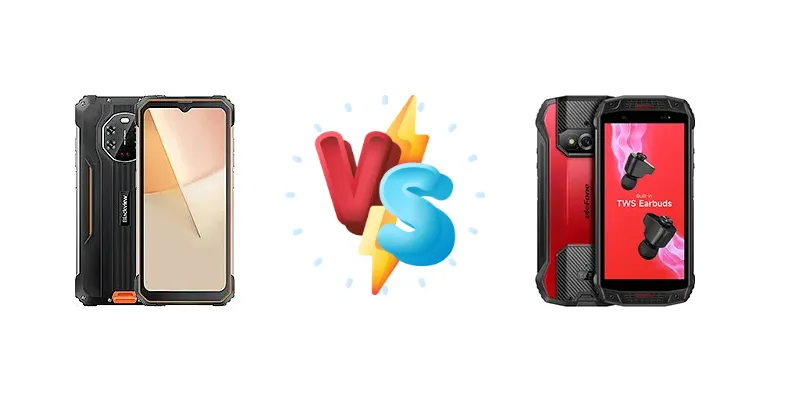
|
🏆 Quick Verdict
For users prioritizing performance and faster charging, the Blackview BL8800 is the clear winner. Its Dimensity 700 chipset offers a significantly smoother experience for demanding tasks. However, the Ulefone Armor 15 remains a viable option for those on a tighter budget who prioritize basic functionality and long-term durability.
| PHONES | ||
|---|---|---|
| Phone Names | Blackview BL8800 | Ulefone Armor 15 |
| Network | ||
|---|---|---|
| 2G bands | GSM 850 / 900 / 1800 / 1900 | GSM 850 / 900 / 1800 / 1900 |
| 3G bands | HSDPA 800 / 850 / 900 / 1700(AWS) / 1900 / 2100 | HSDPA 850 / 900 / 1700(AWS) / 1900 / 2100 |
| 4G bands | 1, 2, 3, 4, 5, 7, 8, 12, 13, 17, 18, 19, 20, 25, 26, 28, 30, 66 | 1, 2, 3, 4, 5, 7, 8, 12, 13, 17, 18, 19, 20, 25, 26, 28, 38, 39, 40, 41, 66 |
| 5G bands | 1, 3, 5, 7, 8, 20, 28, 38, 40, 41, 77, 78, 79 SA/NSA | - |
| Speed | HSPA, LTE, 5G | HSPA, LTE Cat13 300/150 Mbps |
| Technology | GSM / CDMA / HSPA / CDMA2000 / LTE / 5G | GSM / HSPA / LTE |
| CDMA2000 1x | - | |
| Launch | ||
|---|---|---|
| Announced | 2022, May 09 | 2022, July 27 |
| Status | Available. Released 2022, May 09 | Available. Released 2022, August 10 |
| Body | ||
|---|---|---|
| Dimensions | 176.2 x 83.5 x 17.7 mm (6.94 x 3.29 x 0.70 in) | 170.2 x 79.6 x 18.2 mm (6.70 x 3.13 x 0.72 in) |
| SIM | Nano-SIM + Nano-SIM | Nano-SIM + Nano-SIM |
| Weight | 367 g (12.95 oz) | 346 g (12.20 oz) |
| IP68/IP69K dust/water resistant (up to 1.5m for 30 min) Drop-to-concrete resistance from up to 1.5m MIL-STD-810H compliant | IP68 dust/water resistant (up to 1.5m for 30 min) Drop-to-concrete resistance from up to 1.5m MIL-STD-810G compliant Built-in wireless earbuds housed inside the top side of the phone; charging | |
| Display | ||
|---|---|---|
| Resolution | 1080 x 2408 pixels, 20:9 ratio (~401 ppi density) | 720 x 1440 pixels, 18:9 ratio (~295 ppi density) |
| Size | 6.58 inches, 104.3 cm2 (~70.9% screen-to-body ratio) | 5.45 inches, 76.7 cm2 (~56.6% screen-to-body ratio) |
| Type | IPS LCD, 480 nits | IPS LCD |
| Platform | ||
|---|---|---|
| CPU | Octa-core (2x2.2 GHz Cortex-A76 & 6x2.0 GHz Cortex-A55) | Octa-core (4x2.3 GHz Cortex-A53 & 4x1.8 GHz Cortex-A53) |
| Chipset | Mediatek Dimensity 700 (7 nm) | Mediatek MT6765G Helio G35 (12 nm) |
| GPU | Mali-G57 MC2 | PowerVR GE8320 |
| OS | Android 11, Doke-OS 3.0 | Android 12 |
| Memory | ||
|---|---|---|
| Card slot | No | microSDXC (dedicated slot) |
| Internal | 128GB 8GB RAM | 128GB 6GB RAM |
| UFS 2.1 | - | |
| Main Camera | ||
|---|---|---|
| Dual | - | 12 MP, f/1.8, (wide), 1.4μm 13 MP, f/2.4, 106˚ (ultrawide) |
| Features | Dual-LED flash, HDR, panorama | LED flash, HDR, panorama |
| Quad | 50 MP, f/1.8, (wide), PDAF 8 MP, f/2.2, 117˚ (ultrawide) 20 MP, f/1.8, (IR camera), 2 IR emitters Auxiliary lens | - |
| Single | 16 MP, f/2.0, (wide) | 16 MP, f/2.4, (wide), 1.0μm |
| Video | 1440p@30fps | 1080p@30fps |
| Selfie camera | ||
|---|---|---|
| Single | 16 MP, f/2.0, (wide) | 16 MP, f/2.4, (wide), 1.0μm |
| Video | 1080p@30fps | 1080p@30fps |
| Sound | ||
|---|---|---|
| 3.5mm jack | No | No |
| 35mm jack | No | No |
| Loudspeaker | Yes | Yes |
| Comms | ||
|---|---|---|
| Bluetooth | 5.1, A2DP, LE | 5.0, A2DP |
| NFC | Yes | Yes |
| Positioning | GPS, GLONASS, GALILEO, BDS | GPS, GLONASS, BDS, GALILEO |
| Radio | FM radio | Stereo FM radio, RDS, recording |
| USB | USB Type-C 2.0, OTG | USB Type-C 2.0, OTG |
| WLAN | Wi-Fi 802.11 a/b/g/n/ac | Wi-Fi 802.11 a/b/g/n/ac, dual-band |
| Features | ||
|---|---|---|
| Sensors | Fingerprint (side-mounted), accelerometer, gyro, proximity, compass, barometer | Fingerprint (side-mounted), accelerometer, proximity, gyro, compass |
| Battery | ||
|---|---|---|
| Charging | 33W wired, 31% in 30 min, 100% in 90 min Reverse wired | 18W wired |
| Type | 8380 mAh | Li-Po 6600 mAh |
| Misc | ||
|---|---|---|
| Colors | Black, Orange, Green | Meteorite Black, Tech Blue, Sport Red |
| Price | About 480 EUR | About 300 EUR |
Blackview BL8800
- Significantly faster processor for smoother performance
- Faster 33W charging for quicker top-ups
- More efficient chipset potentially leading to better battery life
- Likely a higher price point than the Ulefone Armor 15
- May generate more heat under heavy load (though 7nm helps)
Ulefone Armor 15
- More affordable price point
- Potentially longer battery life due to less power-hungry chipset
- Rugged design for durability
- Slower processor resulting in laggy performance
- Slow 18W charging
- Lower-quality display likely
Display Comparison
Neither device's display specifications are provided, so a direct comparison is limited. However, given the Armor 15's focus on cost savings, it likely utilizes a lower-quality panel than the BL8800. The BL8800, positioned slightly higher in the market, likely benefits from better color accuracy and viewing angles. Rugged phones often prioritize durability over display quality, so expect both to have robust glass protection, but potentially lower peak brightness compared to standard smartphones.
Camera Comparison
Without detailed camera specifications, a precise comparison is difficult. However, the chipset difference suggests the BL8800 will have a more capable image signal processor (ISP), leading to better image quality, especially in low-light conditions. Both phones likely feature multiple cameras, but the Armor 15 may rely on lower-resolution sensors to cut costs. The BL8800’s ISP, paired with the Dimensity 700, will likely offer faster image processing and potentially more advanced features like better HDR.
Performance
The core difference lies in the chipsets. The Blackview BL8800’s Mediatek Dimensity 700 (7nm) is a substantial upgrade over the Ulefone Armor 15’s Helio G35 (12nm). The Dimensity 700’s Cortex-A76 cores provide significantly more processing power than the G35’s Cortex-A53 cores, resulting in faster app loading times and smoother multitasking. The 7nm process also contributes to better thermal efficiency, meaning the BL8800 is less likely to throttle under sustained load. The G35, while adequate for basic tasks, will struggle with demanding games or applications. This translates to a better user experience for anyone beyond basic smartphone usage on the BL8800.
Battery Life
The Ulefone Armor 15’s 18W charging is significantly slower than the Blackview BL8800’s 33W charging. The BL8800 can reach 31% charge in 30 minutes and 100% in 90 minutes, offering a substantial convenience advantage. While battery capacity isn’t specified for either device, the more efficient Dimensity 700 in the BL8800 may offset a potentially smaller battery size, providing comparable or even better real-world battery life despite the faster charging.
Buying Guide
Buy the Blackview BL8800 if you need a rugged phone capable of handling moderate gaming, streaming, and multitasking without significant slowdown. It’s ideal for professionals working in challenging environments who also rely on their phone for productivity. Buy the Ulefone Armor 15 if you prefer a more affordable, no-frills rugged device primarily for calls, texts, and basic app usage, and where battery life is paramount over raw speed.