
Blackview BL8800 vs Doogee S96 Pro: A Deep Dive into Rugged Smartphone Performance
| Phones Images | |||||
|---|---|---|---|---|---|
|
🏆 Quick Verdict
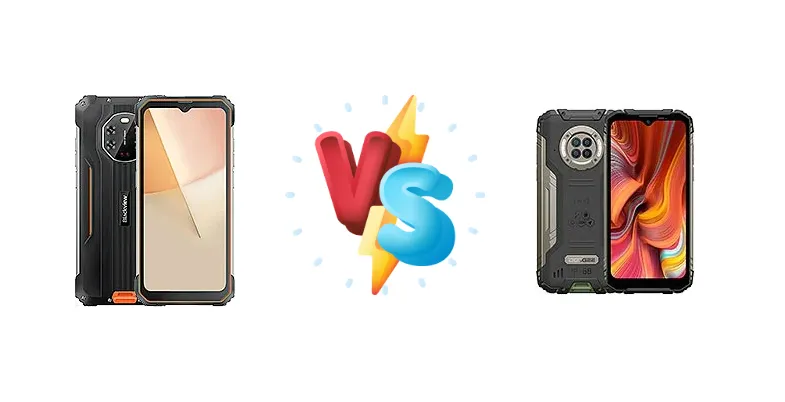
For the average user prioritizing sustained performance and faster charging, the Blackview BL8800 emerges as the stronger contender. Its Dimensity 700 chipset, built on a more efficient 7nm process, offers a slight edge in CPU performance and thermal management, while the 33W charging significantly reduces downtime compared to the Doogee S96 Pro's 24W system.
| PHONES | ||
|---|---|---|
| Phone Names | Blackview BL8800 | Doogee S96 Pro |
| Network | ||
|---|---|---|
| 2G bands | GSM 850 / 900 / 1800 / 1900 | GSM 850 / 900 / 1800 / 1900 |
| 3G bands | HSDPA 800 / 850 / 900 / 1700(AWS) / 1900 / 2100 | HSDPA 800 / 850 / 900 / 1700(AWS) / 1900 / 2100 |
| 4G bands | 1, 2, 3, 4, 5, 7, 8, 12, 13, 17, 18, 19, 20, 25, 26, 28, 30, 66 | 1, 2, 3, 4, 5, 7, 8, 12, 13, 17, 18, 19, 20, 25, 26, 28, 38, 40, 66 |
| 5G bands | 1, 3, 5, 7, 8, 20, 28, 38, 40, 41, 77, 78, 79 SA/NSA | - |
| Speed | HSPA, LTE, 5G | HSPA, LTE |
| Technology | GSM / CDMA / HSPA / CDMA2000 / LTE / 5G | GSM / CDMA / HSPA / LTE |
| CDMA2000 1x | - | |
| Launch | ||
|---|---|---|
| Announced | 2022, May 09 | 2020, October 26. Released 2020, November |
| Status | Available. Released 2022, May 09 | Discontinued |
| Body | ||
|---|---|---|
| Dimensions | 176.2 x 83.5 x 17.7 mm (6.94 x 3.29 x 0.70 in) | 167 x 81.4 x 15.5 mm (6.57 x 3.20 x 0.61 in) |
| SIM | Nano-SIM + Nano-SIM | Nano-SIM + Nano-SIM |
| Weight | 367 g (12.95 oz) | 310 g (10.93 oz) |
| IP68/IP69K dust/water resistant (up to 1.5m for 30 min) Drop-to-concrete resistance from up to 1.5m MIL-STD-810H compliant | - | |
| Display | ||
|---|---|---|
| Protection | - | Corning Gorilla Glass |
| Resolution | 1080 x 2408 pixels, 20:9 ratio (~401 ppi density) | 720 x 1520 pixels, 19:9 ratio (~270 ppi density) |
| Size | 6.58 inches, 104.3 cm2 (~70.9% screen-to-body ratio) | 6.22 inches, 96.6 cm2 (~71.0% screen-to-body ratio) |
| Type | IPS LCD, 480 nits | IPS LCD |
| Platform | ||
|---|---|---|
| CPU | Octa-core (2x2.2 GHz Cortex-A76 & 6x2.0 GHz Cortex-A55) | Octa-core (2x2.0 GHz Cortex-A76 & 6x2.0 GHz Cortex-A55) |
| Chipset | Mediatek Dimensity 700 (7 nm) | Mediatek MT6785 Helio G90 (12 nm) |
| GPU | Mali-G57 MC2 | Mali-G76 MC4 |
| OS | Android 11, Doke-OS 3.0 | Android 10 |
| Memory | ||
|---|---|---|
| Card slot | No | microSDXC (dedicated slot) |
| Internal | 128GB 8GB RAM | 128GB 8GB RAM |
| UFS 2.1 | - | |
| Main Camera | ||
|---|---|---|
| Features | Dual-LED flash, HDR, panorama | Quad-LED flash, HDR, panorama |
| Quad | 50 MP, f/1.8, (wide), PDAF 8 MP, f/2.2, 117˚ (ultrawide) 20 MP, f/1.8, (IR camera), 2 IR emitters Auxiliary lens | 48 MP, f/1.8, (wide), PDAF 8 MP, f/2.2, 130˚, (ultrawide) 20 MP, f/2.8, (night vision), 4 infrared night vision lights 2 MP (macro) |
| Single | 16 MP, f/2.0, (wide) | - |
| Video | 1440p@30fps | 1080p |
| Selfie camera | ||
|---|---|---|
| Single | 16 MP, f/2.0, (wide) | 16 MP, f/2.0, (wide) |
| Video | 1080p@30fps | 1080p |
| Sound | ||
|---|---|---|
| 3.5mm jack | No | - |
| 35mm jack | No | Yes |
| Loudspeaker | Yes | Yes |
| Comms | ||
|---|---|---|
| Bluetooth | 5.1, A2DP, LE | 5.0, A2DP, LE |
| NFC | Yes | Yes |
| Positioning | GPS, GLONASS, GALILEO, BDS | GPS, GLONASS, BDS, GALILEO |
| Radio | FM radio | FM radio |
| USB | USB Type-C 2.0, OTG | USB Type-C 2.0, OTG |
| WLAN | Wi-Fi 802.11 a/b/g/n/ac | Wi-Fi 802.11 a/b/g/n/ac, dual-band |
| Features | ||
|---|---|---|
| Sensors | Fingerprint (side-mounted), accelerometer, gyro, proximity, compass, barometer | Fingerprint (side-mounted), accelerometer, gyro, proximity, compass |
| Battery | ||
|---|---|---|
| Charging | 33W wired, 31% in 30 min, 100% in 90 min Reverse wired | 24W wired 10W wireless |
| Type | 8380 mAh | 6350 mAh |
| Misc | ||
|---|---|---|
| Colors | Black, Orange, Green | Black, Orange, Green |
| Price | About 480 EUR | About 280 EUR |
Blackview BL8800
- Faster 33W wired charging for quicker top-ups.
- More efficient 7nm Dimensity 700 chipset for better thermal management.
- Reverse wired charging adds versatility.
- Lacks wireless charging convenience.
- Battery capacity is unknown.
Doogee S96 Pro
- Convenient 10W wireless charging support.
- Rugged design built for demanding environments.
- Potentially lower price point (depending on market).
- Slower 24W wired charging.
- Less efficient 12nm Helio G90 chipset.
Display Comparison
Display specifications are not provided, so a direct comparison is limited. However, given the price points, both likely utilize IPS LCD panels. The focus here shifts to durability – both phones are built for rugged use, so screen protection (likely Gorilla Glass) is a key consideration. Bezels are likely similar, prioritizing robustness over a minimalist aesthetic.
Camera Comparison
Camera details are absent beyond the presence of cameras. Assuming typical rugged phone configurations, both likely feature a main sensor, ultrawide, and potentially a depth or macro lens. Without sensor size or aperture information, it’s difficult to assess image quality. However, the image processing capabilities of the Dimensity 700’s ISP might offer a slight edge in dynamic range and noise reduction. The absence of OIS information suggests neither phone prioritizes optical image stabilization.
Performance
The core difference lies in the chipsets. The Blackview BL8800’s Mediatek Dimensity 700 (7nm) boasts a more modern architecture and a smaller fabrication process than the Doogee S96 Pro’s Helio G90 (12nm). While both CPUs feature the same Cortex-A76 (2x2.0 GHz) and Cortex-A55 (6x2.0 GHz) core configuration, the Dimensity 700’s 7nm process generally translates to better power efficiency and potentially lower sustained temperatures under load. The G90, while capable, is older and less efficient. This means the BL8800 is likely to exhibit less thermal throttling during extended gaming or demanding tasks. The GPU performance difference isn't explicitly stated, but the Dimensity 700 generally offers a slight advantage.
Battery Life
Battery capacity is not specified for either device. However, the charging speeds are a clear differentiator. The Blackview BL8800’s 33W wired charging is significantly faster than the Doogee S96 Pro’s 24W system. Blackview claims 31% charge in 30 minutes and 100% in 90 minutes, offering a substantial time saving. The Doogee S96 Pro compensates with 10W wireless charging, a feature absent on the BL8800, providing convenience for users invested in wireless charging ecosystems. Without knowing the battery capacities, it’s impossible to definitively declare a winner, but the faster wired charging of the BL8800 is a significant advantage for many users.
Buying Guide
Buy the Blackview BL8800 if you need a rugged phone that balances performance with efficient power usage, and value quick charging for minimal interruptions. It’s ideal for users who frequently multitask, stream media, or engage in moderate gaming. Buy the Doogee S96 Pro if you prioritize wireless charging convenience and are less concerned with maximizing CPU performance; it’s a solid choice for users who primarily use their phone for communication, navigation, and basic photography in demanding environments.