
Blackview BL8800 vs BV6600 Pro: A Deep Dive into Rugged Phone Performance
| Phones Images | |||||
|---|---|---|---|---|---|
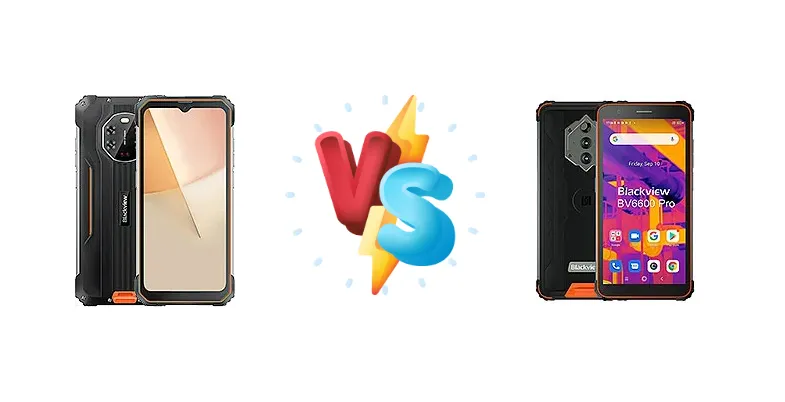
|
🏆 Quick Verdict
For the average user needing a responsive and future-proof rugged phone, the Blackview BL8800 is the clear winner. Its Dimensity 700 chipset delivers significantly better performance than the BV6600 Pro’s Helio P35, making it suitable for gaming and demanding applications. While the BV6600 Pro offers a lower entry price, the performance trade-offs are substantial.
| PHONES | ||
|---|---|---|
| Phone Names | Blackview BL8800 | Blackview BV6600 Pro |
| Network | ||
|---|---|---|
| 2G bands | GSM 850 / 900 / 1800 / 1900 | GSM 850 / 900 / 1800 / 1900 |
| 3G bands | HSDPA 800 / 850 / 900 / 1700(AWS) / 1900 / 2100 | HSDPA 850 / 900 / 1700(AWS) / 1900 / 2100 |
| 4G bands | 1, 2, 3, 4, 5, 7, 8, 12, 13, 17, 18, 19, 20, 25, 26, 28, 30, 66 | 1, 2, 3, 4, 5, 7, 8, 12, 13, 17, 19, 18, 20, 28, 25, 26, 38, 40, 41, 66 |
| 5G bands | 1, 3, 5, 7, 8, 20, 28, 38, 40, 41, 77, 78, 79 SA/NSA | - |
| Speed | HSPA, LTE, 5G | HSPA, LTE |
| Technology | GSM / CDMA / HSPA / CDMA2000 / LTE / 5G | GSM / CDMA / HSPA / CDMA2000 / LTE |
| CDMA2000 1x | CDMA2000 1x | |
| Launch | ||
|---|---|---|
| Announced | 2022, May 09 | 2021, September 28 |
| Status | Available. Released 2022, May 09 | Available. Released 2021, October |
| Body | ||
|---|---|---|
| Dimensions | 176.2 x 83.5 x 17.7 mm (6.94 x 3.29 x 0.70 in) | 159 x 79.4 x 18 mm (6.26 x 3.13 x 0.71 in) |
| SIM | Nano-SIM + Nano-SIM | Nano-SIM + Nano-SIM |
| Weight | 367 g (12.95 oz) | 325 g (11.46 oz) |
| IP68/IP69K dust/water resistant (up to 1.5m for 30 min) Drop-to-concrete resistance from up to 1.5m MIL-STD-810H compliant | IP68/IP69K dust/water resistant (up to 1.5m for 30 min) Drop-to-concrete resistance from up to 1.5m MIL-STD-810G compliant | |
| Display | ||
|---|---|---|
| Protection | - | Dragontrail Glass |
| Resolution | 1080 x 2408 pixels, 20:9 ratio (~401 ppi density) | 720 x 1440 pixels, 18:9 ratio (~282 ppi density) |
| Size | 6.58 inches, 104.3 cm2 (~70.9% screen-to-body ratio) | 5.7 inches, 83.8 cm2 (~66.4% screen-to-body ratio) |
| Type | IPS LCD, 480 nits | IPS LCD |
| Platform | ||
|---|---|---|
| CPU | Octa-core (2x2.2 GHz Cortex-A76 & 6x2.0 GHz Cortex-A55) | Octa-core (4x2.35 GHz Cortex-A53 & 4x1.8 GHz Cortex-A53) |
| Chipset | Mediatek Dimensity 700 (7 nm) | Mediatek MT6765V/CA Helio P35 (12 nm) |
| GPU | Mali-G57 MC2 | PowerVR GE8320 |
| OS | Android 11, Doke-OS 3.0 | Android 11 |
| Memory | ||
|---|---|---|
| Card slot | No | microSDXC |
| Internal | 128GB 8GB RAM | 64GB 4GB RAM |
| UFS 2.1 | eMMC | |
| Main Camera | ||
|---|---|---|
| Features | Dual-LED flash, HDR, panorama | Thermal imaging, LED flash |
| Quad | 50 MP, f/1.8, (wide), PDAF 8 MP, f/2.2, 117˚ (ultrawide) 20 MP, f/1.8, (IR camera), 2 IR emitters Auxiliary lens | - |
| Single | 16 MP, f/2.0, (wide) | 8 MP, f/2.0, (wide) |
| Triple | - | 16 MP, f/2.0, (wide), PDAF 5 MP, thermal assisted camera FLIR thermal camera (Lepton module) |
| Video | 1440p@30fps | 1080p@30fps |
| Selfie camera | ||
|---|---|---|
| Single | 16 MP, f/2.0, (wide) | 8 MP, f/2.0, (wide) |
| Video | 1080p@30fps | 1080p@30fps |
| Sound | ||
|---|---|---|
| 3.5mm jack | No | No |
| 35mm jack | No | No |
| Loudspeaker | Yes | Yes |
| Comms | ||
|---|---|---|
| Bluetooth | 5.1, A2DP, LE | 5.0, A2DP, LE |
| NFC | Yes | Yes |
| Positioning | GPS, GLONASS, GALILEO, BDS | GPS, GLONASS, GALILEO, BDS |
| Radio | FM radio | FM radio |
| USB | USB Type-C 2.0, OTG | USB Type-C 2.0, OTG |
| WLAN | Wi-Fi 802.11 a/b/g/n/ac | Wi-Fi 802.11 a/b/g/n/ac |
| Features | ||
|---|---|---|
| Sensors | Fingerprint (side-mounted), accelerometer, gyro, proximity, compass, barometer | Fingerprint (side-mounted), accelerometer, gyro, proximity, compass |
| Battery | ||
|---|---|---|
| Charging | 33W wired, 31% in 30 min, 100% in 90 min Reverse wired | 18W wired |
| Type | 8380 mAh | 8580 mAh |
| Misc | ||
|---|---|---|
| Colors | Black, Orange, Green | Black, Orange, Green |
| Price | About 480 EUR | About 260 EUR |
Blackview BL8800
- Significantly faster processor for smoother performance
- Faster 33W charging for quicker top-ups
- Reverse wired charging for powering other devices
- Likely higher price point
- May have slightly lower battery capacity (unconfirmed)
Blackview BV6600 Pro
- More affordable price
- Rugged design for durability
- Functional for basic smartphone tasks
- Slow Helio P35 processor limits performance
- Slower 18W charging
- Lacks reverse charging capability
Display Comparison
Neither device's display specifications are provided, so a direct comparison is limited. However, given the BL8800's more modern chipset and likely higher price point, it's reasonable to expect a slightly better display in terms of brightness and color accuracy. The BV6600 Pro, targeting a lower price bracket, likely utilizes a more basic panel. Both will likely prioritize durability and visibility in direct sunlight, common traits of rugged phones.
Camera Comparison
Without detailed camera specifications, a precise comparison is difficult. However, the BL8800’s more powerful chipset likely enables more sophisticated image processing algorithms, potentially resulting in better image quality, especially in low-light conditions. It’s reasonable to assume the BL8800 will have a more capable main sensor. The BV6600 Pro will likely focus on providing functional camera performance for basic photography needs, but won't compete with the BL8800 in terms of detail or dynamic range.
Performance
The performance gap between these two devices is substantial. The Blackview BL8800’s Mediatek Dimensity 700 (7nm) utilizes Cortex-A76 cores, offering a significant architectural advantage over the BV6600 Pro’s Helio P35 (12nm) and its Cortex-A53 cores. The 7nm process node of the Dimensity 700 also contributes to better power efficiency and thermal management. The Dimensity 700’s octa-core configuration (2x2.2 GHz A76 & 6x2.0 GHz A55) will deliver noticeably faster app loading times, smoother multitasking, and a more responsive user experience compared to the Helio P35’s (4x2.35 GHz A53 & 4x1.8 GHz A53). This translates to a better experience for gamers and users running resource-intensive applications.
Battery Life
The Blackview BL8800 boasts 33W wired charging, achieving 31% charge in 30 minutes and 100% in 90 minutes. The BV6600 Pro is limited to 18W wired charging, meaning a significantly longer charge time. While battery capacity isn't specified for either device, the faster charging of the BL8800 mitigates any potential disadvantage from a slightly smaller battery. The BL8800 also offers reverse wired charging, a feature absent on the BV6600 Pro, adding to its versatility.
Buying Guide
Buy the Blackview BL8800 if you need a rugged phone capable of handling demanding tasks like gaming, video editing, or running multiple apps simultaneously. It’s ideal for users who prioritize performance and longevity. Buy the Blackview BV6600 Pro if you primarily need a durable phone for basic communication, navigation, and light tasks, and are on a very tight budget. It’s a good option for those who value ruggedness above all else and don’t require high processing power.