
Blackview BL8800 Pro vs. Apple iPhone 8 Plus: A Clash of Titans
| Phones Images | |||||
|---|---|---|---|---|---|
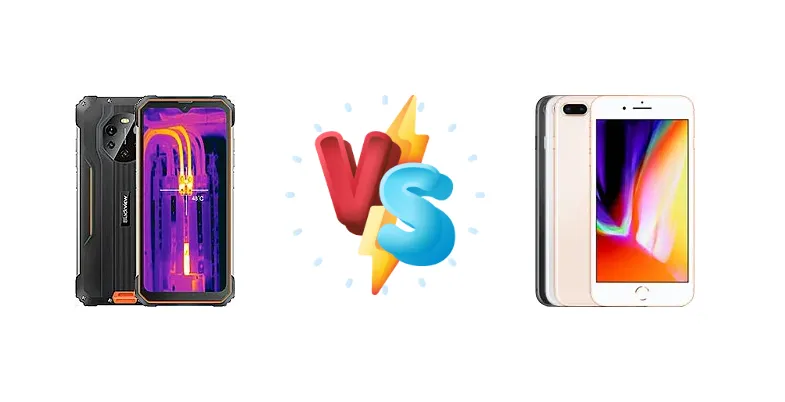
|
🏆 Quick Verdict
The iPhone 8 Plus offers a smoother, more polished experience with a superior camera and iOS ecosystem. However, the BL8800 Pro provides significantly better value with a more modern chipset, faster charging, and a larger battery, appealing to budget-conscious users.
| PHONES | ||
|---|---|---|
| Phone Names | Blackview BL8800 Pro | Apple iPhone 8 Plus |
| Network | ||
|---|---|---|
| 2G bands | GSM 850 / 900 / 1800 / 1900 | GSM 850 / 900 / 1800 / 1900 |
| 3G bands | HSDPA 800 / 850 / 900 / 1700(AWS) / 1900 / 2100 | HSDPA 850 / 900 / 1700(AWS) / 1900 / 2100 |
| 4G bands | 1, 2, 3, 4, 5, 7, 8, 12, 13, 17, 18, 19, 20, 25, 26, 28, 30, 66 | 1, 2, 3, 4, 5, 7, 8, 12, 13, 17, 18, 19, 20, 25, 26, 28, 29, 30, 34, 38, 39, 40, 41, 66 |
| 5G bands | 1, 3, 5, 7, 8, 20, 28, 38, 40, 41, 77, 78, 79 SA/NSA | - |
| Speed | HSPA, LTE, 5G | HSPA 42.2/5.76 Mbps, LTE (3CA) Cat12 600/150 Mbps, EV-DO Rev.A 3.1 Mbps |
| Technology | GSM / CDMA / HSPA / CDMA2000 / LTE / 5G | GSM / HSPA / LTE |
| CDMA2000 1x | - | |
| Launch | ||
|---|---|---|
| Announced | 2022, May 09 | 2017, September 12. Released 2017, September 22 |
| Status | Available. Released 2022, May 09 | Discontinued |
| Body | ||
|---|---|---|
| Build | - | Glass front (Corning-made glass), glass back (Corning-made glass), aluminum frame |
| Dimensions | 176.2 x 83.5 x 17.7 mm (6.94 x 3.29 x 0.70 in) | 158.4 x 78.1 x 7.5 mm (6.24 x 3.07 x 0.30 in) |
| SIM | Nano-SIM + Nano-SIM | Nano-SIM |
| Weight | 367 g (12.95 oz) | 202 g (7.13 oz) |
| IP68/IP69K dust/water resistant (up to 1.5m for 30 min) Drop-to-concrete resistance from up to 1.5m MIL-STD-810H compliant | IP67 dust/water resistant (up to 1m for 30 mins) Apple Pay (Visa, MasterCard, AMEX certified) | |
| Display | ||
|---|---|---|
| Protection | - | Ion-strengthened glass |
| Resolution | 1080 x 2408 pixels, 20:9 ratio (~401 ppi density) | 1080 x 1920 pixels, 16:9 ratio (~401 ppi density) |
| Size | 6.58 inches, 104.3 cm2 (~70.9% screen-to-body ratio) | 5.5 inches, 83.4 cm2 (~67.4% screen-to-body ratio) |
| Type | IPS LCD, 480 nits | Retina IPS LCD, 625 nits (typ) |
| - | 3D Touch display & home button | |
| Platform | ||
|---|---|---|
| CPU | Octa-core (2x2.2 GHz Cortex-A76 & 6x2.0 GHz Cortex-A55) | Hexa-core (2x Monsoon + 4x Mistral) |
| Chipset | Mediatek Dimensity 700 (7 nm) | Apple A11 Bionic (10 nm) |
| GPU | Mali-G57 MC2 | Apple GPU (three-core graphics) |
| OS | Android 11, Doke-OS 3.0 | iOS 11, up to iOS 16.7.12 |
| Memory | ||
|---|---|---|
| Card slot | No | No |
| Internal | 128GB 8GB RAM | 64GB 3GB RAM, 128GB 3GB RAM, 256GB 3GB RAM |
| UFS 2.1 | NVMe | |
| Main Camera | ||
|---|---|---|
| Dual | - | 12 MP, f/1.8, 28mm (wide), PDAF, OIS 12 MP, f/2.8, 57mm (telephoto), PDAF, 2x optical zoom |
| Features | Thermal imaging, Dual-LED flash, HDR, panorama | Quad-LED dual-tone flash, HDR |
| Penta | 50 MP, f/1.8, (wide), PDAF 5 MP, thermal assisted camera FLIR thermal camera (Lepton module) 2x Auxiliary lens | - |
| Single | 16 MP, f/2.0, (wide) | - |
| Video | 1440p@30fps | 4K@24/30/60fps, 1080p@30/60/120/240fps |
| Selfie camera | ||
|---|---|---|
| Features | - | Face detection, HDR |
| Single | 16 MP, f/2.0, (wide) | 7 MP, f/2.2, 32mm (standard) |
| Video | 1080p@30fps | 1080p@30fps |
| Sound | ||
|---|---|---|
| 3.5mm jack | No | No |
| 35mm jack | No | No |
| Loudspeaker | Yes | Yes, with stereo speakers |
| Comms | ||
|---|---|---|
| Bluetooth | 5.1, A2DP, LE | 5.0, A2DP, LE |
| NFC | Yes | Yes |
| Positioning | GPS, GLONASS, GALILEO, BDS | GPS, GLONASS, GALILEO, QZSS |
| Radio | FM radio | No |
| USB | USB Type-C 2.0, OTG | Lightning, USB 2.0 |
| WLAN | Wi-Fi 802.11 a/b/g/n/ac | Wi-Fi 802.11 a/b/g/n/ac, dual-band, hotspot |
| Features | ||
|---|---|---|
| Sensors | Fingerprint (side-mounted), accelerometer, gyro, proximity, compass, barometer | Fingerprint (front-mounted), accelerometer, gyro, proximity, compass, barometer |
| Battery | ||
|---|---|---|
| Charging | 33W wired, 31% in 30 min, 100% in 90 min Reverse wired | 15W wired, PD2.0, 50% in 30 min Wireless (Qi) |
| Talk time | - | Up to 21 h (3G) |
| Type | 8380 mAh | Li-Ion 2691 mAh, non-removable (10.28 Wh) |
| Misc | ||
|---|---|---|
| Colors | Black, Orange, Green | Gold, Space Gray, Silver, Red |
| Models | - | A1864, A1897, A1898, , A1899, iPhone10,2, iPhone10,5 |
| Price | About 300 EUR | About 340 EUR |
| SAR | - | 1.19 W/kg (head) 1.19 W/kg (body) |
| SAR EU | - | 0.99 W/kg (head) 0.99 W/kg (body) |
| Tests | ||
|---|---|---|
| Audio quality | - | Noise -93.5dB / Crosstalk -80.2dB |
| Battery life | - | Endurance rating 81h |
| Camera | - | Photo / Video |
| Display | - | Contrast ratio: 1395:1 (nominal), 3.957 (sunlight) |
| Loudspeaker | - | Voice 76dB / Noise 74dB / Ring 79dB |
| Performance | - | GeekBench: 10037 (v4.4) |
Blackview BL8800 Pro
- Modern chipset (Dimensity 700)
- Faster charging (33W)
- Larger battery
- Reverse wired charging
- More affordable
- Potentially less refined display
- Camera may not match iPhone quality
- Android ecosystem (preference-based)
Apple iPhone 8 Plus
- Smooth iOS experience
- Excellent camera quality
- Established ecosystem
- Premium build quality
- Slower charging (15W)
- Older chipset (A11 Bionic)
- Higher price
- Limited software updates
Display Comparison
Both phones feature a 5.5-inch display with a 1395:1 contrast ratio, indicating good image quality. However, the iPhone 8 Plus likely has better color accuracy and brightness due to Apple's display technology. The BL8800 Pro's display is likely adequate but may not match the iPhone's premium feel.
Camera Comparison
The iPhone 8 Plus has a proven camera system known for its image quality and ease of use. While the BL8800 Pro likely boasts higher megapixel counts, Apple's image processing and computational photography are generally superior. Expect better low-light performance and more natural-looking photos from the iPhone.
Performance
The Mediatek Dimensity 700 in the BL8800 Pro is a more modern chipset than the A11 Bionic in the iPhone 8 Plus. While the A11 was powerful in its time, the Dimensity 700 offers better efficiency and potentially smoother performance in modern Android apps. iOS optimization still gives the iPhone an edge in responsiveness, but the BL8800 Pro shouldn't feel sluggish.
Battery Life
The BL8800 Pro wins hands down in battery capacity and charging speed. Its 33W fast charging is significantly faster than the iPhone 8 Plus's 15W charging. While the iPhone 8 Plus boasts an impressive endurance rating of 81h, this is likely achieved through power-saving measures and a less demanding chipset. The BL8800 Pro's larger battery should provide longer real-world usage.
Buying Guide
The Blackview BL8800 Pro is ideal for users seeking a feature-rich Android phone on a tight budget, prioritizing battery life and fast charging. The iPhone 8 Plus is best for those already invested in the Apple ecosystem, valuing ease of use, a refined camera, and long-term software support (though increasingly limited).