
Blackview BL7000 vs Oukitel WP210: A Rugged Smartphone Showdown
| Phones Images | |||||
|---|---|---|---|---|---|
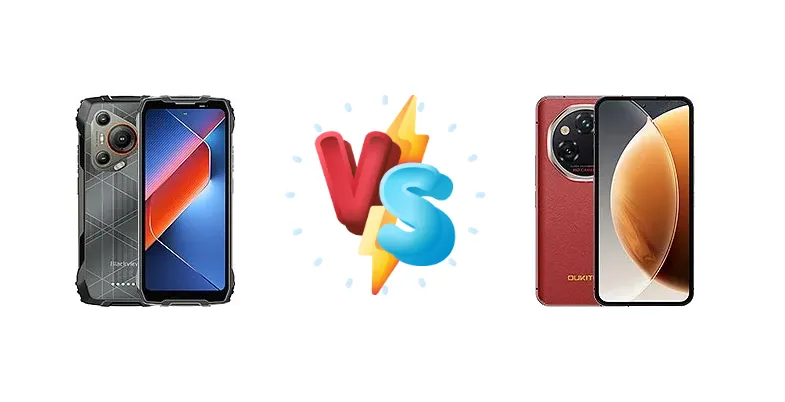
|
🏆 Quick Verdict
For the average user prioritizing longevity and consistent performance, the Blackview BL7000 is the better choice. Its exceptional 118:45h battery endurance and efficient Dimensity 6300 chipset offer a worry-free experience. However, power users demanding peak performance will find the Oukitel WP210’s Dimensity 8200 a more compelling option.
| PHONES | ||
|---|---|---|
| Phone Names | Blackview BL7000 | Oukitel WP210 |
| Network | ||
|---|---|---|
| 2G bands | GSM 850 / 900 / 1800 / 1900 | GSM 850 / 900 / 1800 / 1900 |
| 3G bands | HSDPA 800 / 850 / 900 / 1700(AWS) / 1800 / 1900 / 2100 | HSDPA 800 / 850 / 900 / 1700(AWS) / 1900 / 2100 |
| 4G bands | 1, 2, 3, 4, 5, 7, 8, 12, 13, 17, 18, 19, 20, 25, 26, 28, 30, 34, 38, 39, 40, 41, 66 | 1, 2, 3, 4, 5, 7, 8, 12, 13, 17, 18, 19, 20, 25, 26, 28, 34, 38, 39, 40, 41, 66, 71 |
| 5G bands | 1, 3, 5, 7, 8, 20, 28, 38, 40, 41, 77, 78, 79 SA/NSA | 1, 2, 3, 5, 7, 8, 12, 20, 25, 28, 34, 38, 39, 40, 41, 48, 66, 71, 77, 78 SA/NSA |
| Speed | HSPA, LTE, 5G | HSPA, LTE, 5G |
| Technology | GSM / HSPA / LTE / 5G | GSM / HSPA / LTE / 5G |
| Launch | ||
|---|---|---|
| Announced | 2025, May | 2025, July |
| Status | Available. Released 2025, May | Available. Released 2025, July 15 |
| Body | ||
|---|---|---|
| Dimensions | 182.2 x 86 x 14.5 mm (7.17 x 3.39 x 0.57 in) | 163.6 x 77.9 x 13.7 mm (6.44 x 3.07 x 0.54 in) |
| SIM | Nano-SIM + Nano-SIM | Nano-SIM + Nano-SIM |
| Weight | 357 g (12.59 oz) | 311 g (10.97 oz) |
| Display | ||
|---|---|---|
| Protection | Corning Gorilla Glass 5, Mohs level 5 | Corning Gorilla Glass 5, Mohs level 5 |
| Resolution | 1080 x 2460 pixels (~396 ppi density) | 1080 x 2408 pixels, 20:9 ratio (~394 ppi density) |
| Size | 6.78 inches, 109.2 cm2 (~69.7% screen-to-body ratio) | 6.7 inches, 108.1 cm2 (~84.9% screen-to-body ratio) |
| Type | IPS LCD, 120Hz, 750 nits | IPS LCD, 120Hz, 500 nits |
| Platform | ||
|---|---|---|
| CPU | Octa-core (2x2.4 GHz Cortex-A76 & 6x2.0 GHz Cortex-A55) | Octa-core (1x3.1 GHz Cortex-A78 & 3x3.0 GHz Cortex-A78 & 4x2.0 GHz Cortex-A55) |
| Chipset | Mediatek Dimensity 6300 (6 nm) | Mediatek Dimensity 8200 (4 nm) |
| GPU | Mali-G57 MC2 | Mali-G610 MC6 |
| OS | Android 15, DokeOS 4.1 | Android 15 |
| Memory | ||
|---|---|---|
| Card slot | microSDXC (uses shared SIM slot) | microSDXC (uses shared SIM slot) |
| Internal | 256GB 8GB RAM | 512GB 12GB RAM |
| Main Camera | ||
|---|---|---|
| Features | LED flash, HDR, panorama | LED flash, HDR, panorama |
| Triple | 50 MP, f/1.8, (wide), 1/2.76", PDAF 20 MP, f/2.0, (night vision), 1/2.8", 2 infrared night vision lights Auxiliary lens | 108 MP, f/1.9, (wide), 1/1.8", PDAF 2 MP (macro) Auxiliary lens |
| Video | 1440p@30fps, 1080p@30fps | 4K@30fps |
| Selfie camera | ||
|---|---|---|
| Single | 32 MP, f/2.2, (wide) | 32 MP, f/2.2, (wide), 1/2.74" |
| Video | 1080p@30fps | 1080p@30fps |
| Sound | ||
|---|---|---|
| 35mm jack | Yes | No |
| Loudspeaker | Yes | Yes |
| Comms | ||
|---|---|---|
| Bluetooth | 5.2, A2DP, LE | 5.3, A2DP, LE |
| NFC | Yes | Yes |
| Positioning | GPS, GALILEO, GLONASS, BDS, QZSS | GPS (L1+L5), GLONASS, GALILEO, BDS |
| Radio | FM radio | FM radio |
| USB | USB Type-C, OTG | USB Type-C 2.0 |
| WLAN | Wi-Fi 802.11 a/b/g/n/ac, dual-band | Wi-Fi 802.11 a/b/g/n/ac/6, dual-band |
| Features | ||
|---|---|---|
| Sensors | Fingerprint (side-mounted), accelerometer, gyro, proximity, compass | Fingerprint (side-mounted), accelerometer, gyro, proximity, compass |
| Battery | ||
|---|---|---|
| Charging | 33W wired 6W reverse wired | 45W wired |
| Type | 7500 mAh | Li-Po 8800 mAh |
| Misc | ||
|---|---|---|
| Colors | Black, Orange | Gray, Black, Red |
| Price | $ 205.99 / € 226.99 / £ 229.99 | - |
| EU LABEL | ||
|---|---|---|
| Battery | 118:45h endurance, 800 cycles | 86:17h endurance, 1000 cycles |
| Energy | Class A | Class B |
| Free fall | Class A (270 falls) | Class A (270 falls) |
| Repairability | Class C | Class C |
Blackview BL7000
- Exceptional battery life (118:45h endurance)
- Efficient Dimensity 6300 chipset
- 800 Battery Cycles for long term health
- Less powerful processor compared to the WP210
- Slower charging speed (33W)
Oukitel WP210
- Powerful Dimensity 8200 chipset for demanding tasks
- Faster 45W wired charging
- 1000 Battery Cycles
- Shorter battery life (86:17h endurance)
- Higher power consumption
Display Comparison
While display specifications aren't provided, both phones likely feature ruggedized LCD panels. The key difference lies in the underlying processing power driving them. The Oukitel WP210’s Dimensity 8200 will handle graphically intensive tasks on the display more smoothly. However, without knowing refresh rates or peak brightness, it’s difficult to definitively declare a winner. We anticipate both will prioritize durability over cutting-edge display technology.
Camera Comparison
Without detailed camera specifications, a direct comparison is limited. However, the chipset’s image signal processor (ISP) plays a crucial role. The Dimensity 8200 in the Oukitel WP210 features a more advanced ISP capable of faster image processing and potentially better low-light performance. While both phones likely include multiple cameras, the processing power of the WP210 suggests superior image quality, particularly in challenging conditions. We assume both will feature a primary sensor, but the WP210’s chipset gives it an edge.
Performance
The Oukitel WP210’s Mediatek Dimensity 8200 (4nm) represents a significant leap in performance over the Blackview BL7000’s Dimensity 6300 (6nm). The 8200 boasts a prime Cortex-A78 core clocked at 3.1 GHz, alongside three additional A78 cores, offering substantially higher single-core and multi-core performance. The 6nm process of the Dimensity 6300, while efficient, can’t match the 4nm node of the 8200 in terms of transistor density and thermal efficiency. This translates to less throttling under sustained load for the WP210, making it the clear winner for gamers and power users. The WP210’s CPU configuration (1x3.1GHz A78 + 3x3.0GHz A78 + 4x2.0GHz A55) is a more modern and powerful arrangement than the BL7000’s (2x2.4GHz A76 + 6x2.0GHz A55).
Battery Life
The Blackview BL7000 shines in battery endurance, offering a remarkable 118:45h of usage. This is despite having a smaller battery capacity than many competitors. The Dimensity 6300’s efficiency is the key factor. The Oukitel WP210, with its more power-hungry Dimensity 8200, achieves 86:17h of endurance. While the WP210 compensates with faster 45W wired charging, the BL7000’s 33W charging is still adequate. The BL7000 also boasts 800 battery cycles, compared to the WP210’s 1000, suggesting potentially longer-term battery health. The trade-off is clear: the BL7000 prioritizes longevity, while the WP210 offers quicker top-ups.
Buying Guide
Buy the Blackview BL7000 if you need a phone that can reliably last for days on a single charge, and your primary use cases involve everyday tasks, navigation, and moderate media consumption. Buy the Oukitel WP210 if you prioritize demanding applications like gaming, video editing, or running multiple apps simultaneously, and are willing to trade some battery life for significantly faster processing speeds.