
Blackview BL7000 vs Nokia XR21: A Deep Dive into Rugged Smartphone Performance
| Phones Images | |||||
|---|---|---|---|---|---|
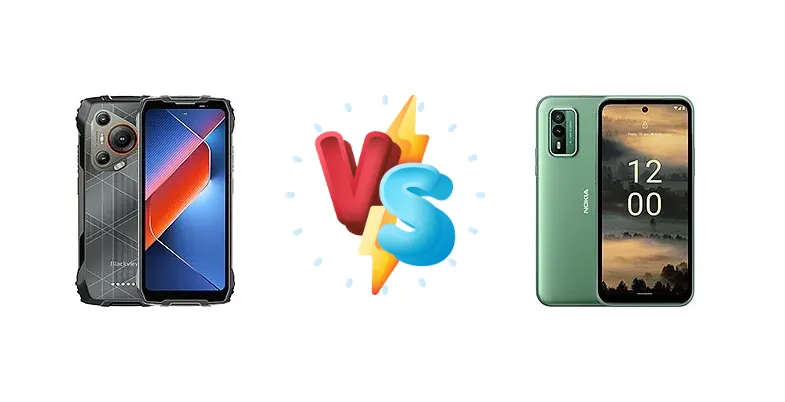
|
🏆 Quick Verdict
For users prioritizing exceptional battery life and raw processing power for the price, the Blackview BL7000 emerges as the winner. Its Dimensity 6300 chipset and impressive 118:45h endurance significantly outperform the Nokia XR21, making it ideal for extended off-grid use. However, the XR21's Qualcomm chipset offers broader compatibility and potentially smoother software experience.
| PHONES | ||
|---|---|---|
| Phone Names | Blackview BL7000 | Nokia XR21 |
| Network | ||
|---|---|---|
| 2G bands | GSM 850 / 900 / 1800 / 1900 | GSM 850 / 900 / 1800 / 1900 |
| 3G bands | HSDPA 800 / 850 / 900 / 1700(AWS) / 1800 / 1900 / 2100 | HSDPA 850 / 900 / 1700(AWS) / 1900 / 2100 |
| 4G bands | 1, 2, 3, 4, 5, 7, 8, 12, 13, 17, 18, 19, 20, 25, 26, 28, 30, 34, 38, 39, 40, 41, 66 | 1, 2, 3, 4, 5, 7, 8, 12, 13, 17, 20, 25, 26, 28, 32, 38, 39, 40, 41, 42, 43, 48, 66, 71 |
| 5G bands | 1, 3, 5, 7, 8, 20, 28, 38, 40, 41, 77, 78, 79 SA/NSA | 1, 2, 3, 5, 7, 20, 25, 28, 40, 41, 66, 71, 77, 78, 79 SA/NSA |
| Speed | HSPA, LTE, 5G | HSPA, LTE, 5G |
| Technology | GSM / HSPA / LTE / 5G | GSM / HSPA / LTE / 5G |
| Launch | ||
|---|---|---|
| Announced | 2025, May | 2023, May 03 |
| Status | Available. Released 2025, May | Available. Released 2023, June 11 |
| Body | ||
|---|---|---|
| Build | - | Glass front (Gorilla Glass Victus), plastic back, plastic frame |
| Dimensions | 182.2 x 86 x 14.5 mm (7.17 x 3.39 x 0.57 in) | 168 x 78.6 x 10.5 mm (6.61 x 3.09 x 0.41 in) |
| SIM | Nano-SIM + Nano-SIM | Nano-SIM + Nano-SIM + eSIM (max 2 at a time) |
| Weight | 357 g (12.59 oz) | 231 g (8.15 oz) |
| - | IP68/IP69K dust/water resistant (up to 1.5m for 60 min) Drop-to-concrete resistance from up to 1.8m MIL-STD-810H compliant | |
| Display | ||
|---|---|---|
| Protection | Corning Gorilla Glass 5, Mohs level 5 | Corning Gorilla Glass Victus |
| Resolution | 1080 x 2460 pixels (~396 ppi density) | 1080 x 2400 pixels, 20:9 ratio (~406 ppi density) |
| Size | 6.78 inches, 109.2 cm2 (~69.7% screen-to-body ratio) | 6.49 inches, 101.7 cm2 (~77.0% screen-to-body ratio) |
| Type | IPS LCD, 120Hz, 750 nits | IPS LCD, 120Hz, 450 nits (typ), 550 nits (HBM) |
| Platform | ||
|---|---|---|
| CPU | Octa-core (2x2.4 GHz Cortex-A76 & 6x2.0 GHz Cortex-A55) | Octa-core (2x2.2 GHz Kryo 660 Gold & 6x1.7 GHz Kryo 660 Silver) |
| Chipset | Mediatek Dimensity 6300 (6 nm) | Qualcomm SM6375 Snapdragon 695 5G (6 nm) |
| GPU | Mali-G57 MC2 | Adreno 619 |
| OS | Android 15, DokeOS 4.1 | Android 12 |
| Memory | ||
|---|---|---|
| Card slot | microSDXC (uses shared SIM slot) | Unspecified |
| Internal | 256GB 8GB RAM | 128GB 6GB RAM |
| Main Camera | ||
|---|---|---|
| Dual | - | 64 MP, f/1.8, (wide), 1/2.0", PDAF 8 MP, f/2.2, (ultrawide), 1/4.0", 1.12µm |
| Features | LED flash, HDR, panorama | Dual-LED dual-tone flash, second LED flash, HDR, panorama |
| Triple | 50 MP, f/1.8, (wide), 1/2.76", PDAF 20 MP, f/2.0, (night vision), 1/2.8", 2 infrared night vision lights Auxiliary lens | - |
| Video | 1440p@30fps, 1080p@30fps | 1080p@30fps |
| Selfie camera | ||
|---|---|---|
| Single | 32 MP, f/2.2, (wide) | 16 MP, f/2.4 (wide) |
| Video | 1080p@30fps | 1080p@30fps |
| Sound | ||
|---|---|---|
| 3.5mm jack | - | Yes |
| 35mm jack | Yes | Yes |
| Loudspeaker | Yes | Yes, with stereo speakers |
| Comms | ||
|---|---|---|
| Bluetooth | 5.2, A2DP, LE | 5.1, A2DP, LE, aptX Adaptive |
| NFC | Yes | Yes (market/region dependent) |
| Positioning | GPS, GALILEO, GLONASS, BDS, QZSS | GPS (L1+L5), GLONASS (G1), BDS (B1I+B1c+B2a), GALILEO (E1+E5a), QZSS (L1+L5), NavIC (L5) |
| Radio | FM radio | Unspecified |
| USB | USB Type-C, OTG | USB Type-C 2.0, OTG |
| WLAN | Wi-Fi 802.11 a/b/g/n/ac, dual-band | Wi-Fi 802.11 a/b/g/n/ac/6, dual-band |
| Features | ||
|---|---|---|
| Sensors | Fingerprint (side-mounted), accelerometer, gyro, proximity, compass | Fingerprint (side-mounted), accelerometer, gyro, proximity, compass, barometer |
| Battery | ||
|---|---|---|
| Charging | 33W wired 6W reverse wired | 33W wired, PD2.0, QC3 |
| Type | 7500 mAh | Li-Po 4800 mAh |
| Misc | ||
|---|---|---|
| Colors | Black, Orange | Midnight Black, Pine Green |
| Price | $ 205.99 / € 226.99 / £ 229.99 | About 570 EUR |
| EU LABEL | ||
|---|---|---|
| Battery | 118:45h endurance, 800 cycles | - |
| Energy | Class A | - |
| Free fall | Class A (270 falls) | - |
| Repairability | Class C | - |
Blackview BL7000
- Exceptional battery life (118:45h endurance)
- More powerful CPU (Dimensity 6300)
- High battery cycle count (800 cycles)
- Software experience may be less refined
- Camera specifications unknown
Nokia XR21
- Qualcomm Snapdragon 695 for 5G compatibility
- PD2.0 and QC3 fast charging support
- Potentially cleaner Android experience
- Lower battery endurance compared to BL7000
- Less powerful CPU for demanding tasks
Display Comparison
Display specifications are absent from the provided data, but considering the market segment, both likely feature durable, sunlight-readable panels. The Nokia XR21, given Nokia's history, may offer slightly better color calibration and viewing angles. However, without specific details like resolution, peak brightness, and panel type (IPS vs AMOLED), a definitive comparison is impossible. The rugged nature of both devices likely prioritizes durability over cutting-edge display technology.
Camera Comparison
Camera details are missing, but given the rugged focus, expect practical, rather than flagship-level, camera systems. The absence of high-resolution sensors suggests a focus on durability and functionality over photographic excellence. Image processing will likely be a key differentiator, with Nokia potentially offering more natural-looking images, while Blackview might prioritize vibrant colors. Without sensor size or aperture information, it’s difficult to assess low-light performance.
Performance
The core difference lies in the chipsets. The Blackview BL7000’s Mediatek Dimensity 6300 (6nm) boasts a more powerful CPU configuration – 2x2.4 GHz Cortex-A76 cores versus the Nokia XR21’s 2x2.2 GHz Kryo 660 Gold cores. This suggests the BL7000 will handle CPU-intensive tasks like video editing and demanding games with greater ease. While both are 6nm chips, the Dimensity 6300’s architecture provides a performance edge. The Snapdragon 695 in the XR21 is known for its 5G modem capabilities and efficient power consumption, but it’s generally less powerful than the Dimensity 6300 in raw processing terms. The BL7000 will benefit users who frequently run multiple apps or engage in resource-heavy activities.
Battery Life
The Blackview BL7000’s battery endurance of 118:45h is a standout feature, significantly exceeding what’s typically found in smartphones. This, combined with the 800 charge cycle rating, indicates a long-lasting battery designed for extended use. While both phones offer 33W wired charging, the Nokia XR21 adds PD2.0 and QC3 support, potentially allowing for faster charging with compatible adapters. However, the BL7000’s massive endurance mitigates the need for frequent charging, making the XR21’s faster charging less critical for many users.
Buying Guide
Buy the Blackview BL7000 if you need maximum battery life, prioritize CPU performance for multitasking and demanding apps, and are comfortable with a potentially less refined software experience. Buy the Nokia XR21 if you prefer a Qualcomm chipset for wider 5G band support, value a cleaner Android experience with guaranteed updates, and prioritize compatibility with a broader range of accessories and software.