
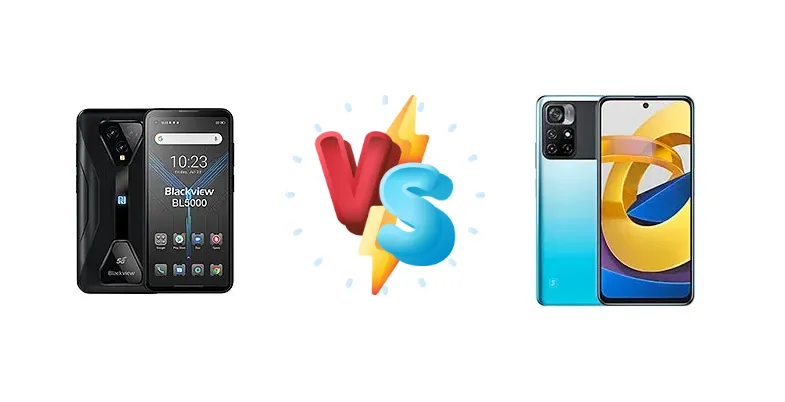
Blackview BL5000 vs Xiaomi Poco M4 Pro 5G: A Budget 5G Showdown
| Phones Images | |||||
|---|---|---|---|---|---|
|
🏆 Quick Verdict
The Poco M4 Pro 5G edges out the BL5000 thanks to its faster charging, slightly more powerful chipset, and generally more polished software experience. While the BL5000 offers a rugged design, the Poco's balance of features and performance makes it the better choice for most users.
| PHONES | ||
|---|---|---|
| Phone Names | Blackview BL5000 | Xiaomi Poco M4 Pro 5G |
| Network | ||
|---|---|---|
| 2G bands | GSM 850 / 900 / 1800 / 1900 | GSM 850 / 900 / 1800 / 1900 |
| 3G bands | HSDPA 800 / 850 / 900 / 1700(AWS) / 1900 / 2100 | HSDPA 850 / 900 / 1700(AWS) / 1900 / 2100 - International |
| 4G bands | 1, 2, 3, 4, 5, 7, 8, 12, 13, 17, 18, 19, 20, 25, 26, 28, 34, 38, 39, 40, 41, 66 | 1, 2, 3, 4, 5, 7, 8, 12, 17, 20, 28, 32, 38, 40, 41, 66 - International |
| 5G bands | 1, 3, 5, 7, 8, 20, 28, 38, 40, 41, 77, 78, 79 SA/NSA | 1, 3, 5, 7, 8, 20, 28, 38, 40, 41, 66, 77, 78 SA/NSA - International |
| Speed | HSPA, LTE, 5G | HSPA, LTE, 5G |
| Technology | GSM / CDMA / HSPA / CDMA2000 / LTE / 5G | GSM / HSPA / LTE / 5G |
| CDMA2000 1x | 1, 3, 5, 8, 28, 40, 78 SA/NSA - India | |
| Launch | ||
|---|---|---|
| Announced | 2021, July 29 | 2021, November 09 |
| Status | Available. Released 2021, August | Available. Released 2021, November 11 |
| Body | ||
|---|---|---|
| Build | - | Glass front (Gorilla Glass 3), plastic back, plastic frame |
| Dimensions | 164 x 80.4 x 12.8 mm (6.46 x 3.17 x 0.50 in) | 163.6 x 75.8 x 8.8 mm (6.44 x 2.98 x 0.35 in) |
| SIM | Nano-SIM + Nano-SIM | Nano-SIM + Nano-SIM |
| Weight | 273 g (9.63 oz) | 195 g (6.88 oz) |
| IP68/IP69K dust/water resistant (up to 1.5m for 30 min) Drop-to-concrete resistance from up to 1.5m MIL-STD-810G compliant | IP53, dust and splash resistant | |
| Display | ||
|---|---|---|
| Protection | Corning Gorilla Glass 5 | Corning Gorilla Glass 3 |
| Resolution | 1080 x 2300 pixels (~400 ppi density) | 1080 x 2400 pixels, 20:9 ratio (~399 ppi density) |
| Size | 6.36 inches, 100.4 cm2 (~76.1% screen-to-body ratio) | 6.6 inches, 105.2 cm2 (~84.8% screen-to-body ratio) |
| Type | IPS LCD | IPS LCD, 90Hz, 450 nits (typ) |
| Platform | ||
|---|---|---|
| CPU | Octa-core (2x2.2 GHz Cortex-A76 & 6x2.0 GHz Cortex-A55) | Octa-core (2x2.4 GHz Cortex-A76 & 6x2.0 GHz Cortex-A55) |
| Chipset | Mediatek Dimensity 700 (7 nm) | Mediatek Dimensity 810 (6 nm) |
| GPU | Mali-G57 MC2 | Mali-G57 MC2 |
| OS | Android 11 | Android 11, upgradable to Android 12, MIUI 13 |
| Memory | ||
|---|---|---|
| Card slot | No | microSDXC |
| Internal | 128GB 8GB RAM | 64GB 4GB RAM, 64GB 6GB RAM, 128GB 4GB RAM, 128GB 6GB RAM, 128GB 8GB RAM, 256GB 8GB RAM |
| UFS 2.2 | UFS 2.2 | |
| Main Camera | ||
|---|---|---|
| Dual | 12 MP, f/1.8, (wide), PDAF 16 MP, 125˚ (ultrawide) | 50 MP, f/1.8, 26mm (wide), PDAF 8 MP, f/2.2, 119˚ (ultrawide) |
| Features | LED flash, HDR, panorama | LED flash, HDR, panorama |
| Single | 16 MP, f/2.0, (wide) | 16 MP, f/2.5, (wide), 1/3.06" 1.0µm |
| Video | 1440p@30fps | 1080p@30/60fps |
| Selfie camera | ||
|---|---|---|
| Features | - | Panorama |
| Single | 16 MP, f/2.0, (wide) | 16 MP, f/2.5, (wide), 1/3.06" 1.0µm |
| Video | 1080p@30fps | 1080p@30fps |
| Sound | ||
|---|---|---|
| 3.5mm jack | No | Yes |
| 35mm jack | No | Yes |
| Loudspeaker | Yes | Yes, with stereo speakers |
| Comms | ||
|---|---|---|
| Bluetooth | 5.2, A2DP, LE | 5.1, A2DP, LE |
| Infrared port | - | Yes |
| NFC | Yes | Yes (market/region dependent) |
| Positioning | GPS, GLONASS, GALILEO, BDS | GPS, GLONASS, GALILEO, BDS |
| Radio | FM radio | FM radio |
| USB | USB Type-C 2.0, OTG | USB Type-C 2.0, OTG |
| WLAN | Wi-Fi 802.11 a/b/g/n/ac | Wi-Fi 802.11 a/b/g/n/ac, dual-band, Wi-Fi Direct |
| Features | ||
|---|---|---|
| Sensors | Fingerprint (side-mounted), accelerometer, gyro, proximity, compass, barometer | Fingerprint (side-mounted), accelerometer, gyro, compass |
| Battery | ||
|---|---|---|
| Charging | 30W wired | 33W wired, 100% in 59 min |
| Type | 4980 mAh | Li-Po 5000 mAh |
| Misc | ||
|---|---|---|
| Colors | Black, Orange, Green | Poco Yellow, Power Black, Cool Blue |
| Models | - | 21091116AG, MZB0BGVIN |
| Price | About 260 EUR | About 150 EUR |
| SAR | - | 1.07 W/kg (head) 1.09 W/kg (body) |
| SAR EU | - | 0.59 W/kg (head) 1.00 W/kg (body) |
| Tests | ||
|---|---|---|
| Battery life | - | Endurance rating 123h |
| Camera | - | Photo / Video |
| Display | - | Contrast ratio: 1553:1 (nominal) |
| Loudspeaker | - | -24.9 LUFS (Very good) |
| Performance | - | AnTuTu: 296721 (v8), 353663 (v9) GeekBench: 1797 (v5.1) GFXBench: 13fps (ES 3.1 onscreen) |
Blackview BL5000
- Rugged and durable design
- Decent battery life
- 5G connectivity
- Less powerful chipset
- Slower charging
- Potentially less refined display
- Limited software support
Xiaomi Poco M4 Pro 5G
- Faster charging (33W)
- Slightly more powerful chipset (Dimensity 810)
- Brighter display (510 nits)
- Generally better software experience
- Good value for money
- Less rugged design
- Battery life, while good, isn't dramatically better than BL5000
Display Comparison
Both phones feature similar contrast ratios (1553:1), but the Poco M4 Pro 5G boasts a measured brightness of 510 nits, offering a slightly better viewing experience, especially outdoors. The Poco likely has a more refined color calibration as well, typical of Xiaomi devices. The BL5000's display is likely adequate but may lack the vibrancy of the Poco.
Camera Comparison
Camera details are sparse for both devices, but the Poco M4 Pro 5G generally benefits from Xiaomi's established camera software and image processing. Expect slightly better image quality and more features on the Poco. Both likely offer adequate photo and video capabilities for casual users.
Performance
The Poco M4 Pro 5G's Dimensity 810 chipset (6nm) holds a slight advantage over the BL5000's Dimensity 700 (7nm). While both are capable of handling everyday tasks and light gaming, the Poco will likely offer smoother performance and better multitasking capabilities. The 6nm process also suggests better power efficiency for the Poco.
Battery Life
Both phones boast impressive endurance ratings (123h), suggesting excellent battery life. However, the Poco M4 Pro 5G's 33W charging significantly outperforms the BL5000's 30W, allowing for much faster top-ups. This is a crucial advantage for users who value quick charging.
Buying Guide
The Blackview BL5000 is ideal for users prioritizing durability and a rugged design, potentially those working in demanding environments. The Xiaomi Poco M4 Pro 5G is a better fit for users seeking a well-rounded smartphone with a good display, decent camera, and fast charging, all at an attractive price point.