
Blackview Active 10 Pro vs. Samsung Galaxy XCover Pro: A Rugged Performance Showdown
| Phones Images | |||||
|---|---|---|---|---|---|
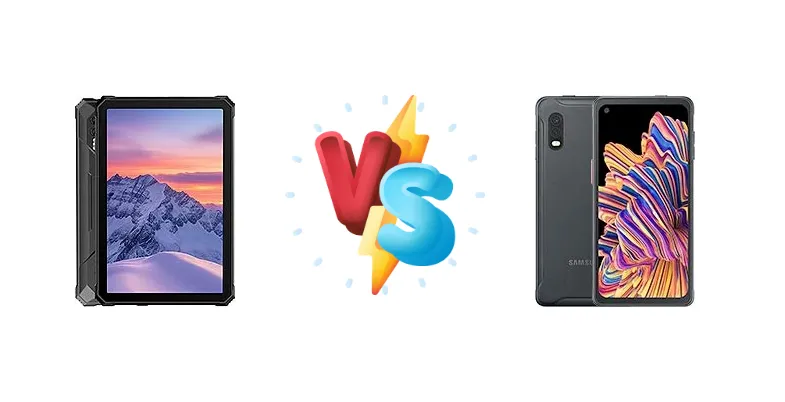
|
🏆 Quick Verdict
For the average user prioritizing performance and battery life, the Blackview Active 10 Pro is the clear winner. Its Dimensity 7300 chipset and 55W charging significantly outperform the aging Exynos 9611 in the Galaxy XCover Pro. However, Samsung’s software ecosystem and brand trust are still valuable considerations.
| PHONES | ||
|---|---|---|
| Phone Names | Blackview Active 10 Pro | Samsung Galaxy XCover Pro |
| Network | ||
|---|---|---|
| 2G bands | GSM 850 / 900 / 1800 / 1900 | GSM 850 / 900 / 1800 / 1900 |
| 3G bands | HSDPA 800 / 850 / 900 / 1700(AWS) / 1900 / 2100 | HSDPA 850 / 900 / 1900 / 2100 - International |
| 4G bands | 1, 2, 3, 4, 5, 7, 8, 12, 13, 17, 18, 19, 20, 25, 26, 28, 30, 34, 38, 39, 40, 41, 66 | 1, 2, 3, 5, 7, 8, 20, 28, 38, 40, 41 - International |
| 5G bands | 1, 3, 5, 7, 8, 20, 28, 38, 40, 41, 77, 78, 79 SA/NSA | - |
| Speed | HSPA, LTE, 5G | HSPA 42.2/5.76 Mbps, LTE (3CA) Cat11 600/50 Mbps |
| Technology | GSM / CDMA / HSPA / LTE / 5G | GSM / HSPA / LTE |
| - | 1, 2, 3, 4, 5, 7, 12, 13, 14, 20, 29, 38, 40, 41, 66 - Canada | |
| Launch | ||
|---|---|---|
| Announced | 2024, December 09 | 2020, January |
| Status | Available. Released 2024, December 09 | Available. Released 2020, January |
| Body | ||
|---|---|---|
| Dimensions | 267.6 x 179 x 19.5 mm (10.54 x 7.05 x 0.77 in) | 159.9 x 76.7 x 10 mm (6.30 x 3.02 x 0.39 in) |
| SIM | Nano-SIM + Nano-SIM | · Nano-SIM· Nano-SIM + Nano-SIM |
| Weight | 1214 g (2.68 lb) | 218 g (7.69 oz) |
| - | IP68 dust/water resistant (up to 1.5m for 35 min) Drop-to-concrete resistance from up to 1.5m MIL-STD-810G compliant* *does not guarantee ruggedness or use in extreme conditions | |
| Display | ||
|---|---|---|
| Protection | Corning Gorilla Glass 5, Mohs level 5 | Corning Gorilla Glass 5 |
| Resolution | 1200 x 1920 pixels, 16:10 ratio (~207 ppi density) | 1080 x 2340 pixels, 19.5:9 ratio (~409 ppi density) |
| Size | 10.95 inches, 347.7 cm2 (~72.6% screen-to-body ratio) | 6.3 inches, 97.4 cm2 (~79.4% screen-to-body ratio) |
| Type | IPS LCD, 90Hz, 360 nits | IPS LCD |
| Platform | ||
|---|---|---|
| CPU | Octa-core (4x2.5 GHz Cortex-A78 & 4x2.0 GHz Cortex-A55) | Octa-core (4x2.3 GHz Cortex-A73 & 4x1.7 GHz Cortex-A53) |
| Chipset | Mediatek Dimensity 7300 (4 nm) | Exynos 9611 (10 nm) |
| GPU | Mali-G615 MC2 | Mali-G72 MP3 |
| OS | Android 14, Doke OS_P 4.0 | Android 10, upgradable to Android 13, One UI 5 |
| Memory | ||
|---|---|---|
| Card slot | Unspecified | microSDXC (dedicated slot) |
| Internal | 256GB 12GB RAM, 512GB 12GB RAM | 64GB 4GB RAM |
| Main Camera | ||
|---|---|---|
| Dual | 108 MP, (wide) 20 MP, (night vision) | 25 MP, f/1.7, 26mm (wide), PDAF 8 MP, f/2.2, 123˚ (ultrawide), 1/4.0", 1.12µm |
| Features | LED flash | Dual-LED flash, HDR, panorama |
| Video | 1080p@60fps | 1080p@30fps |
| Selfie camera | ||
|---|---|---|
| Features | - | HDR |
| Single | 50 MP, (wide) | 13 MP, f/2.0, (wide), 1/3.1", 1.12µm |
| Video | 1080p@30fps | 1080p@30fps |
| Sound | ||
|---|---|---|
| 3.5mm jack | - | Yes |
| 35mm jack | Yes | Yes |
| Loudspeaker | Yes, with stereo speakers | Yes |
| Comms | ||
|---|---|---|
| Bluetooth | 5.4, A2DP, LE | 5.0, A2DP, LE |
| NFC | Yes | Yes |
| Positioning | GPS, GLONASS, GALILEO, BDS | GPS, GLONASS, GALILEO, BDS |
| Radio | FM Radio | FM radio (market/region dependent) |
| USB | USB Type-C 2.0, OTG | USB Type-C 2.0 |
| WLAN | Wi-Fi 802.11 a/b/g/n/ac/6, dual-band | Wi-Fi 802.11 a/b/g/n/ac/k/v/r, dual-band, Wi-Fi Direct |
| Features | ||
|---|---|---|
| Sensors | Accelerometer, gyro, proximity, compass, barometer | Fingerprint (side-mounted), accelerometer, gyro, proximity, compass |
| - | ANT+ | |
| Battery | ||
|---|---|---|
| Charging | 55W wired | 15W wired |
| Type | 30000 mAh | Li-Po 4050 mAh, removable |
| Misc | ||
|---|---|---|
| Colors | Black, Orange | Black |
| Models | - | SM-G715FN/DS, SM-G715FN, SM-G715F, SM-G715W, SM-G715U, SM-G715U1 |
| Price | About 330 EUR | About 120 EUR |
| SAR | 1.34 W/kg (body) | - |
| SAR EU | - | 0.47 W/kg (head) 1.23 W/kg (body) |
| EU LABEL | ||
|---|---|---|
| Battery | 166:39h endurance, 2000 cycles | - |
| Energy | Class D | - |
| Free fall | Class A (208 falls) | - |
| Repairability | Class B | - |
Blackview Active 10 Pro
- Significantly faster processor (Dimensity 7300)
- Exceptional battery life (166:39h endurance)
- Rapid 55W wired charging
- Potentially superior image processing
- Less established brand reputation
- Software support may be less frequent than Samsung
Samsung Galaxy XCover Pro
- Established Samsung brand and ecosystem
- Potential for longer software support
- Rugged design for demanding environments
- Replaceable battery (a niche advantage)
- Outdated Exynos 9611 chipset
- Slow 15W charging
- Inferior performance compared to the Active 10 Pro
- Lower battery endurance
Display Comparison
Neither device boasts a cutting-edge display. While specific display specs (resolution, panel type) are missing for both, the focus here is on durability. Both are likely to feature hardened glass, but the real difference lies elsewhere. The XCover Pro’s older chipset will struggle to drive a high-refresh-rate panel effectively, while the Active 10 Pro’s Dimensity 7300 has headroom for smoother visuals if Blackview chooses to implement it in future iterations.
Camera Comparison
Without detailed camera specifications, a direct comparison is limited. However, the chipset plays a crucial role in image processing. The Dimensity 7300’s integrated ISP (Image Signal Processor) is far more advanced than the Exynos 9611’s, enabling faster processing, better noise reduction, and improved dynamic range. While both phones likely feature a standard array of cameras, the Active 10 Pro will likely produce superior image quality, especially in challenging lighting conditions. The presence of a 2MP macro camera on either device is largely a marketing gimmick and shouldn't heavily influence purchasing decisions.
Performance
The performance gap is substantial. The Blackview Active 10 Pro’s Mediatek Dimensity 7300 (4nm) is a generational leap ahead of the Samsung Galaxy XCover Pro’s Exynos 9611 (10nm). The Dimensity 7300’s Cortex-A78 cores, clocked at 2.5 GHz, offer significantly higher single-core performance than the XCover Pro’s Cortex-A73 cores at 2.3 GHz. Furthermore, the 4nm process node of the Dimensity 7300 translates to improved thermal efficiency, reducing throttling during sustained workloads. This means the Active 10 Pro will handle multitasking, gaming, and demanding applications with greater ease and consistency. The older Exynos 9611 will likely exhibit noticeable slowdowns under heavy load.
Battery Life
The Blackview Active 10 Pro’s battery endurance of 166:39h is a standout feature, dwarfing what’s typically expected from a phone in this category. While the exact battery capacity isn’t specified, the combination of the efficient Dimensity 7300 chipset and optimized software contributes to this impressive longevity. The 55W wired charging is another significant advantage, allowing for rapid replenishment. In contrast, the Galaxy XCover Pro’s 15W charging feels antiquated, requiring considerably longer to reach a full charge. The Active 10 Pro also boasts 2000 charge cycles, suggesting a longer lifespan before significant battery degradation.
Buying Guide
Buy the Blackview Active 10 Pro if you need a rugged phone with modern processing power for demanding tasks, extended battery life for fieldwork, and fast charging capabilities. Buy the Samsung Galaxy XCover Pro if you prioritize Samsung’s established software support, potential compatibility with existing Samsung ecosystems, and a more recognizable brand name, accepting compromises in performance and charging speed.