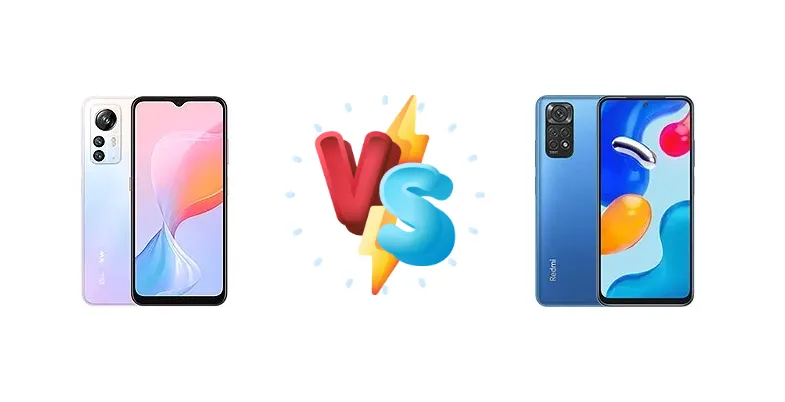
Looking for a reliable smartphone without breaking the bank? The Blackview A85 and Xiaomi Redmi Note 11S are both contenders in the budget phone arena. But which one reigns supreme? We'll break down their key features to help you decide.
🏆 Quick Verdict
The Xiaomi Redmi Note 11S emerges as the clear winner, offering a superior chipset, faster charging, and a brighter display. While the Blackview A85 is a budget-friendly option, the Redmi Note 11S provides a more well-rounded and premium experience for a slightly higher price.
| Network |
|---|
| 2G bands | GSM 850 / 900 / 1800 / 1900 | GSM 850 / 900 / 1800 / 1900 |
| 3G bands | HSDPA 900 / 2100 | HSDPA 850 / 900 / 1700(AWS) / 1900 / 2100 |
| 4G bands | 1, 3, 7, 8, 20, 40 | 1, 2, 3, 4, 5, 7, 8, 20, 28, 38, 40, 41 |
| Speed | HSPA, LTE | HSPA, LTE |
| Technology | GSM / HSPA / LTE | GSM / HSPA / LTE |
| Launch |
|---|
| Announced | 2022, November 22 | 2022, January 26 |
| Status | Available. Released 2022, November 25 | Available. Released 2022, February 09 |
| Body |
|---|
| Build | Glass front, aluminum frame, glass back | Glass front (Gorilla Glass 3), plastic frame, glass back |
| Dimensions | 164.3 x 76.1 x 8.7 mm (6.47 x 3.00 x 0.34 in) | 159.9 x 73.9 x 8.1 mm (6.30 x 2.91 x 0.32 in) |
| SIM | Nano-SIM + Nano-SIM | Nano-SIM + Nano-SIM |
| Weight | 193 g (6.81 oz) | 179 g (6.31 oz) |
| | - | IP53, dust and splash resistant |
| Display |
|---|
| Protection | - | Corning Gorilla Glass 3 |
| Resolution | 720 x 1612 pixels, 20:9 ratio (~272 ppi density) | 1080 x 2400 pixels, 20:9 ratio (~409 ppi density) |
| Size | 6.5 inches, 101.5 cm2 (~81.2% screen-to-body ratio) | 6.43 inches, 99.8 cm2 (~84.5% screen-to-body ratio) |
| Type | IPS LCD, 90Hz | AMOLED, 90Hz, 700 nits, 1000 nits (peak) |
| Platform |
|---|
| CPU | Octa-core (2x1.6 GHz Cortex-A75 & 6x1.6 GHz Cortex-A55) | Octa-core (2x2.05 GHz Cortex-A76 & 6x2.0 GHz Cortex-A55) |
| Chipset | Unisoc T606 (12 nm) | Mediatek MT6781 Helio G96 (12 nm) |
| GPU | Mali-G57 MP1 | Mali-G57 MC2 |
| OS | Android 12, Doke OS 3.0 | Android 11, MIUI 13 |
| Memory |
|---|
| Card slot | microSDXC (dedicated slot) | microSDXC (dedicated slot) |
| Internal | 128GB 8GB RAM | 64GB 6GB RAM, 128GB 6GB RAM, 128GB 8GB RAM |
| | UFS 2.1 | UFS 2.2 |
| Main Camera |
|---|
| Dual | 50 MP, (wide), 1/2.76", 0.64µm, PDAF
8 MP, 120˚ (ultrawide) | - |
| Features | Dual-LED dual-tone flash, HDR, panorama | LED flash, HDR, panorama |
| Quad | - | 108 MP, f/1.9, 26mm (wide), 1/1.52", 0.7µm, PDAF
8 MP, f/2.2, 118˚ (ultrawide)
2 MP (macro)
Auxiliary lens |
| Single | 8 MP, (wide), 1/4", 1.12µm | - |
| Video | 1080p@30fps | 1080p@30fps |
| Selfie camera |
|---|
| Single | 8 MP, (wide), 1/4.0", 1.12µm | 16 MP, f/2.5, (wide), 1/3.06" 1.0µm |
| Video | Yes | 1080p@30fps |
| Sound |
|---|
| 3.5mm jack | Yes | Yes |
| 35mm jack | Yes | Yes |
| Loudspeaker | Yes | Yes, with stereo speakers |
| | - | 24-bit/192kHz audio |
| Comms |
|---|
| Bluetooth | Yes | 5.0, A2DP, LE |
| Infrared port | - | Yes |
| NFC | Yes | Yes (market/region dependent) |
| Positioning | GPS, GLONASS, GALILEO, BDS | GPS, GLONASS, BDS, GALILEO |
| Radio | FM radio | FM radio |
| USB | Yes, OTG | USB Type-C 2.0, OTG |
| WLAN | Yes | Wi-Fi 802.11 a/b/g/n/ac, dual-band, Wi-Fi Direct |
| Features |
|---|
| Sensors | Fingerprint (side-mounted), accelerometer, proximity | Fingerprint (side-mounted), accelerometer, gyro, compass |
| | - | Virtual proximity sensing |
| Battery |
|---|
| Charging | 18W wired | 33W wired, PD3.0, QC3, 100% in 58 min |
| Type | 4480 mAh | Li-Po 5000 mAh |
| Misc |
|---|
| Colors | Black, Blue, Sky | Graphite Gray, Pearl White, Twilight Blue |
| Models | - | 2201117SG, 2201117SI, 2201117SY, 2201117SL |
| Price | About 160 EUR | € 136.99 |
| SAR | - | 1.09 W/kg (head) 1.05 W/kg (body) |
| SAR EU | - | 0.59 W/kg (head) 0.88 W/kg (body) |
| Tests |
|---|
| Battery life | - |
Endurance rating 133h
|
| Camera | - |
Photo / Video |
| Display | - |
Contrast ratio: Infinite (nominal) |
| Loudspeaker | - |
-25.4 LUFS (Very good)
|
| Performance | - |
AnTuTu: 251201 (v8), 308741 (v9)
GeekBench: 1873 (v5.1)
GFXBench: 12fps (ES 3.1 onscreen) |
Blackview A85
- Affordable
- Decent battery life
- Basic functionality
- Weaker chipset
- Lower display quality
- Slower charging
- Limited camera capabilities
- Missing detailed specs
Xiaomi Redmi Note 11S
- Faster chipset (Helio G96)
- Brighter and better display
- Faster charging (33W)
- Likely better camera
- More established brand
- Slightly more expensive
- Endurance rating is similar, so not a huge battery advantage
Display Comparison
The Redmi Note 11S boasts a significantly brighter display (744 nits) compared to the A85, offering better visibility in sunlight. While the A85's display is adequate, the Redmi Note 11S's contrast ratio (infinite nominal) suggests richer colors and deeper blacks. The Redmi Note 11S likely has a higher resolution as well, though specific A85 resolution data is scarce.
Camera Comparison
While both phones offer 'Photo / Video' capabilities, the Redmi Note 11S is expected to have a more advanced camera system. The G96 chipset often supports better image processing, and Xiaomi generally prioritizes camera quality in their Redmi series. Specific camera specs (megapixels, aperture) for the A85 are unavailable, further suggesting the Redmi Note 11S holds an advantage.
Performance
The Redmi Note 11S's Helio G96 chipset is noticeably more powerful than the A85's Unisoc T606. The Cortex-A76 cores in the G96 provide a significant boost in performance for demanding tasks and gaming. Expect smoother multitasking and faster app loading times on the Redmi Note 11S.
Battery Life
Both phones claim impressive endurance ratings (133h), suggesting excellent battery life. However, the Redmi Note 11S's 33W fast charging significantly reduces charging times compared to the A85's 18W wired charging. This is a crucial advantage for users who value convenience.
Buying Guide
The Blackview A85 is ideal for users prioritizing affordability above all else and needing a basic smartphone for calls, texts, and light social media use. The Xiaomi Redmi Note 11S is a better choice for those seeking a smoother performance, better camera capabilities, faster charging, and a more vibrant display, even on a budget.
Frequently Asked Questions
❓ Is the Blackview A85 a good phone for gaming?
The Blackview A85's Unisoc T606 chipset is not ideal for demanding games. It can handle basic games, but you may experience lag and reduced performance in more graphically intensive titles. The Redmi Note 11S is a better choice for gaming.
❓ How does the charging speed of the Redmi Note 11S compare to the A85?
The Redmi Note 11S charges significantly faster with its 33W wired charging, reaching 100% in approximately 58 minutes. The A85's 18W charging will take considerably longer.