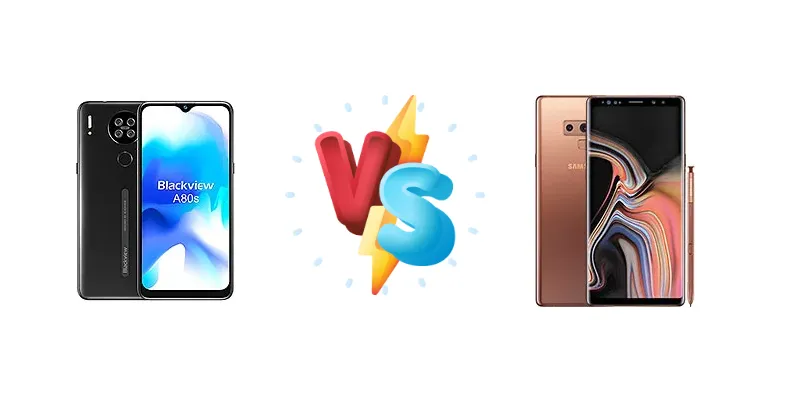
The smartphone landscape is vast, offering options for every budget and need. Today, we pit a budget-friendly contender, the Blackview A80s, against a former flagship powerhouse, the Samsung Galaxy Note9. Can the A80s hold its own against a phone known for its premium features and performance?
🏆 Quick Verdict
The Samsung Galaxy Note9 unequivocally wins this comparison. While the Blackview A80s offers affordability, the Note9's superior performance, camera, display, and build quality make it the clear victor, despite its age. It's a flagship experience versus a budget option.
| Network |
|---|
| 2G bands | GSM 850 / 900 / 1800 / 1900 | GSM 850 / 900 / 1800 / 1900 |
| 3G bands | HSDPA 850 / 900 / 1900 / 2100 | HSDPA 850 / 900 / 1700(AWS) / 1900 / 2100 |
| 4G bands | 1, 3, 7, 8, 20, 40 | 1, 2, 3, 4, 5, 7, 8, 12, 13, 17, 18, 19, 20, 25, 26, 28, 32, 38, 39, 40, 41, 66, 71 - Global |
| Speed | HSPA, LTE | HSPA 42.2/5.76 Mbps, LTE (5CA) Cat18 1200/200 Mbps |
| Technology | GSM / HSPA / LTE | GSM / CDMA / HSPA / EVDO / LTE |
| | - | 1, 2, 3, 4, 5, 7, 8, 12, 13, 14, 17, 18, 19, 20, 25, 26, 28, 29, 30, 38, 39, 40, 41, 46, 66, 71 - USA |
| Launch |
|---|
| Announced | 2021, January 12 | 2018, August 09. Released 2018, August 24 |
| Status | Available. Released 2021, January | Discontinued |
| Body |
|---|
| Build | - | Glass front (Gorilla Glass 5), glass back (Gorilla Glass 5), aluminum frame |
| Dimensions | 157.6 x 76.3 x 8.8 mm (6.20 x 3.00 x 0.35 in) | 161.9 x 76.4 x 8.8 mm (6.37 x 3.01 x 0.35 in) |
| SIM | Nano-SIM + Nano-SIM | · Nano-SIM· Nano-SIM + Nano-SIM |
| Weight | 180 g (6.35 oz) | 201 g (7.09 oz) |
| | - | IP68 dust/water resistant (up to 1.5m for 30 min)
Stylus (Bluetooth integration) |
| Display |
|---|
| Protection | - | Corning Gorilla Glass 5 |
| Resolution | 720 x 1520 pixels, 19:9 ratio (~270 ppi density) | 1440 x 2960 pixels, 18.5:9 ratio (~516 ppi density) |
| Size | 6.22 inches, 96.6 cm2 (~80.3% screen-to-body ratio) | 6.4 inches, 103.2 cm2 (~83.4% screen-to-body ratio) |
| Type | IPS LCD | Super AMOLED, HDR10 |
| | - | Always-on display |
| Platform |
|---|
| CPU | Octa-core (4x1.8 GHz Cortex-A53 & 4x1.5 GHz Cortex-A53) | Octa-core (4x2.7 GHz Mongoose M3 & 4x1.8 GHz Cortex-A55) - EMEAOcta-core (4x2.8 GHz Kryo 385 Gold & 4x1.7 GHz Kryo 385 Silver) - USA/LATAM, China |
| Chipset | Mediatek MT6762V/WD Helio A25 (12 nm) | Exynos 9810 (10 nm) - EMEAQualcomm SDM845 Snapdragon 845 (10 nm) - USA/LATAM, China |
| GPU | PowerVR GE8320 | Mali-G72 MP18 - EMEAAdreno 630 - USA/LATAM, China |
| OS | Android 10 | Android 8.1 (Oreo), upgradable to Android 10, One UI 2.5 |
| Memory |
|---|
| Card slot | microSDXC | microSDXC (uses shared SIM slot) |
| Internal | 64GB 4GB RAM | 128GB 6GB RAM, 128GB 8GB RAM, 512GB 8GB RAM |
| | eMMC 5.1 | UFS 2.1 |
| Main Camera |
|---|
| Dual | - | 12 MP, f/1.5-2.4, 26mm (wide), 1/2.55", 1.4µm, dual pixel PDAF, OIS
12 MP, f/2.4, 52mm (telephoto), 1/3.4", 1.0µm, AF, OIS, 2x optical zoom |
| Features | LED flash, HDR | LED flash, auto-HDR, panorama |
| Quad | 13 MP, f/2.2, (wide), AF
other unspecified cameras | - |
| Single | 5 MP, (wide) | - |
| Video | 1080p@30fps | 4K@60fps (no OIS/EIS), 4K@30fps, 1080p@30/60/240fps, 720p@960fps, HDR, stereo sound rec., gyro-EIS & OIS |
| Selfie camera |
|---|
| Dual | - | 8 MP, f/1.7, 25mm (wide), 1/3.6", 1.22µm, AF
2 MP (dedicated iris scanner camera) |
| Features | - | HDR |
| Single | 5 MP, (wide) | - |
| Video | Yes | 1440p@30fps |
| Sound |
|---|
| 3.5mm jack | Yes | Yes |
| 35mm jack | Yes | Yes |
| Loudspeaker | Yes | Yes, with stereo speakers |
| | - | 32-bit/384kHz audio
|
| Comms |
|---|
| Bluetooth | 4.2, A2DP, LE | 5.0, A2DP, LE, aptX |
| NFC | Yes | Yes |
| Positioning | GPS, GLONASS, BDS | GPS, GLONASS, BDS, GALILEO |
| Radio | FM radio | No |
| USB | microUSB 2.0, OTG | USB Type-C 3.1 |
| WLAN | Wi-Fi 802.11 a/b/g/n/ac, dual-band | Wi-Fi 802.11 a/b/g/n/ac, dual-band, Wi-Fi Direct |
| Features |
|---|
| Sensors | Fingerprint (rear-mounted), accelerometer, proximity | Iris scanner, fingerprint (rear-mounted), accelerometer, gyro, proximity, compass, barometer, heart rate, SpO2 |
| | - | Samsung DeX (desktop experience support)
ANT+
Bixby natural language commands and dictation
Samsung Pay (Visa, MasterCard certified) |
| Battery |
|---|
| Charging | - | 15W wired
Wireless (Qi) (market dependent) |
| Type | 4200 mAh | Li-Ion 4000 mAh, non-removable |
| Misc |
|---|
| Colors | Black, Blue, Red | Metallic Copper, Lavender Purple, Ocean Blue, Midnight Black, Pure White, Alpine White |
| Models | - | SM-N960F, SM-N9600, SM-N960F, SM-N960U, SM-N960U1, SM-N960N, SM-N960W, SM-N960X, SCV40 |
| Price | About 130 EUR | About 430 EUR |
| SAR | - | 1.29 W/kg (head) 1.03 W/kg (body) |
| SAR EU | - | 0.38 W/kg (head) 1.51 W/kg (body) |
| Tests |
|---|
| Audio quality | - |
Noise -93.7dB / Crosstalk -94.1dB |
| Battery life | - |
Endurance rating 97h
|
| Camera | - |
Photo / Video |
| Display | - |
Contrast ratio: Infinite (nominal), 4.531 (sunlight) |
| Loudspeaker | - |
Voice 71dB / Noise 74dB / Ring 80dB
|
| Performance | - |
AnTuTu: 248823 (v7), 315447 (v8)
GeekBench: 9026 (v4.4), 2092 (v5.1)
GFXBench: 15fps (ES 3.1 onscreen) |
Blackview A80s
- Affordable
- Decent battery life
- Large display
- Expandable storage
- Weak performance
- Mediocre camera
- Plastic build
- Lower screen quality
Samsung Galaxy Note9
- Excellent performance
- Superior camera
- Premium design
- Bright and vibrant display
- S Pen functionality
- Older model
- Higher price (used)
- No longer receiving major software updates
Display Comparison
The Samsung Galaxy Note9 boasts a stunning Super AMOLED display with vibrant colors, deep blacks, and excellent viewing angles. Its contrast ratio is exceptional. The Blackview A80s has a decent IPS LCD display, but it lacks the Note9's brightness, color accuracy, and overall visual appeal. The Note9's display is significantly superior.
Camera Comparison
The Samsung Galaxy Note9's camera system is far more advanced, offering better image quality, dynamic range, and low-light performance. It also features more advanced features like optical image stabilization (OIS). The Blackview A80s' camera is adequate for basic photography, but it falls short in comparison.
Performance
The Note9's Exynos 9810 or Snapdragon 845 chipset (depending on region) provides significantly faster processing speeds and smoother multitasking compared to the Blackview A80s' Helio A25. The Note9 handles demanding games and applications with ease, while the A80s may struggle. The Note9's RAM advantage also contributes to better performance.
Battery Life
Both phones offer impressive battery life, with the Note9 achieving an endurance rating of 97h. The A80s also provides good battery life for its class, but the Note9's larger battery capacity and more efficient chipset give it a slight edge.
Buying Guide
Who should buy the Blackview A80s? Users on a tight budget who prioritize basic functionality and affordability. Who should buy the Samsung Galaxy Note9? Users seeking a premium experience with excellent performance, a great camera, and a long-lasting battery, even if it's a slightly older device.
Frequently Asked Questions
❓ Is the Blackview A80s a good phone for gaming?
The Blackview A80s is not ideal for demanding games due to its weaker processor and limited RAM. It can handle basic games, but don't expect high frame rates or smooth performance.
❓ Will the Samsung Galaxy Note9 receive software updates?
The Samsung Galaxy Note9 is no longer receiving major Android updates. However, it may still receive security patches for a limited time.