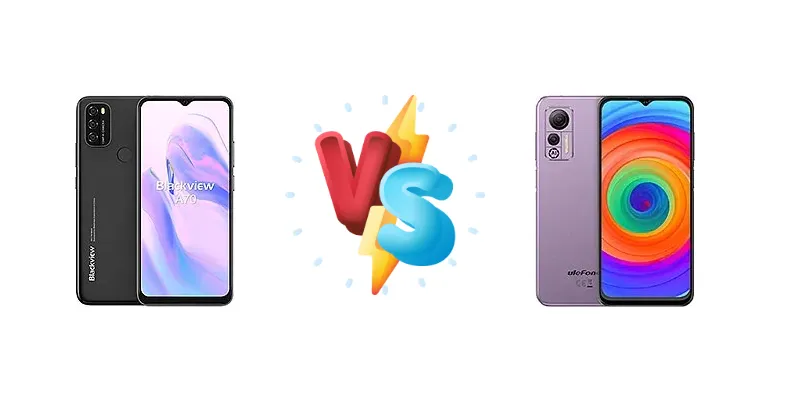
Looking for an affordable smartphone that doesn't completely break the bank? The Blackview A70 and Ulefone Note 14 are both contenders in the budget phone arena, offering a range of features at attractive price points. But which one delivers the best overall experience?
🏆 Quick Verdict
The Ulefone Note 14 edges out the Blackview A70 thanks to its more efficient chipset and generally better performance. While both are budget options, the Note 14's Helio A22 provides a smoother experience for everyday tasks and light gaming.
| Network |
|---|
| 2G bands | GSM 850 / 900 / 1800 / 1900 | GSM 850 / 900 / 1800 / 1900 |
| 3G bands | HSDPA 850 / 900 / 2100 | HSDPA 850 / 900 / 1700(AWS) / 1900 / 2100 |
| 4G bands | 1, 3, 7, 8, 20, 40, 41 | 1, 2, 3, 4, 5, 7, 8, 12, 17, 19, 20, 28 |
| Speed | HSPA, LTE | HSPA, LTE |
| Technology | GSM / HSPA / LTE | GSM / HSPA / LTE |
| | - | eMMC 5.1 |
| Launch |
|---|
| Announced | 2021, January 26 | 2022, September 29 |
| Status | Available. Released 2021, February | Available. Released 2022, September 29 |
| Body |
|---|
| Dimensions | 165.3 x 77.5 x 8.3 mm (6.51 x 3.05 x 0.33 in) | 164.8 x 76 x 9 mm (6.49 x 2.99 x 0.35 in) |
| SIM | Nano-SIM + Nano-SIM | Nano-SIM + Nano-SIM |
| Weight | 205 g (7.23 oz) | 189 g (6.67 oz) |
| Display |
|---|
| Resolution | 720 x 1600 pixels, 20:9 ratio (~269 ppi density) | 720 x 1600 pixels, 20:9 ratio (~269 ppi density) |
| Size | 6.52 inches, 102.6 cm2 (~80.1% screen-to-body ratio) | 6.52 inches, 102.6 cm2 (~81.9% screen-to-body ratio) |
| Type | IPS LCD | IPS LCD |
| Platform |
|---|
| CPU | Octa-core (4x1.6 GHz Cortex-A55 & 4x1.2 GHz Cortex-A55) | Quad-core 2.0 GHz Cortex-A53 |
| Chipset | Unisoc SC9863A (28 nm) | Mediatek MT6761 Helio A22 (12 nm) |
| GPU | IMG8322 | PowerVR GE8300 |
| OS | Android 11 | Android 12 |
| Memory |
|---|
| Card slot | microSDXC | microSDXC (dedicated slot) |
| Internal | 32GB 3GB RAM | 16GB 3GB RAM, 64GB 4GB RAM |
| | eMMC | - |
| Main Camera |
|---|
| Dual | - | 13 MP, f/2.0, (wide), 1.12µm, AF (64/4 model)
8 MP, f/1.8, (wide), 1.12µm, AF (16/3 model)
Depth camera |
| Features | LED flash | LED flash, HDR, panorama |
| Single | 5 MP, f/2.2, (wide) | 5 MP, f/2.0, (wide) |
| Triple | 13 MP, f/2.2, (wide), AF
other unspecified cameras | - |
| Video | 1080p@30fps | 1080p@30fps |
| Selfie camera |
|---|
| Single | 5 MP, f/2.2, (wide) | 5 MP, f/2.0, (wide) |
| Video | Yes | 1080p@30fps |
| Sound |
|---|
| 3.5mm jack | Yes | Yes |
| 35mm jack | Yes | Yes |
| Loudspeaker | Yes | Yes |
| Comms |
|---|
| Bluetooth | 4.2, A2DP, LE | 5.0, A2DP, LE |
| NFC | No | No |
| Positioning | GPS, GLONASS, BDS | GPS, GLONASS, GALILEO, BDS |
| Radio | FM radio | Stereo FM radio, RDS, recording |
| USB | microUSB 2.0, OTG | USB Type-C 2.0 |
| WLAN | Wi-Fi 802.11 b/g/n | Wi-Fi 802.11 a/b/g/n/ac, dual-band |
| Features |
|---|
| Sensors | Fingerprint (rear-mounted), accelerometer, proximity | Fingerprint (side-mounted), accelerometer, proximity |
| Battery |
|---|
| Charging | 10W wired | - |
| Type | 5380 mAh | Li-Po 4500 mAh |
| Misc |
|---|
| Colors | Black, Blue, Red, Green | Midnight Black, Mint Green, Lavender Purple |
| Price | About 120 EUR | About 100 EUR |
Blackview A70
- Larger Display
- Affordable Price
- Decent Battery Life
- Older Chipset
- Slower Performance
- Slow Charging
Ulefone Note 14
- More Efficient Chipset
- Better Performance
- Modern Design
- Slightly Smaller Display
- Slow Charging
- Basic Camera
Display Comparison
The Blackview A70 typically features a larger display (around 6.53 inches) compared to the Ulefone Note 14 (around 6.5 inches). Both likely use IPS LCD panels with HD+ resolution. While the Blackview offers more screen real estate, the Ulefone's display might benefit from slightly better color accuracy due to its more modern panel technology, though this is often difficult to discern at this price point.
Camera Comparison
Camera performance on both phones is likely comparable, with both offering a primary rear camera around 13MP. Expect decent image quality in good lighting conditions, but struggles in low light. The Ulefone Note 14 might have a slight edge in image processing due to its newer chipset, but don't expect a dramatic difference. Both will likely include basic features like HDR and portrait mode.
Performance
Here's where the Ulefone Note 14 takes a clear lead. Its Mediatek Helio A22 (12nm) is significantly more efficient than the Blackview A70's Unisoc SC9863A (28nm). The Helio A22's quad-core 2.0 GHz Cortex-A53 CPU generally provides smoother multitasking and app loading times compared to the A70's octa-core, but slower, 1.6 GHz Cortex-A55 cores. The A70's octa-core setup doesn't translate to significantly better real-world performance due to the chipset's limitations.
Battery Life
Both phones typically feature batteries around 5000mAh, offering all-day battery life with moderate usage. Charging speeds are similar, both supporting 10W wired charging, which is relatively slow by modern standards. Battery optimization will largely depend on software and usage patterns.
Buying Guide
The Blackview A70 is a good choice for users prioritizing a larger screen and basic functionality on a very tight budget. The Ulefone Note 14 is better suited for those needing slightly better performance, a more modern chipset, and a more responsive user experience, even if it means a slightly smaller display.
Frequently Asked Questions
❓ What is the difference between the Unisoc SC9863A and Mediatek Helio A22 chipsets?
The Mediatek Helio A22 is a more modern and efficient chipset built on a 12nm process, offering better performance and power efficiency compared to the older, 28nm Unisoc SC9863A.
❓ Are these phones good for gaming?
Neither phone is ideal for demanding games. The Ulefone Note 14 will handle lighter games better than the Blackview A70, but both will struggle with graphically intensive titles. Expect low frame rates and potential lag.